
mental health
Anchor Me: A Grounding Tool for Anxiety Spikes
When panic narrows your world, Anchor Me walks you through the 5-4-3-2-1 technique in one tap, no login, no audio, no clutter — just a way back to the present.
Artem
Founder
· 5 min read
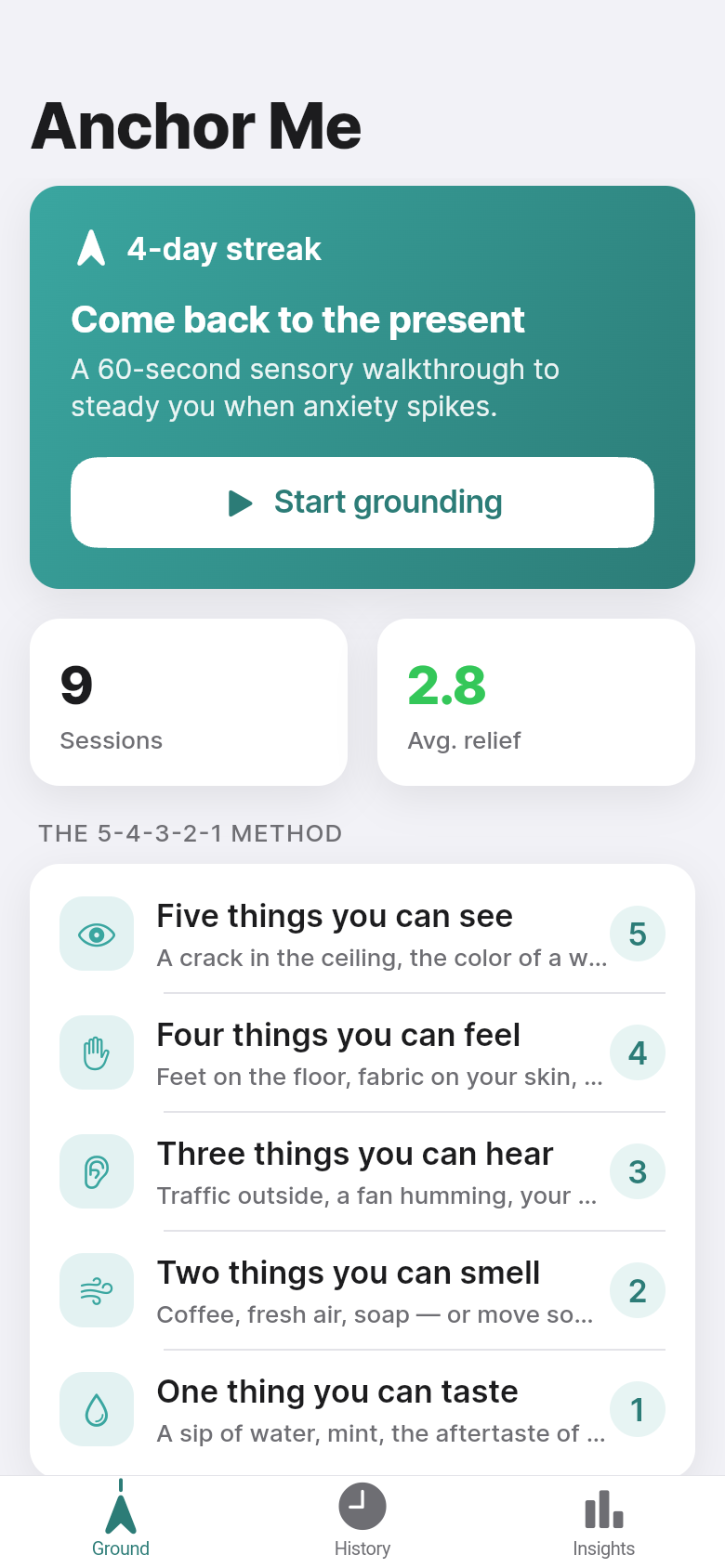
Panic does not wait for a good moment. It arrives mid-meeting, on the train, at 2 a.m., and the first thing it steals is your ability to think clearly. You might know grounding techniques exist. You might even know the 5-4-3-2-1 method by name. But recalling the steps and actually following them when your chest is tight and the room feels wrong is a different thing entirely.
Anchor Me was built for exactly that gap. Open it and you are already starting. No account, no tutorial screen, no ambient music you have to dismiss. Just a calm, focused walkthrough of one of the most widely recommended anxiety coping tools in clinical practice, ready the moment you need it.
Live demo
What the 5-4-3-2-1 method actually does
The 5-4-3-2-1 technique works by pulling your attention out of anxious thought and back into sensory experience. You name five things you can see, four you can physically feel, three you can hear, two you can smell, one you can taste. Each step asks your nervous system to do something concrete, which interrupts the loop of abstract worry.
Therapists recommend it because it requires no equipment, no prior practice, and no calm mental state to begin. The problem is that in a real spike, even a five-step list is easy to lose track of. Anchor Me handles that structure for you: one sense at a time, with tally dots so you never have to count in your head, and a gentle forward nudge when you are ready to move on. You can try the full walkthrough right in the demo above.
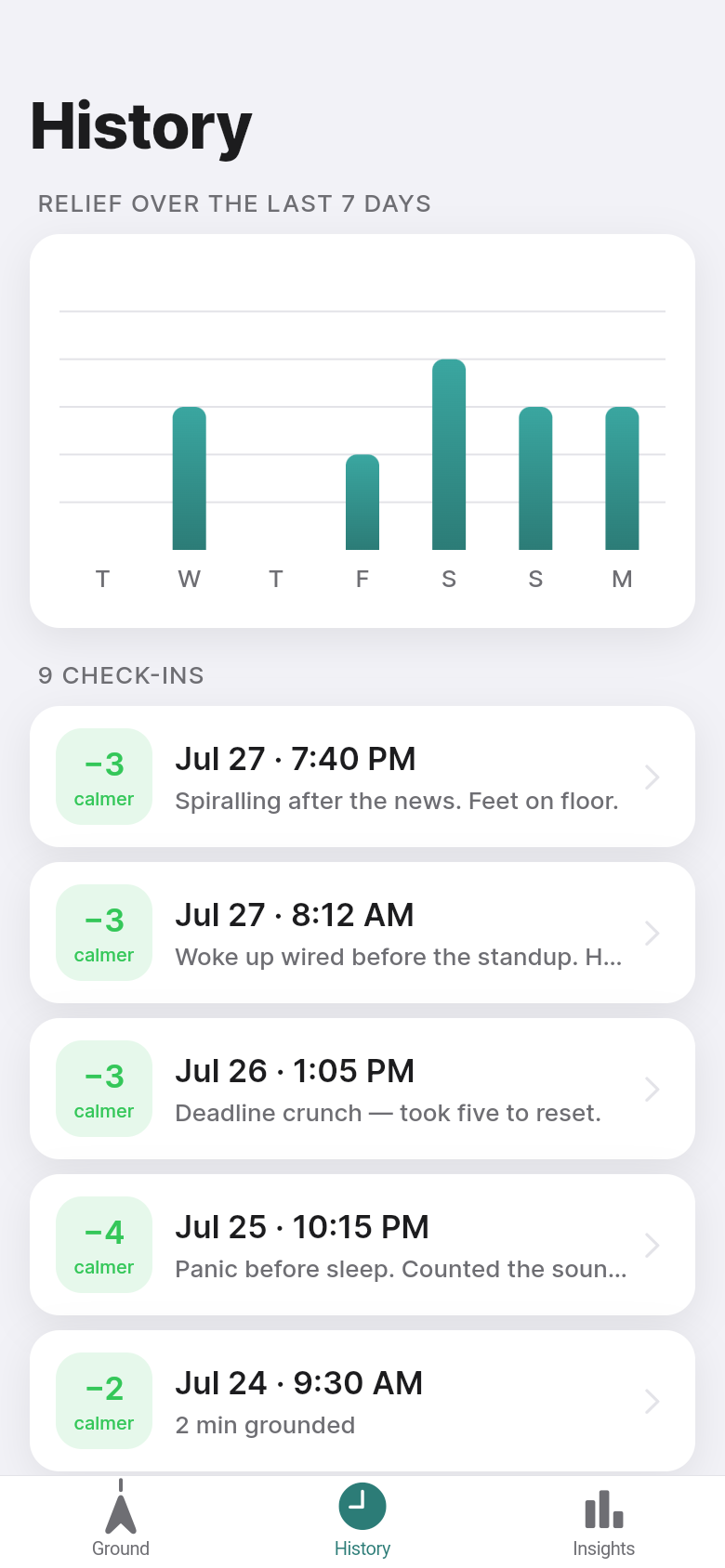
Before and after: seeing that it helped
One feature that sets Anchor Me apart from a static reference card is the distress rating. Before you begin, you rate how you are feeling on a simple scale. After the walkthrough, you rate again. That comparison, visible immediately, gives you evidence that the technique worked, or that you might need another pass.
Over time, those ratings become your history. The app shows a relief chart across your sessions, your overall calmer-rate, and a streak that marks consistent practice. None of this is gamification for its own sake. People who use grounding tools between therapy sessions often struggle to describe their progress to a clinician. A simple chart of before-and-after distress levels is something concrete to bring to that conversation.
Everything is stored locally on your device. No data leaves your phone, no server is involved, and the app works in airplane mode on a mountain or in a basement with no signal.
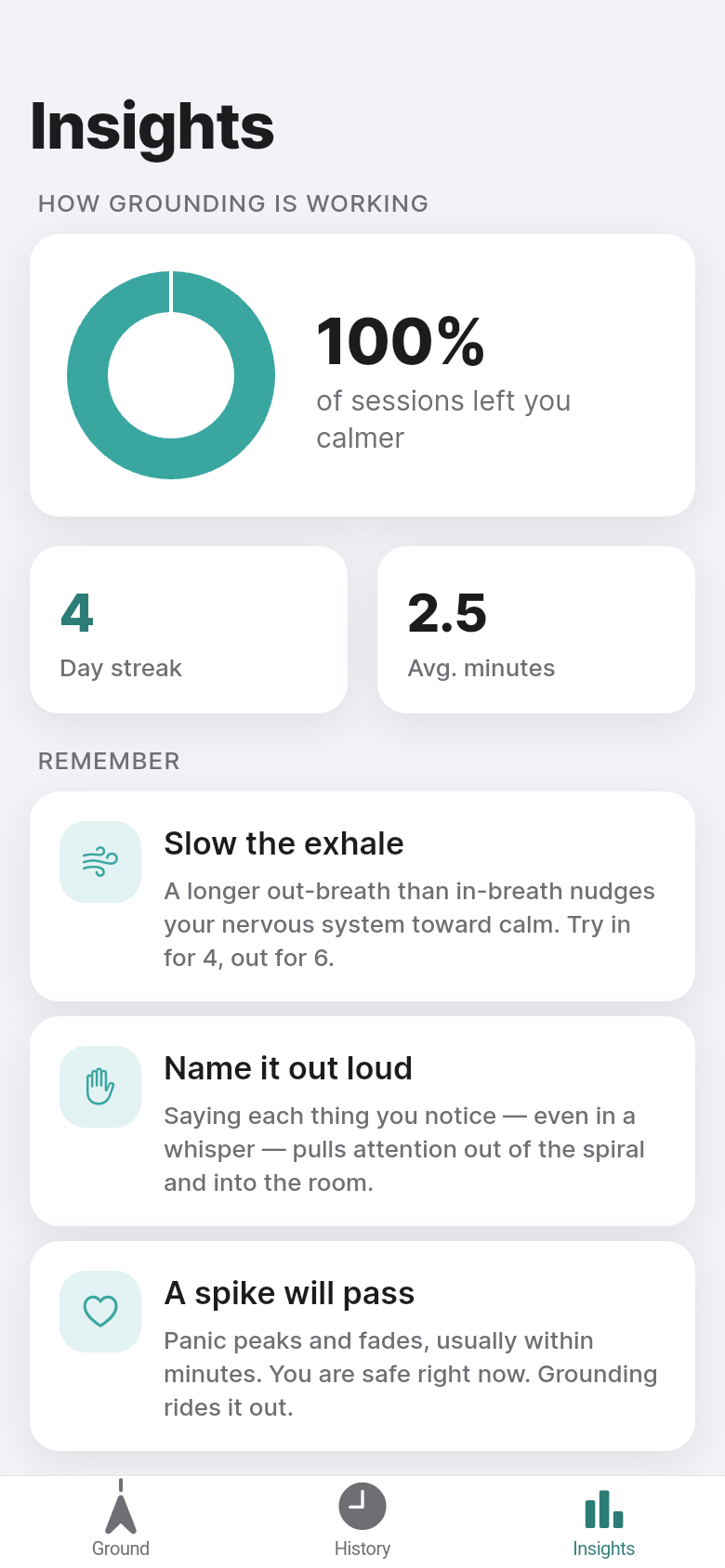
Designed to be usable when you are at your worst
Most wellness apps are designed to be explored when you are feeling fine. Features are nested, settings are customizable, onboarding walks you through a philosophy. That is fine for a fitness tracker. It is the wrong shape for an anxiety tool.
Anchor Me opens to a single action: start. The interface is deliberately sparse, with large tap targets and no competing elements. The color palette is quiet. There is no audio to toggle, no subscription to consider, no profile to fill out. If you have thirty seconds of attention left, the app can work with that.
When you first open it, you will see a believable history already in place rather than an empty screen asking you to imagine what the app might someday mean to you. That small detail matters when you are evaluating whether something will actually help.
Who this is for
Anchor Me is built for adults who experience acute anxiety, panic attacks, or moments of overwhelm and want something that works without setup. That includes people currently in therapy who want a tool to practice grounding between sessions, people who prefer not to involve an app subscription in their mental health routine, and people who have tried full meditation suites and found them hard to reach for in a real moment.
It is also genuinely useful for caregivers, teachers, or anyone who sometimes needs to offer a grounding resource to someone else quickly. Handing someone a phone with Anchor Me open is a lot easier than talking them through the steps from memory.
If you have been curious about the 5-4-3-2-1 method but have never actually completed a full session, the live demo embedded above is a real working copy. Try it now, even if you are calm. The familiarity of having done it once makes it much easier to reach for when you actually need it.
From idea to working app
Anchor Me started as a one-line description of a problem: people need a fast, offline grounding tool that removes all friction at the worst moment. From that, Leanfinit built a complete, interactive app, including the guided walkthrough, distress tracking, history charts, and streak logic.
The same process is available to anyone. If you have a tool you wish existed, something specific and useful for a real problem you or people you know face, you can describe it and have a working version to try the same day.
39
files in the build
40.1 MB
app bundle
Flutter Web
runs in any browser
Have a tool idea of your own?
Describe the problem you want to solve and Leanfinit will build a working app from it. No code, no design skills, no waiting.