
personal finance
Worth It: Track Your Net Worth Without Linking a Single Account
A clean, private app that turns scattered balances across accounts and debts into one honest number — and shows you whether it's growing.
Artem
Founder
· 5 min read
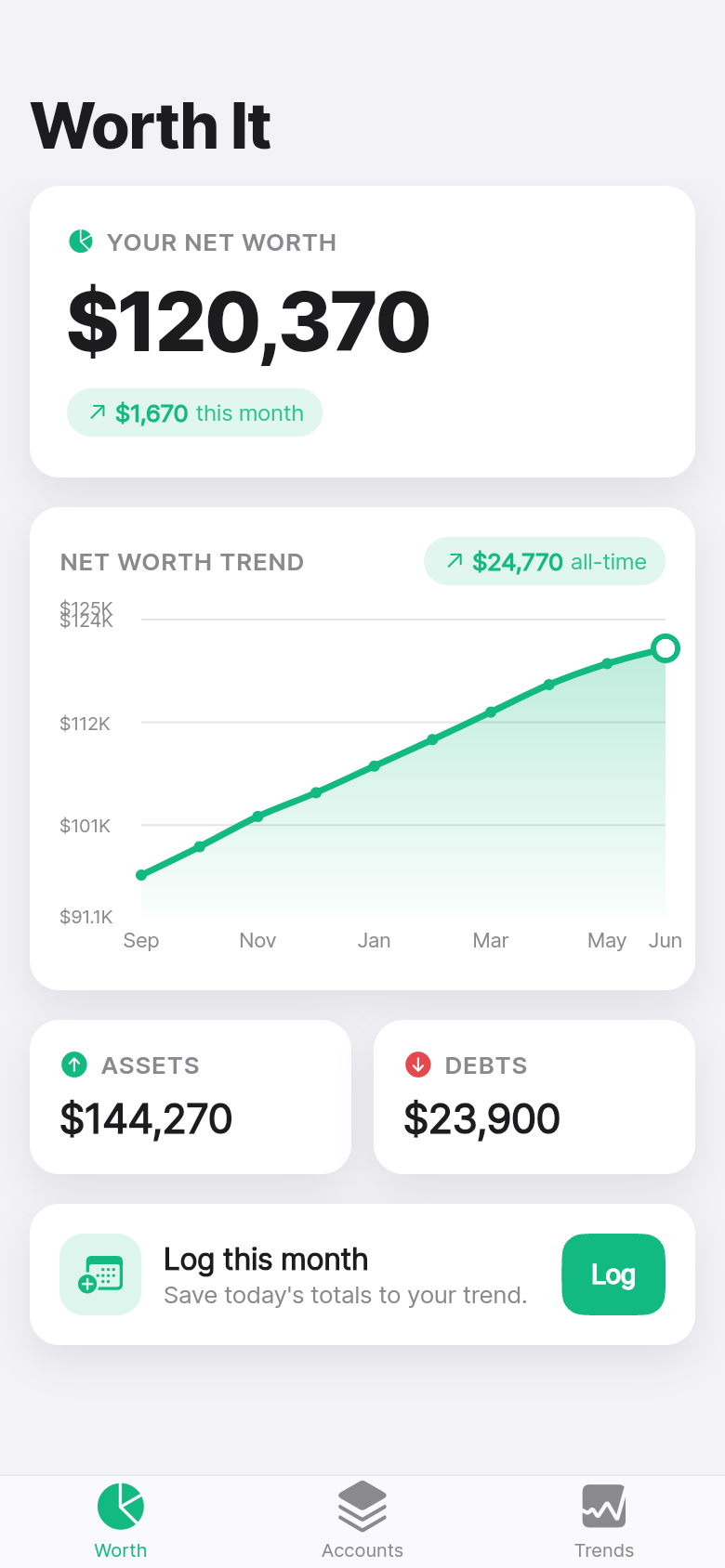
You probably have a rough sense of where you stand financially. But a rough sense isn't the same as a number. Your checking account is in one app, your Roth IRA in another, your car loan somewhere else, and that student debt balance you'd rather not think about is in a third place entirely. 'Am I actually getting ahead?' is a question most people can't answer quickly — not because they're irresponsible, but because the information is genuinely scattered.
Worth It is a small app built around one idea: give you a single, honest net-worth number every time you open it, computed live from assets and debts you enter yourself. No bank-account linking, no subscription, no data leaving your phone. The demo is embedded right here — go ahead and add a couple of accounts to see how it works.
Live demo
The problem with 'net worth' as a concept
Net worth is simple math: everything you own minus everything you owe. The calculation takes about ten seconds once you have the numbers. The hard part is having the numbers in one place at the same time. Most people's financial lives are spread across four or five different apps, each refreshing on its own schedule, each showing only its own slice.
The usual workarounds are a spreadsheet you update when you remember to, or a tool like Empower or Monarch that pulls everything in automatically. The spreadsheet works but requires discipline. The aggregators are genuinely useful, but they ask you to hand over your bank credentials, and a meaningful number of people aren't comfortable with that — especially when all they want is to watch one line go up over time.
Worth It sits in the middle: manual entry (so nothing is ever connected to your actual accounts) but structured and persistent (so you're not rebuilding from scratch each month).
What you actually do in the app
Open the app and the first thing you see is your net-worth number — or a prompt to add your first account if you're starting fresh. There's no empty loading screen, no onboarding flow asking for your email. You start adding things immediately.
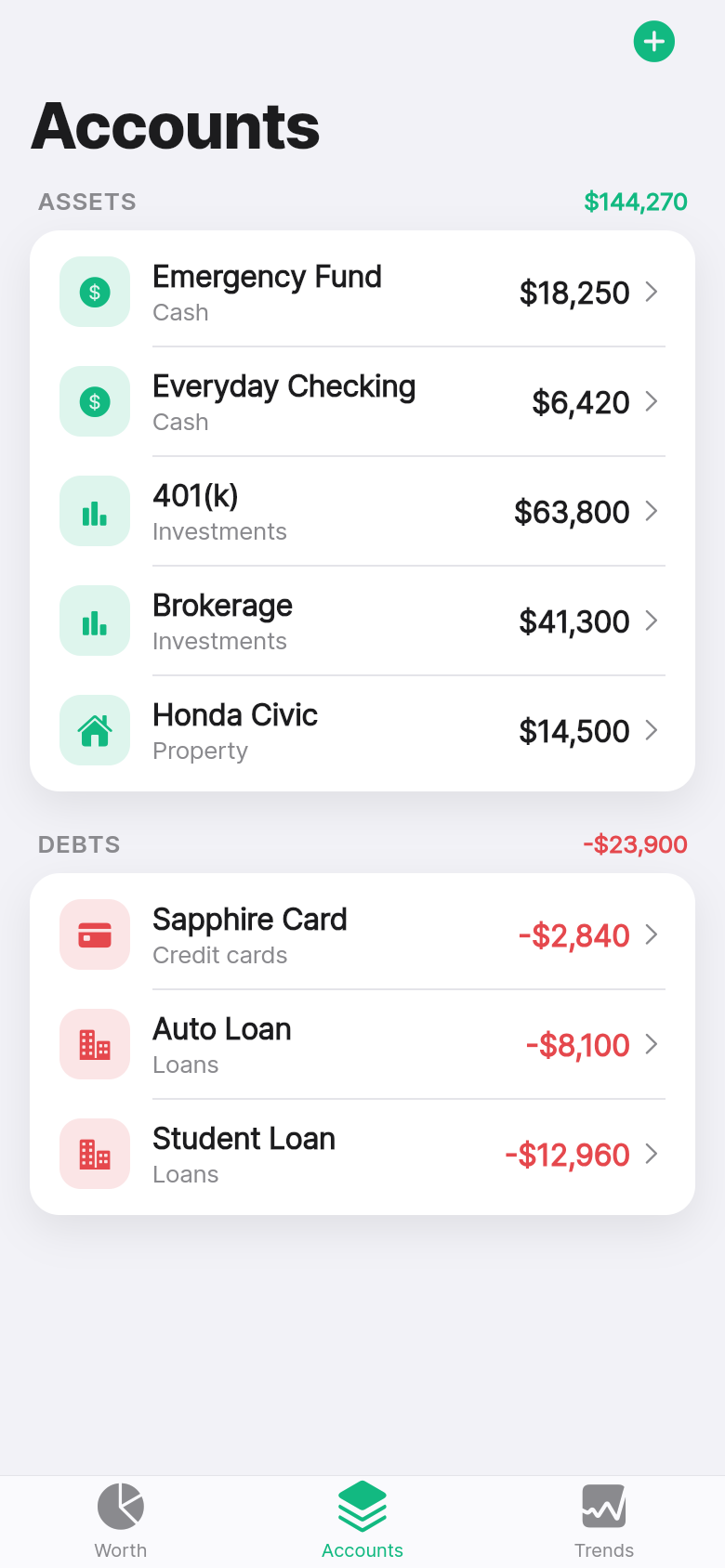
Assets and debts each get a category. On the asset side that might be Checking, Savings, Brokerage, Retirement, Real Estate, or Other. Debts get similar buckets: Credit Cards, Student Loans, Auto, Mortgage. You type in the name and the current balance. The total at the top updates as you go — you can watch your net worth assemble itself in real time.
Try it in the demo above: add a savings account, then add a credit card balance. The number at the top adjusts instantly. That live feedback is the whole point. It makes the relationship between individual balances and your overall position concrete in a way a spreadsheet rarely does.
The monthly snapshot: where it gets useful
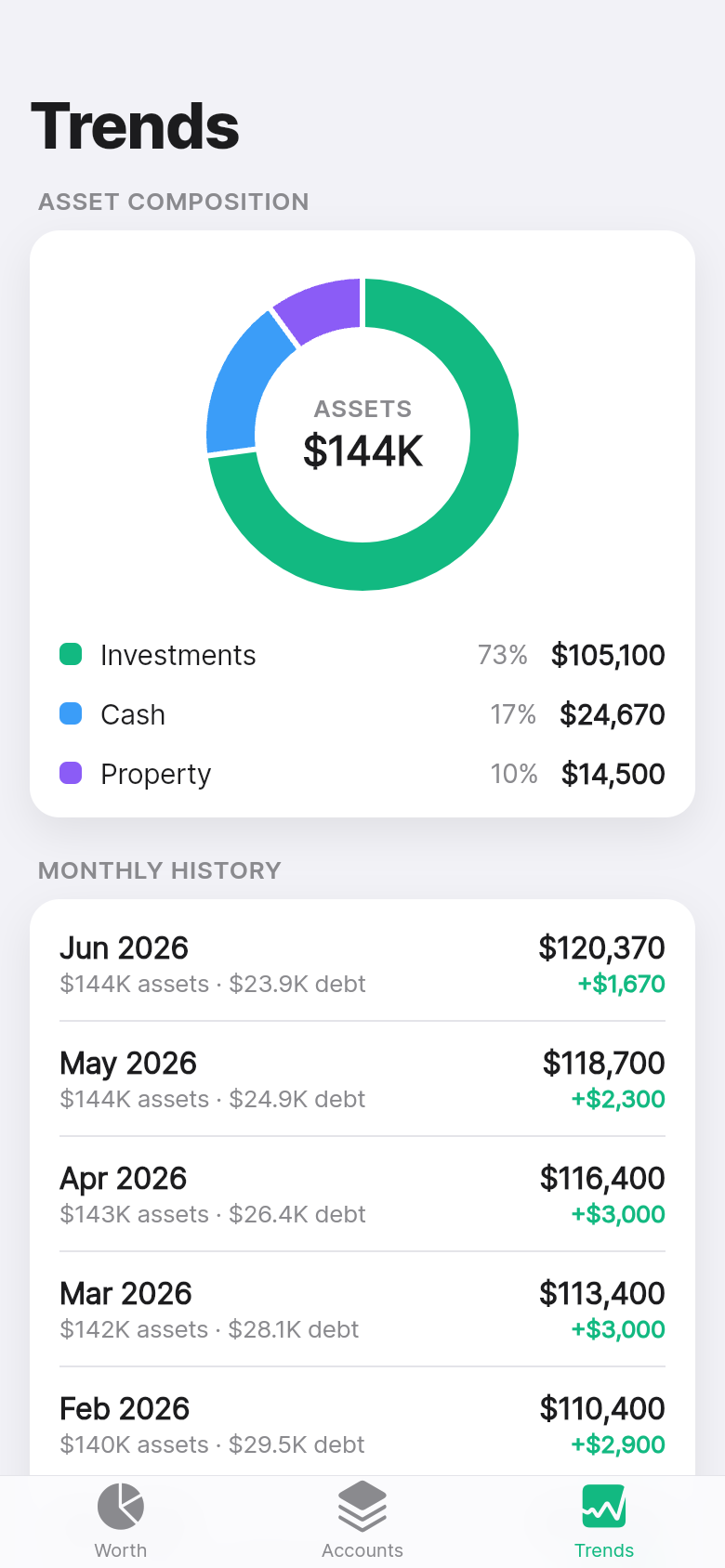
A single net-worth number is a snapshot. What makes it useful is watching it move. Once a month — or whenever you feel like it — you log a snapshot, and Worth It plots those snapshots as a line over time. The chart is deliberately simple: one line, net worth on the vertical axis, time on the horizontal.
For people in the debt-payoff-while-investing phase of life, that chart is often more motivating than any individual account balance. You might look at your brokerage and feel good, then look at your student loan and feel bad. The net-worth line shows you the net effect: the market went up and you made an extra payment and you are, in fact, getting ahead — even if it doesn't feel like it day to day.
The chart also catches things you'd otherwise miss. A month where you ran up a credit card and told yourself you'd pay it off quickly will show up as a dip. Seeing it on a line tends to change how you think about the next month.
Privacy by design, not by policy
Every number in Worth It stays on your device. There's no account to create, no server receiving your balances, no analytics pipeline processing your debt amounts. This isn't a privacy policy you have to trust — it's how the app is built. Offline-first, local persistence, no network calls for your financial data.
For people who've spent time in personal-finance communities, this distinction matters a lot. Linking bank accounts to a third-party aggregator means trusting that aggregator's security practices, their breach response, their data-sharing agreements, and their future ownership. A lot of people who are otherwise financially engaged simply don't want to make that bet. Worth It doesn't ask you to.
The tradeoff is manual entry. You have to type in balances when they change. For most people, doing this once a month — or whenever one of their accounts has a meaningful update — takes under five minutes. That's a reasonable cost for knowing exactly where your data lives.
Who gets the most out of it
Worth It is particularly useful for people in a specific financial phase: you have some assets building (a 401k, maybe a brokerage account you've been adding to), and you also have real debts you're working through. In that situation, the individual account balances can feel contradictory. The net-worth number cuts through the noise.
It's also good for households where two people want a shared view without sharing bank credentials with an app. You can maintain one Worth It database that reflects both people's accounts — named clearly — without anyone's login information going anywhere.
And it's good for people who tried a spreadsheet but kept letting it go stale. The app gives you just enough structure to make it a habit: open it, update the balances that changed, log the snapshot, close it. That's the workflow. It doesn't ask for more.
39
files in the build
40.3 MB
app bundle
Flutter Web
runs in any browser
Have a tool idea of your own?
Worth It started as a one-line description of a problem. If you've got a financial habit, workflow, or personal system you wish existed as a real app, you can build it the same way — just describe what you need.