
strength training
Plate Math: Stop Doing Arithmetic Between Sets
A barbell plate calculator that shows you the exact stack to load, handles your warm-up ramp, and works offline when you need it most.
Artem
Founder
· 4 min read
You're two sets into squats, your rest timer is counting down, and you need to add weight for the next set. The math should take two seconds. Instead you're standing there: 135 on the bar, want 185, bar weighs 45, so 140 per side... no, that's the total... you do it again, slower this time. You get it right. Probably.
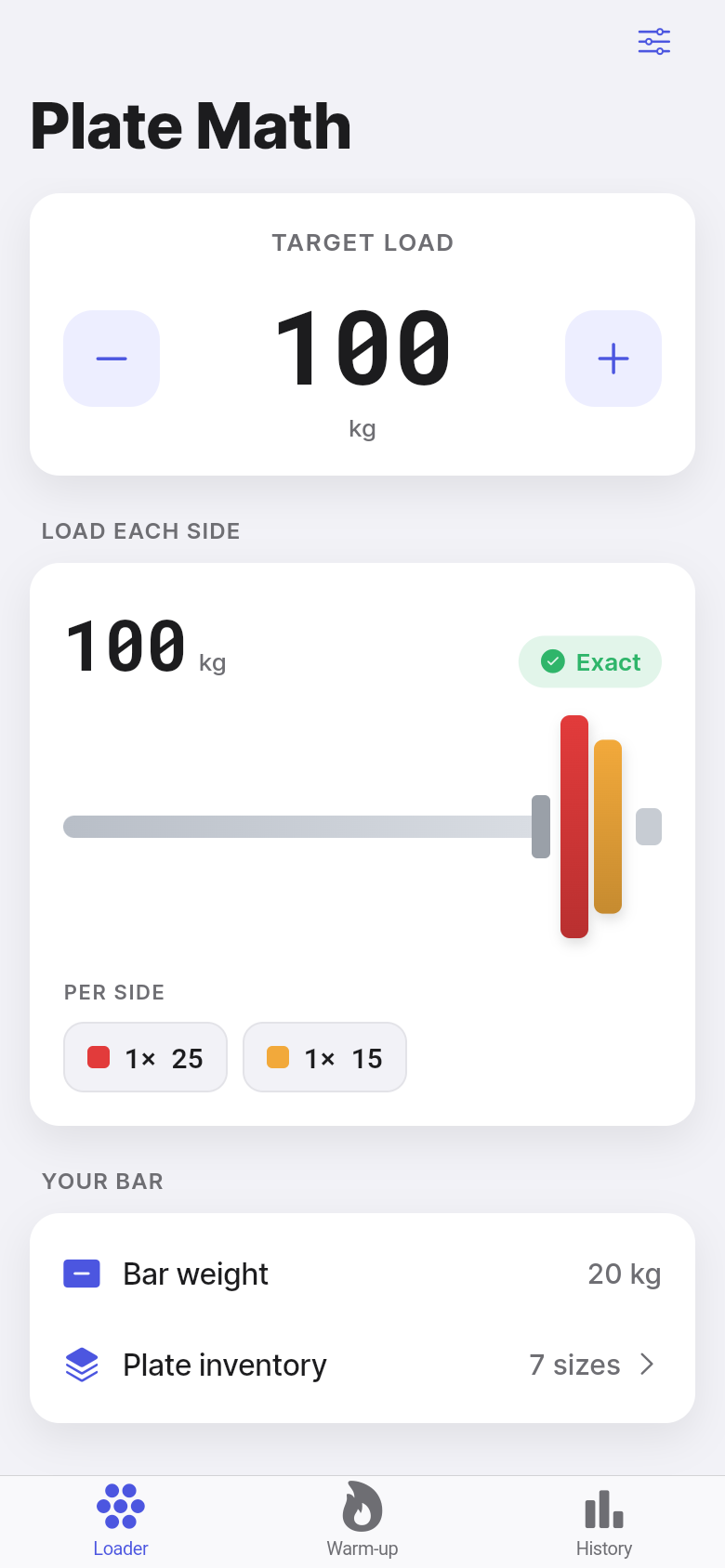
Plate Math is a small, focused app that handles this for you. Type in your target weight, and it tells you exactly which plates go on each side of the bar, drawn out clearly so there's no room for error. That's the whole job. The app is embedded live below, so go ahead and try it before reading further.
Live demo
The math is simple, but simple math goes wrong when you're tired
Barbell arithmetic is deterministic. There are only so many plate denominations, bar weights are standardized, and the relationship between total load and per-side plates is just subtraction and division. A computer is better at this than a fatigued human who just finished a heavy set.
What makes plate-loading errors particularly annoying is that they're invisible until you're already under the bar. Loading 190 when you meant 185 might not matter, but loading 175 when you meant 185 derails your session log. Plate Math eliminates that variable entirely. The answer is there before your rest period ends, and it's drawn as a bar diagram so you can verify it at a glance rather than re-reading a number.
Set it up once, use it every session
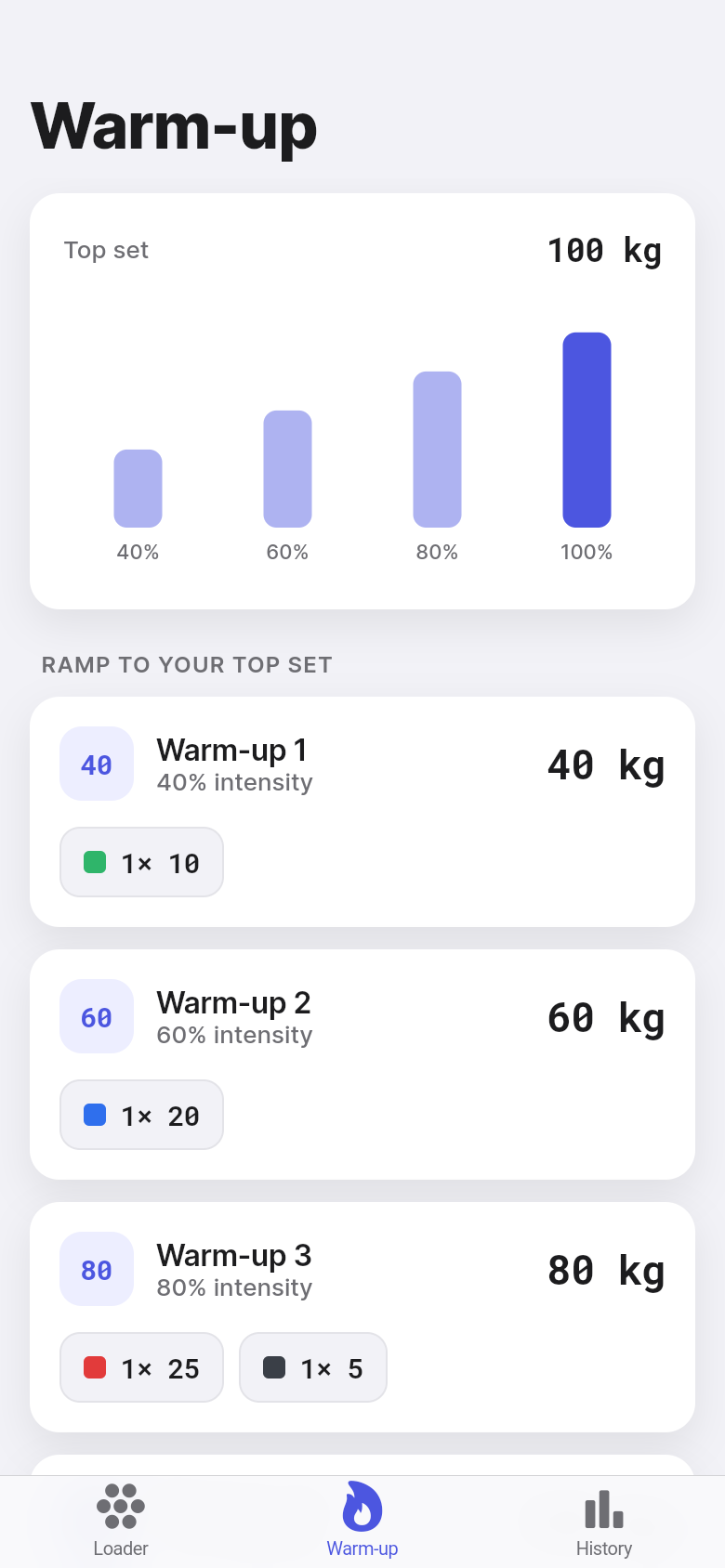
The first thing you do is tell the app what you're working with: your bar weight (standard 45 lb Olympic, a 35 lb women's bar, a 15 lb technique bar, or whatever you actually have) and which plates are in your gym bag or on your rack. You enter how many of each denomination you own per side, and the app will never suggest a combination that exceeds your actual inventory.
That setup persists locally. You don't create an account, you don't log in, and the app works fully offline. Open it in airplane mode on your phone before a meet, in a basement gym with no signal, or anywhere else, and it behaves exactly the same way. Your configuration and history are saved on the device.
Warm-up ramps, already solved
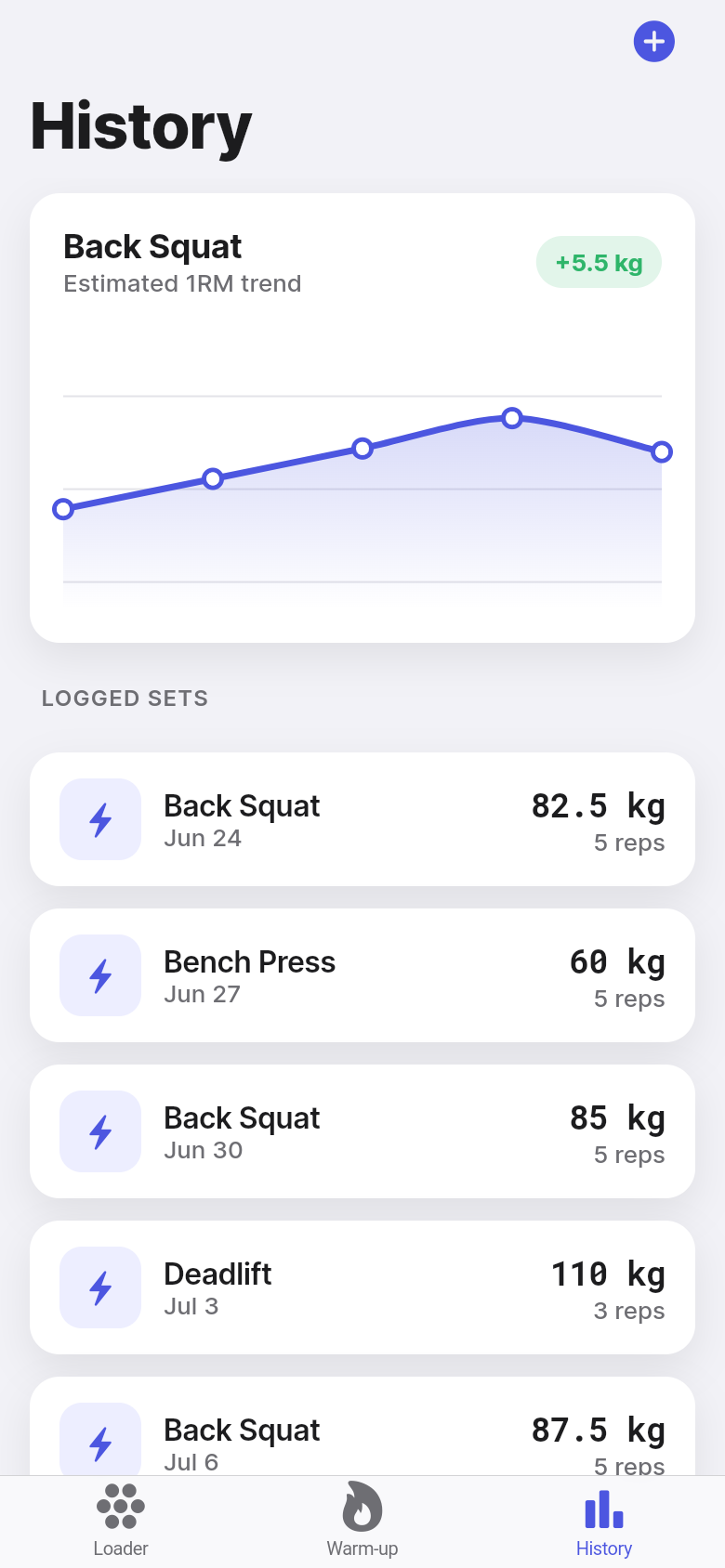
Most strength programs include a warm-up ramp before the working sets: something like 40%, 60%, and 80% of your target weight, each for a few reps. The percentages are easy to remember; the plate math for each rung is not, especially when the percentages produce weights that don't land on a clean plate combination.
Plate Math includes a saved warm-up feature that takes your working weight and computes the closest achievable load at each ramp percentage, given your actual plates. The result is a complete session plan: four or five rows, each showing the bar diagram for that set. You can review the whole ramp at once before you touch the bar, then work through it row by row. If a rung can't be hit exactly with your available plates, the app flags it and shows the nearest achievable weight so you can decide how to handle it.
What it feels like to use
Try the embedded app above. Pick a lift, set your bar weight, and enter a target like 225 or 315. The plate stack updates instantly, and the bar visualization updates with it. The legend beneath the bar labels each plate denomination so there's no ambiguity about the color coding. If you reduce the available plates in your inventory to something that can't reach your target, the app tells you the closest it can get and marks the shortfall clearly.
The interface is intentionally minimal. There are no social features, no logging graphs, no progression tracking. Those tools exist elsewhere and do that job well. Plate Math does one thing: it answers the question 'which plates do I load right now' as fast as possible and gets out of your way.
Who this is built for
Recreational lifters who train three or four days a week and follow a set program are the core audience. You know your lifts, you load your own bar, and you're not a competitive powerlifter with a coach doing this for you. You just want to spend your rest period recovering instead of doing arithmetic.
It's also useful in commercial gyms where the available plates change depending on what other people have left on nearby racks. You can quickly adjust your inventory to reflect what's actually available, and the app recomputes your stack immediately. Home gym owners with a fixed plate set benefit from the initial configuration staying saved and accurate every time they open the app.
39
files in the build
39.9 MB
app bundle
Flutter Web
runs in any browser
Have a tool you wish existed?
Plate Math started as a one-line idea and turned into a working app. If there's a small, focused utility you reach for that doesn't quite exist yet, you can build it the same way.