
camino de santiago
Camino Etapas: Plan Your Camino Francés One Knee-Friendly Day at a Time
A quiet, offline-first planner that breaks 780 km into stages your body can handle, tracks your albergues, and keeps your gear checklist one tap away.
Artem
Founder
· 5 min read
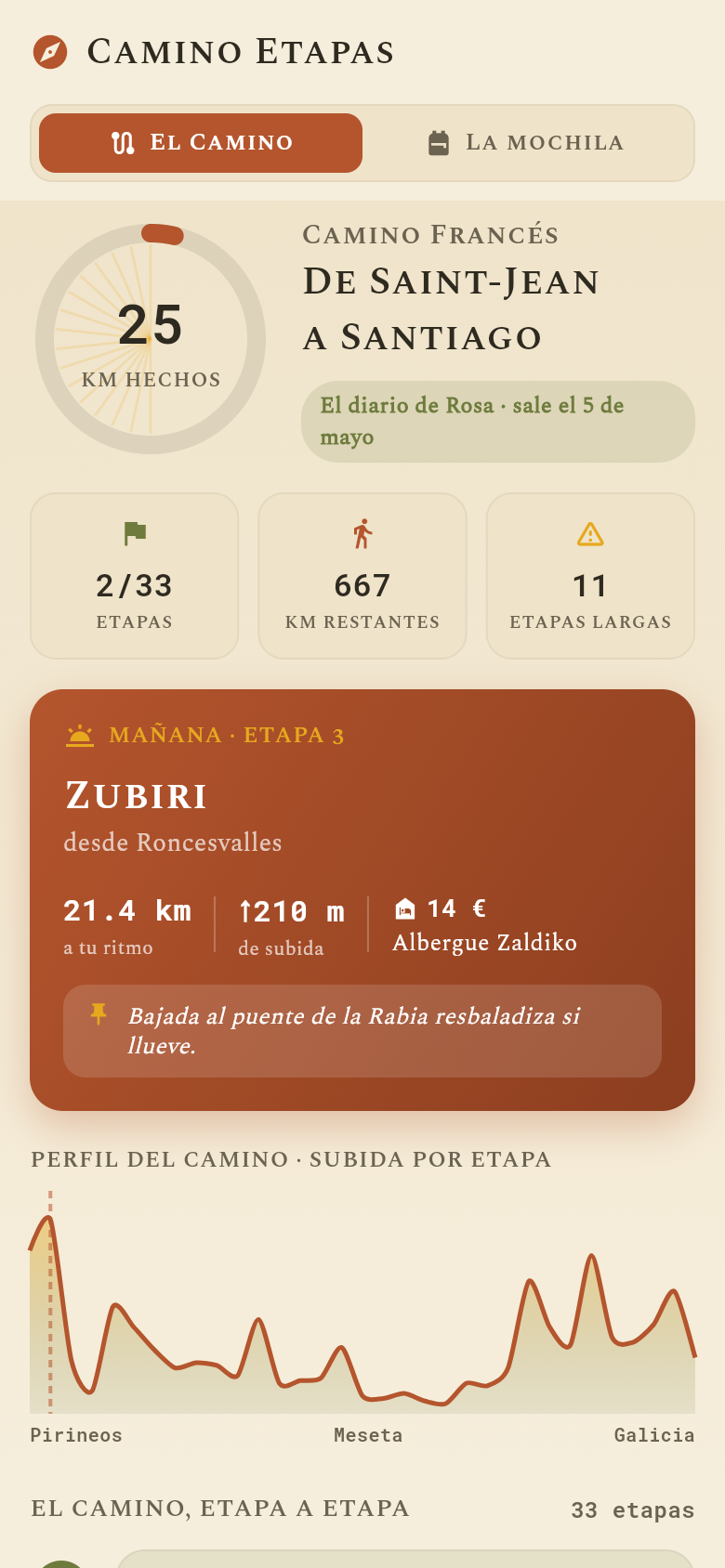
Most Camino route guides assume you can walk 28 kilometres a day. They were not written for knees that have opinions. If you are planning to walk from Saint-Jean-Pied-de-Port to Santiago and your body sets a firm ceiling of around 22 km, the standard stage breakdowns simply do not fit, and rewriting them by hand across a paper notebook on the floor of a hostel at 9 pm is nobody's idea of a good evening.
Camino Etapas was built for exactly that situation. It takes the full 780 km Francés route and lays it out as a personal, editable day-by-day plan, with your target albergue, bed price, and a flag on any day that creeps over your limit. Everything lives on your device. No signal required, no account, no fuss. You can try the live version embedded here right now, and it will behave exactly the way the real app does.
Live demo
The problem with one-size stages
The classic guidebooks divide the Camino Francés into roughly 33 stages, many of them 25 to 33 km long. That range works well for a fit walker in their thirties taking a three-week holiday. It is harder to fit if you are 58, your knees have mileage on them, and you are walking solo with no one to slow down for you except yourself.
Pushing through a too-long day does not just mean tired legs. It is usually how the blisters start, and blisters that get infected are the single most common reason pilgrims abandon the Camino before Burgos. A plan that respects your actual daily limit is not being cautious, it is being smart about finishing.
Camino Etapas flags every stage that exceeds your personal cap in orange, so you can see at a glance where you need to split a long day or reorganise your overnight stop. The flags are advisory, not restrictive. You can edit any stage, adjust the distance, swap the albergue, and save a note about why. The plan is yours.
The evening ritual: tomorrow's stage, front and centre
Experienced pilgrims have a routine. You arrive, shower, eat, do your laundry, tend your feet, and then, before you sleep, you check tomorrow. Where does it start, where does it end, how far, how much ascent, and which albergue are you aiming for? Albergues on the busiest stretches fill up by early afternoon, so knowing your target in the morning matters.
The app opens to tomorrow's stage by default. The distance, the ascent, the albergue name and its approximate bed price are all there on one screen. If you walked today already, tap the checkmark and today slides into your completed list. The next day takes its place at the top.
Try it in the frame above. Tap through a few days, mark one as walked, and see how the view recentres. The interaction is deliberate and slow, the same pace the Camino itself tends to encourage.
Editing your plan without ceremony
No two pilgrims walk the same Camino. Maybe you want to stop in Logroño a day early because a friend is there. Maybe you decide in Pamplona that your knees need a rest day and you want to absorb an extra short stage into the following week. The app lets you tap any stage and change the distance, the albergue name, the price estimate, or add a personal note.
There are no accounts to log into, no sync to wait for. Your edits are saved immediately and stay saved. If you close the app and open it in a dark albergue dormitory at 6 am with the phone on minimum brightness, your plan is exactly where you left it.
The gear checklist that takes blisters seriously
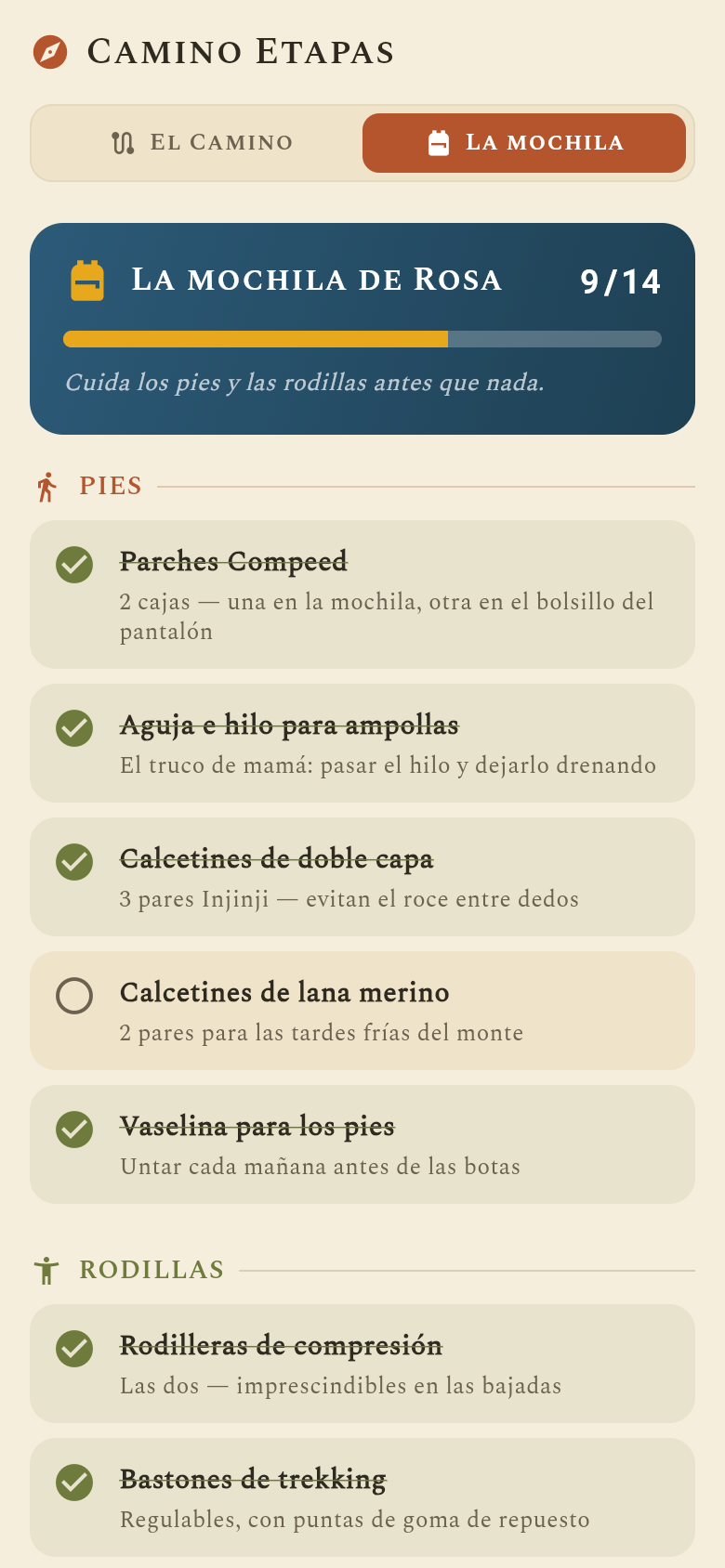
Experienced Camino walkers will tell you the same things. Break in your boots before you start. Carry two pairs of socks and alternate them. Know how to tape your toes. Have knee support in your bag before you need it, not after.
The packing checklist in the app is grouped into four categories: feet, knees, sleep, and documents. Each item is a checkbox. You tick it as you pack it. The groupings matter because feet and knees are the two systems most likely to end a pilgrimage early, and they deserve their own section rather than being buried in a generic gear list.
Work through the checklist in the app now, if you like. The sleep section is a useful reminder that an eye mask and ear plugs are not luxuries in a shared dormitory.
Offline, always
The signal on the Camino Francés is not reliable. Rural stretches between small villages can have nothing for hours. Old stone albergues with thick walls and no router are common. Any tool that depends on a connection for basic functions is the wrong tool for this journey.
Camino Etapas stores everything locally. The full stage list, your edits, your checked-off days, your packing checklist, all of it lives on your device. It does not need to phone home to work. You can download it before you leave Saint-Jean, switch your phone to airplane mode to save battery on the meseta, and the app will be exactly as useful on day 27 as it was on day one.
That is not a technical footnote. For a 58-year-old walker who describes herself as a guidebook-and-notebook person rather than a gadget person, an app that just works without fiddling is the only kind worth carrying 780 km.
39
files in the build
40.5 MB
app bundle
Flutter Web
runs in any browser
Have an idea for your own tool?
Camino Etapas started as a one-line description of a problem a real person needed to solve. If you have a trip, a routine, or a project that could use a small, focused app built around the way you actually think, you can have one built in minutes.