
health
Sleep Debt: See the Fatigue You've Been Accumulating
Most sleep apps show last night. Sleep Debt shows the week, with a running balance that finally explains why Thursday afternoon feels impossible.
Artem
Founder
· 5 min read
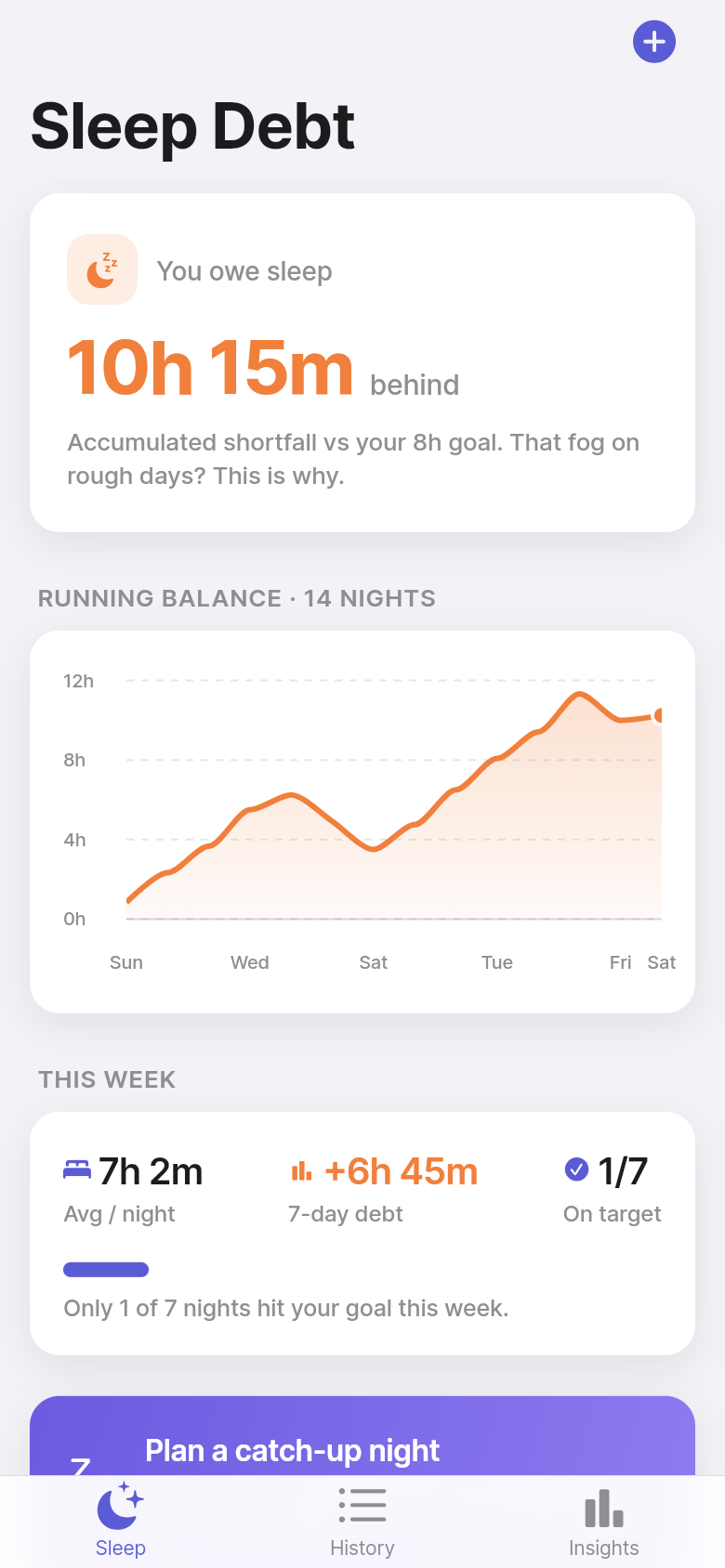
You slept six hours last night. Fine, right? But Sunday was five and a half, Monday was six again, Tuesday you stayed up late and managed five. By Wednesday afternoon you are running on a deficit that has been quietly compounding since the weekend, and no app you own has told you the total. Sleep Debt fixes that with a single number: how many hours you owe your body, or how many you are ahead.
The app lives on your phone, works entirely offline, and opens to your actual data every time. Log when you went to bed and when you got up, set a nightly goal that fits your real life, and the app does the rest. The chart below the balance shows the full two-week picture, so you can see the debt building, spot the night you clawed some back, and actually plan a recovery night before the week gets away from you.
Live demo
The number that was always missing
Mainstream trackers are good at telling you what happened last night. They surface duration, maybe stages, maybe a readiness score. What they rarely show is the accumulated shortfall across the week, the figure that actually predicts how foggy Thursday is going to be. Sleep Debt makes that the centerpiece.
Every night you log goes into a running balance. If your goal is seven and a half hours and you slept six, the app adds an hour and a half to the debt column. If you sleep eight on Saturday, it subtracts thirty minutes. The balance updates instantly, and it never resets arbitrarily, so the trend you see is honest. You can scroll the live demo above, tap into a past night to correct an entry, or adjust your goal and watch every figure recompute in real time.
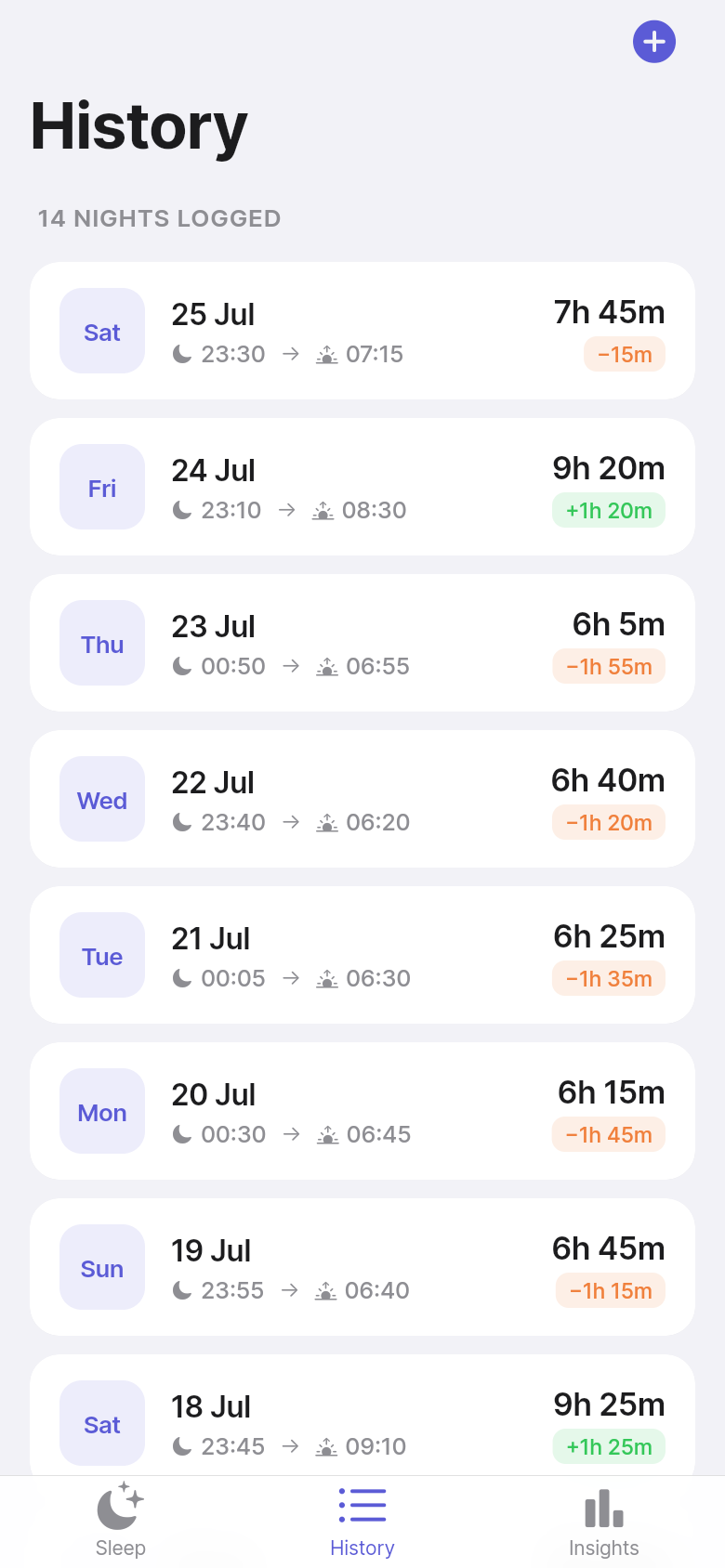
Logging that takes ten seconds
The friction of sleep tracking is usually what kills the habit. Sleep Debt keeps the entry to two time pickers: when did you get into bed, and when did you get up. Midnight crossings are handled correctly, so a 10:45 PM to 6:15 AM night shows as seven and a half hours, not a negative number or an error.
There is no account, no pairing, no cloud sync required. The data stays on the device and the app opens immediately to your current balance. If you missed a night, add it retroactively. If you entered something wrong, tap the entry and fix it. The goal setting is a single slider, not a quiz. The whole philosophy is that the app should feel like a notepad you happen to look at every morning, not a program you need to manage.
Reading the chart
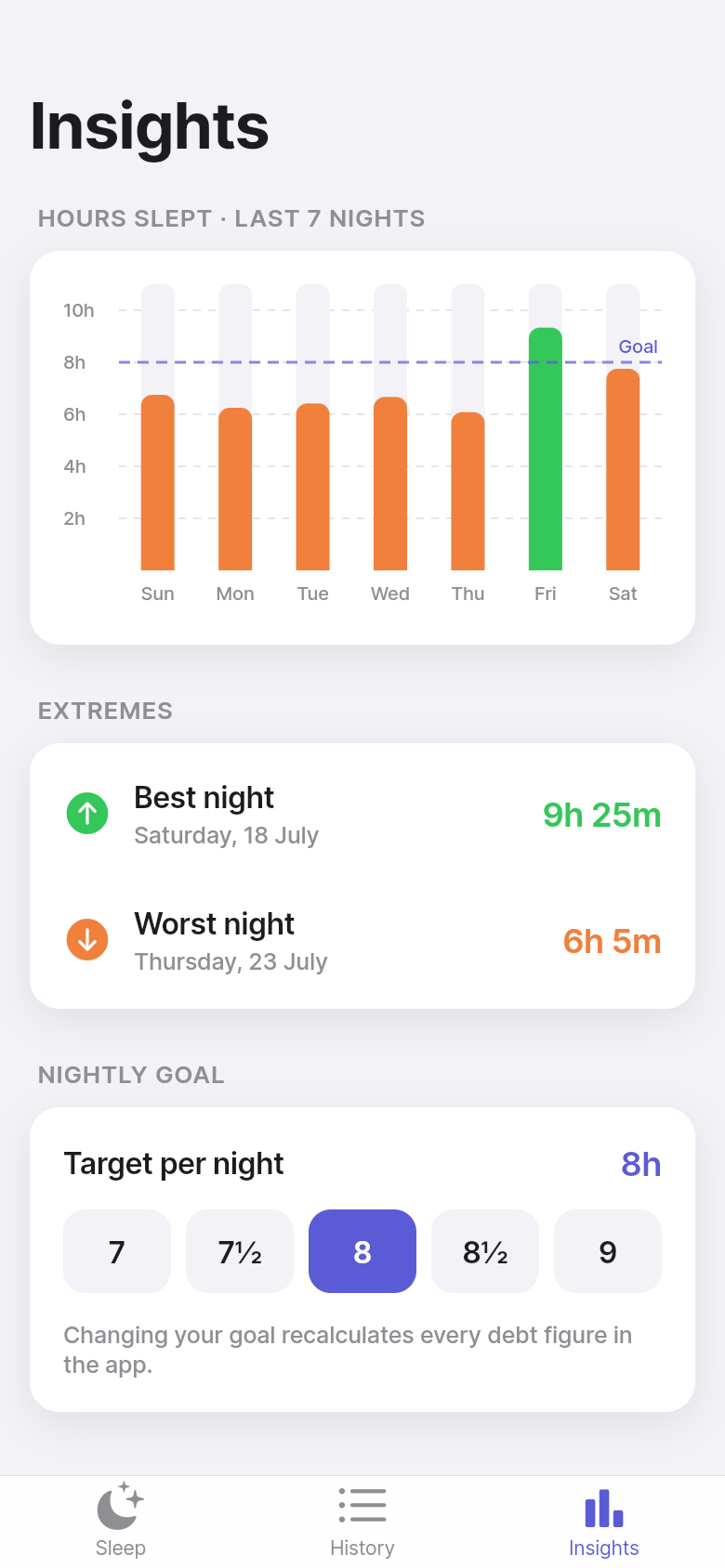
Below the balance number is a two-week chart with two layers. The bars show per-night hours against your goal line, so a short bar is instantly visible. The line running across both is the cumulative debt, rising when you fall short and dipping when you overshoot. Try it in the demo: add a few nights of varying lengths and watch the line move.
The chart is the part of the app that tends to surprise people. A single bad night looks like a blip on a bar chart. On a cumulative line, you can see it carry forward into the rest of the week. That visual is often more motivating than any score or grade, because it makes the math undeniable. The solution to Thursday's fog is not a second coffee, it is a nine-hour night on Friday, and the chart shows you exactly how much that would recover.
Who this is actually for
Sleep Debt is not a clinical tool. It does not measure sleep stages or connect to a wearable. It is for people who already have a rough sense of how much sleep they need and want a honest running total without committing to an ecosystem or a subscription.
That covers a wide range: a parent whose evenings run long on school nights, a student whose schedule shifts across the week, a professional who travels across time zones and wants to see the damage accumulate in plain numbers. The app works for anyone whose sleep varies, because that is exactly when the single-night view stops being useful and the cumulative view starts mattering. If your schedule is perfectly consistent every night, you probably do not need this. If it is not, you probably do.
A few minutes to build, ready to use today
Sleep Debt started as a one-line idea and became a working app in a single session. The problem was clear, the logic was simple, and the result is a tool that does exactly what it promises and nothing extra. There are no notifications pushing you to log, no social features, no premium tier gating the useful part. The running balance is just there, every time you open it.
If you have been blaming midweek fatigue on vague factors, try spending a week logging honestly. The number that appears after a few days is usually the clearest explanation you have ever had. Give the demo above a few taps, enter your last few nights, and see what the balance actually says.
39
files in the build
39.9 MB
app bundle
Flutter Web
runs in any browser
Have an idea for your own tool?
Sleep Debt was built from a single sentence. If there is a small, specific problem you keep solving with a spreadsheet or a notes app, you can turn it into a real working tool the same way.