
gratitude
Three Goods: A 30-Second Nightly Gratitude Ritual
A minimal app for logging three good things before bed — no account, no streaks pressure, just a quiet moment to notice what actually went right today.
Artem
Founder
· 5 min read
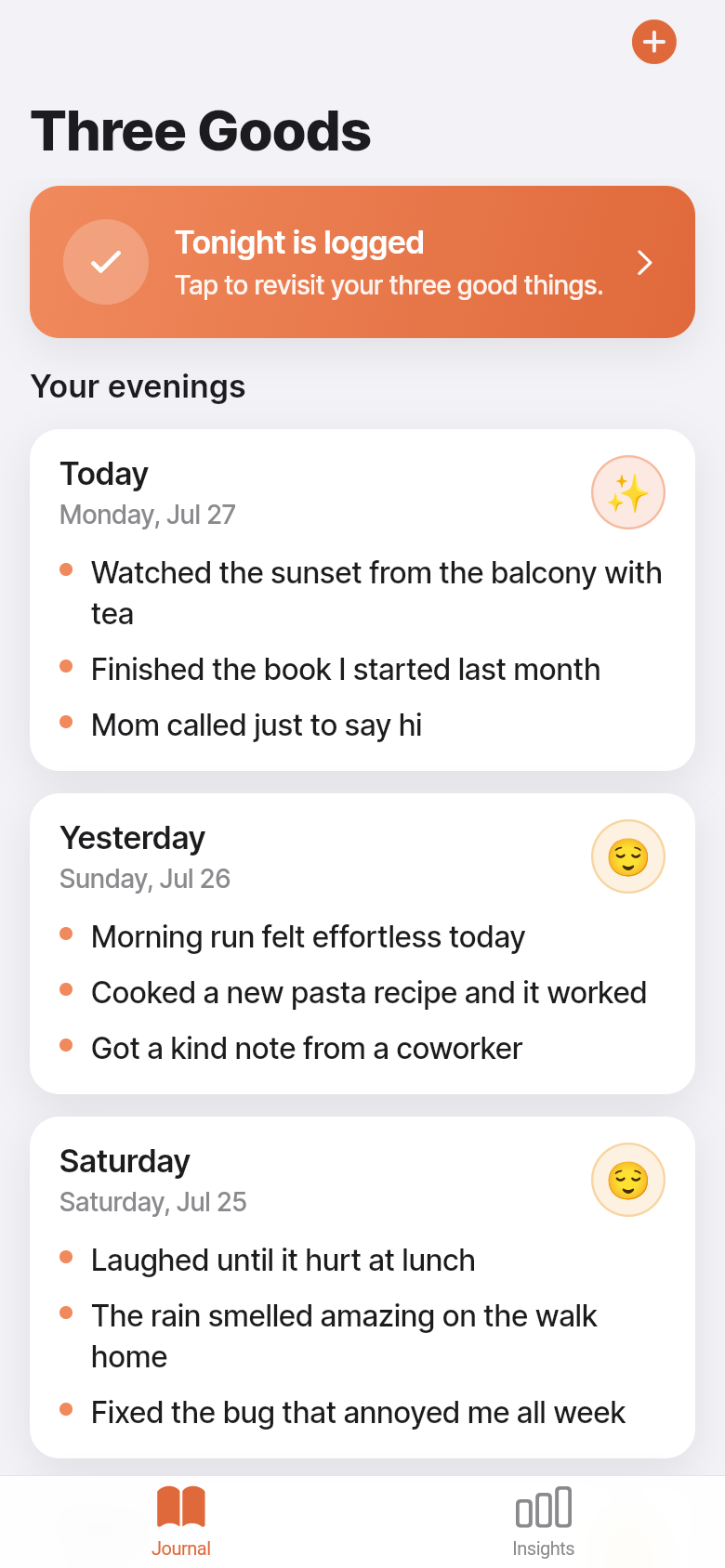
Most nights end the same way: you lie down, and your brain immediately starts replaying the awkward meeting, the thing you forgot, the email you still haven't sent. The good parts of the day — and there almost always are some — quietly disappear. Three Goods is a small app built around one of the most well-researched exercises in positive psychology: before you sleep, write down exactly three things that went well. That's the whole ritual. It takes under a minute, and over time it genuinely changes what your brain notices during the day.
The app is embedded live just below this paragraph. Open it, tap through the tabs, and log something — even something small. Then keep reading to understand what it's doing and why it works the way it does.
Live demo
Why three things, and why at night
The 'Three Good Things' exercise comes from Martin Seligman's work on positive psychology, where it consistently shows up as one of the interventions with the strongest and most durable effect on mood and sleep quality. The specific number matters: three is enough to require real thought, but not so many that it feels like homework. One thing is too easy to dismiss. Ten is exhausting.
Doing it at night also matters. You're not trying to manufacture positivity in the morning before you've experienced anything. You're closing a loop on a real day, hunting through what actually happened for the moments that deserved more attention than they got. A slow commute where you listened to something you loved. A coffee that was genuinely good. A conversation that landed well. These things happened. Three Goods just asks you to notice them.
What you actually do in the app
The main screen is a simple entry form: three text fields and a mood selector. That's it. No categories, no sub-questions, no word-count minimums. You type a sentence or a fragment, pick how you're feeling (there are five moods, from rough to great), and tap save. The whole thing takes thirty seconds if you know what you want to write, maybe ninety if you're thinking.
One thing Three Goods does that most journaling apps don't: it never shows you an empty screen. When you first open it, there's already a week of believable entries waiting. This solves a real problem — a blank slate on night one feels like a test you haven't studied for. Starting with history makes the app feel lived-in immediately, and it gives you a sense of what the entries are supposed to look like before you've written any of your own.
After a few nights, the History tab starts to fill with your own words. You can scroll back through past entries, see your mood logged alongside each one, and read what you were grateful for on any given night. There's something quietly powerful about this. The entries you wrote two weeks ago are almost always more interesting than you remembered.
Seeing gratitude build up over time
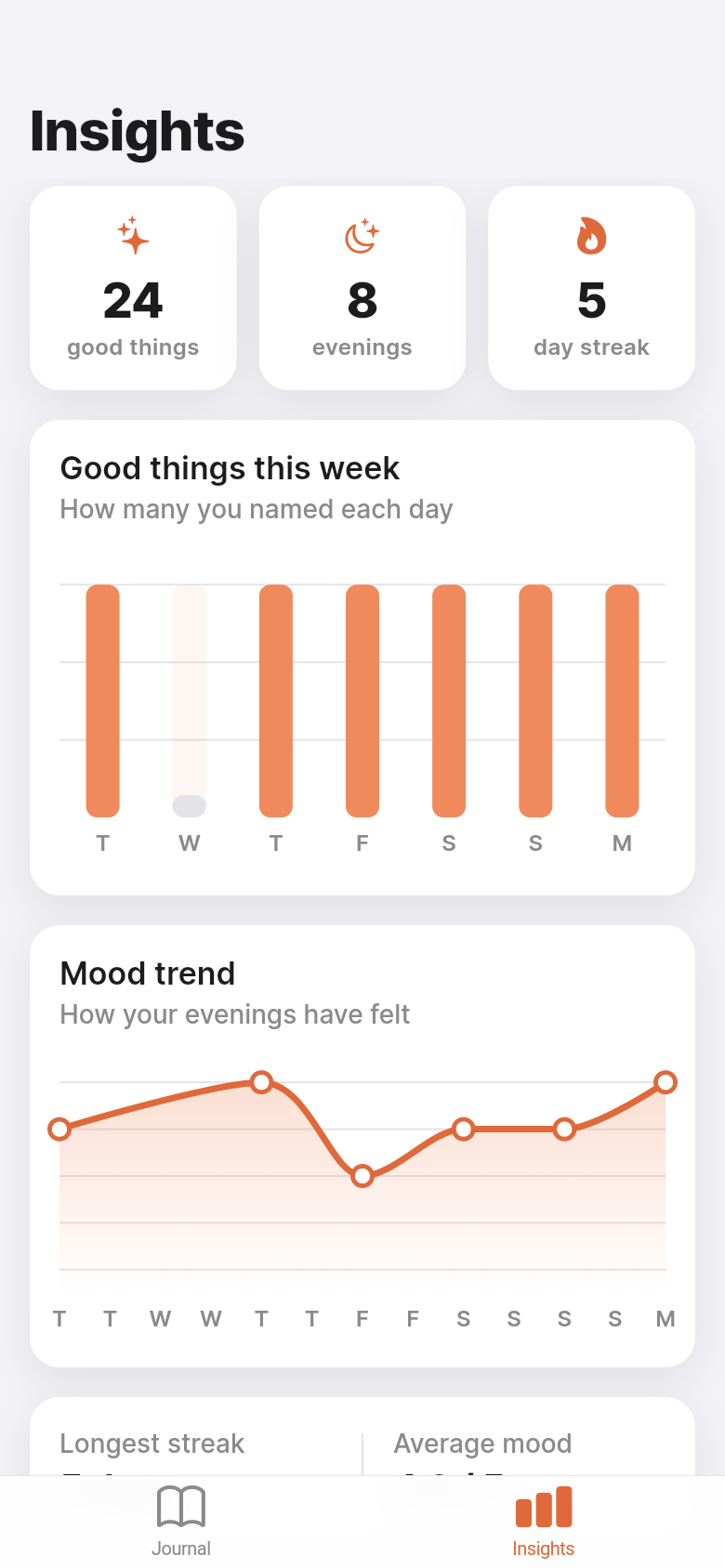
The Stats tab is where the longer view comes in. You can see your total entry count, your current streak, and charts that break down your mood patterns week by week. None of this is designed to make you competitive with yourself or anxious about missing a day. It's more like a quiet record: here's evidence that you've been paying attention.
The weekly mood chart is particularly useful. It's easy to remember a week as generally stressful or generally fine, but the chart often tells a more specific story — a rough Monday, a noticeably better Thursday, a weekend that genuinely helped. That specificity is more useful than a vague sense of how things have been going.
Everything stays on your device. There's no account to create, no data going anywhere, no feed to scroll. The app works offline by default and that's the only mode it has. Your entries are yours.
Who this is for, and who it isn't
Three Goods is built for people who have thought about keeping a gratitude journal, maybe tried one, and found that the friction of a blank page or a complicated app quietly killed the habit before it started. If you've downloaded three different journaling apps and never opened them past day two, this is designed with you specifically in mind.
It's not for people who want to write long reflective entries, track complex emotions across multiple dimensions, or integrate their journaling practice with goals and habit stacks. Those apps exist and they're good. This one does one thing: three things, one mood, every night. The constraint is the point.
The app feels native on iOS — large titles, Cupertino tabs, rounded cards, smooth transitions. It doesn't feel like a web page crammed into a phone frame. That matters more than it sounds, because friction anywhere in a nightly ritual is the thing that kills it. When the app feels right to tap around in, you actually come back to it.
Built from an idea in an afternoon
Three Goods was generated by Leanfinit from a single prompt describing the problem — people ending the day replaying stress instead of noticing what went well — and the core ritual it should enable. The app you're looking at above, with its working entry form, history, mood tracking, and stats charts, came out of that process as a real, functional tool.
This is what Leanfinit is for: turning a specific, well-understood problem into something you can actually hand to someone and say, here, try this tonight. If you have a tool you've been meaning to build — something small, something useful, something that solves a real problem for real people — the form at the bottom of this page is where to start.
39
files in the build
40.1 MB
app bundle
Flutter Web
runs in any browser
Have a tool idea of your own?
If there's a small habit, tracker, or ritual you've wanted to build for yourself or share with others, Leanfinit can turn that idea into a working app. Describe the problem in a sentence and see what comes back.