
life in the uk
Fatou Citizenship: Drill the 24 Dates That Trip Everyone Up
A focused flash-card app built for one woman's Life in the UK exam — targeting only the battles, kings, and dates that keep getting mixed up, night after night.
Artem
Founder
· 6 min read
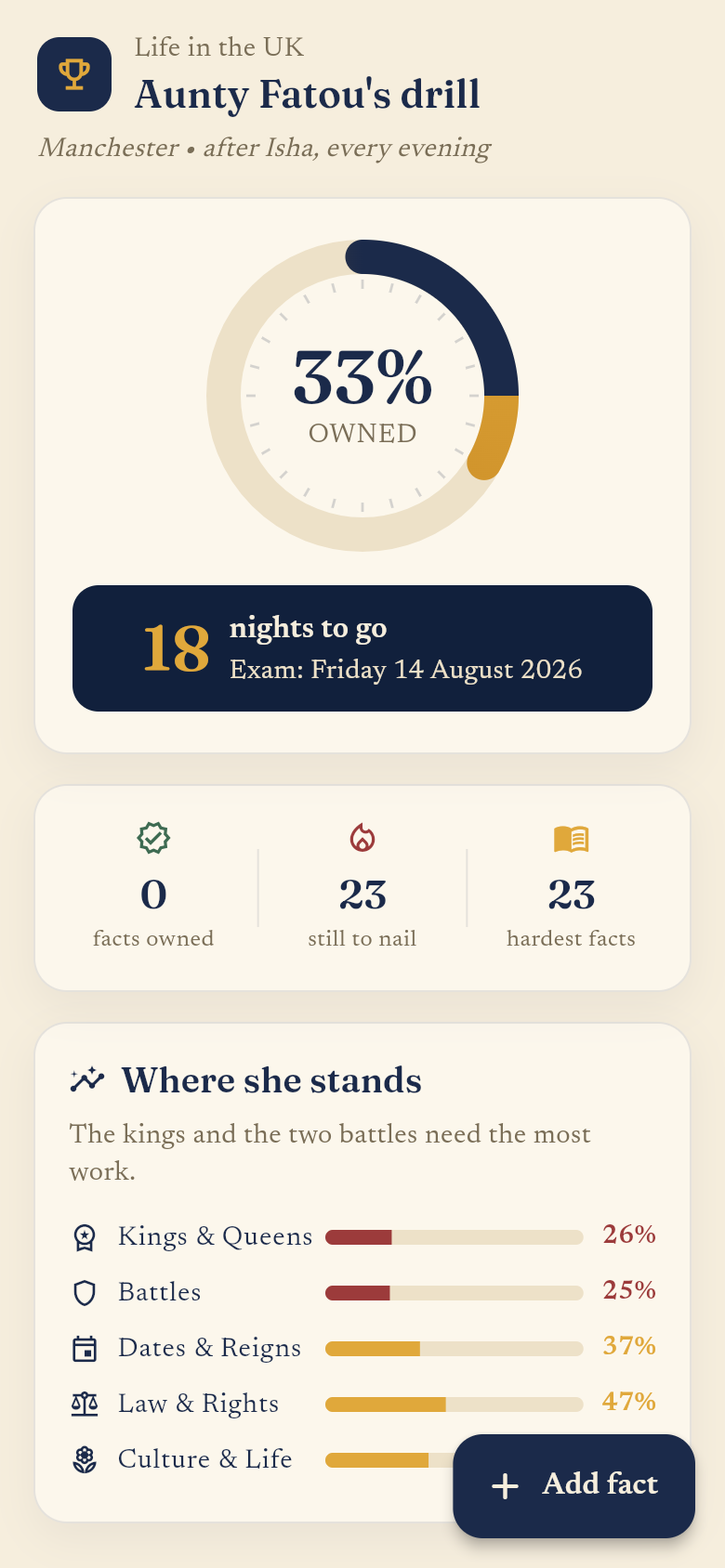
Aunty Fatou knows the general idea. She knows who William the Conqueror was. She knows the Magna Carta mattered. What keeps catching her out is the number — was that 1066 or 1485? Was Bosworth the one with the Normans, or the one that ended the Plantagenets? Generic revision apps serve up three thousand questions and bury those two battles somewhere in the middle. By the time the weak facts come around again, the evening is over.
This app was built for exactly that problem: a tight set of the twenty-four hardest facts, drilled in short nightly sessions, with the weakest ones surfacing first. Her niece in Manchester can sit across the table after Isha prayers, read the question aloud, and wait for the answer. The exam date — 14 August — counts down on screen so every session feels purposeful rather than open-ended.
Live demo
Why a small fact set beats a big question bank
Most Life in the UK revision tools assume the problem is breadth: not enough questions, not enough topics. But the people who fail the test usually know the broad strokes. They stumble on a handful of specific facts that look similar to each other — a date that's close to another date, two battles with rhyming names, a string of monarchs in a sequence that doesn't stick.
Fatou Citizenship ignores everything you already know. It opens with the twenty-four facts candidates most commonly swap or blank on: the Battle of Hastings (1066), the Battle of Bosworth Field (1485), the reigns of the early kings, a handful of constitutional milestones. That's it. No reading comprehension questions, no politics section, no filler. Every session is a direct hit on the weak spot.
Try the drill in the phone frame above. Tap a card, read the question, think of your answer, then flip it. The app registers whether you got it right or not, and the ones you miss come back sooner. That's the core loop — simple enough to run at the kitchen table with a cup of tea.
How the spaced recall actually works
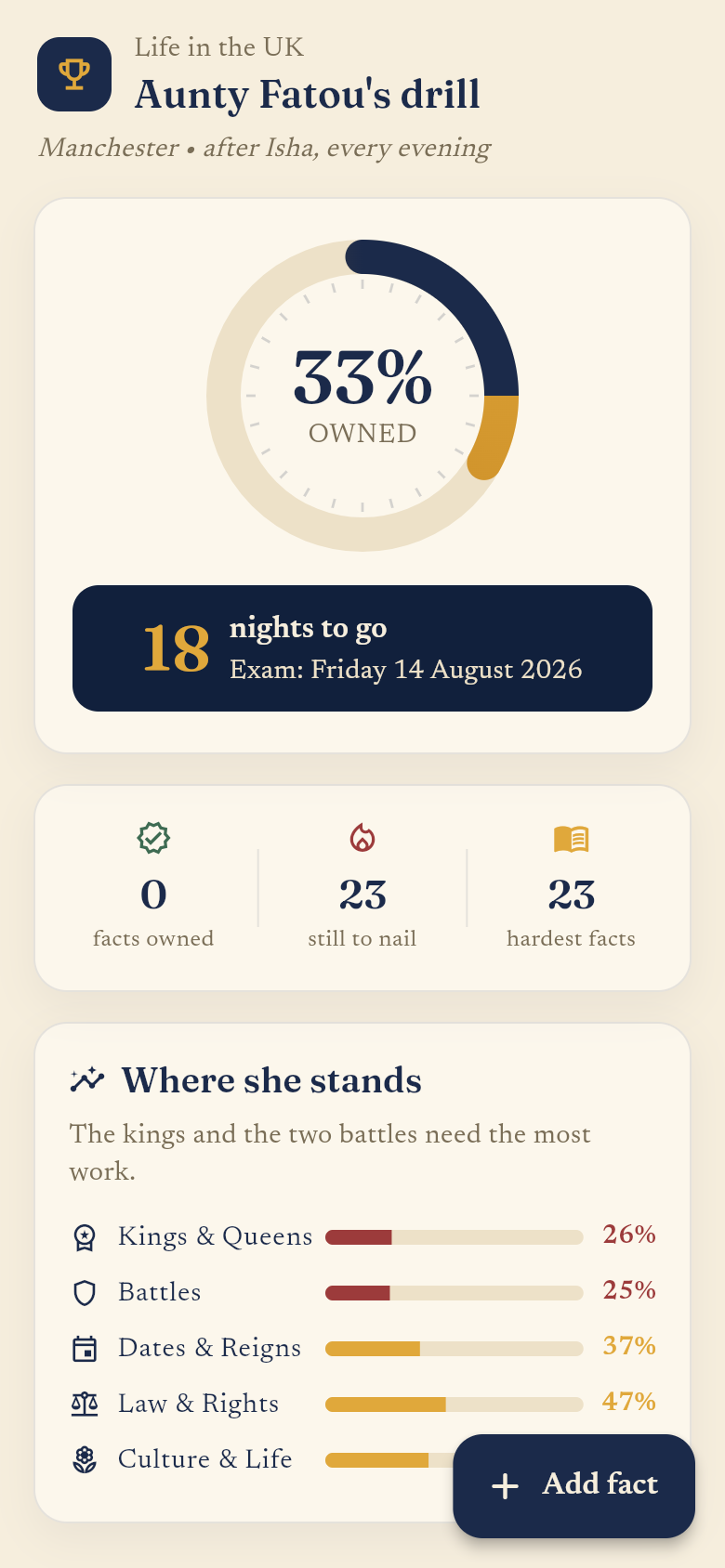
Each fact has a strength rating that starts at zero. Get it right and the rating climbs; get it wrong and it drops back. The app uses that rating to decide what to show you next: strong facts rest for a session or two, weak facts come back almost immediately. After a few evenings you'll notice Hastings appearing less often because it's settled in, while Bosworth keeps returning until it does the same.
This is the Leitner method applied to a single small deck. It's been studied for decades and the finding is consistent: short, frequent sessions with immediate feedback beat long re-reads by a wide margin, especially for factual recall under time pressure. The app doesn't explain any of this to you — it just does it, quietly, in the background.
The read-aloud flow is worth using if you have a study partner available. One person holds the phone, reads the question out loud, and waits. The other person answers. Then the card flips. That slight social pressure — answering out loud to someone who's watching — tends to consolidate the memory faster than tapping alone.
The countdown and the nightly rhythm
Revision works better when it has a shape. The exam date is fixed, the calendar is finite, and a visible countdown turns an abstract "I should revise" into a concrete "nine sessions left." Every time you open the app, the number is there at the top. It's a gentle, persistent reminder that the goal is real and the time is specific.
Each session is designed to fit into the gap after prayers and before sleep — roughly fifteen to twenty minutes. You're not meant to finish the whole deck in one go. The app surfaces the weakest facts first, so even a short session does useful work. If you only have ten minutes, that's fine; the algorithm makes sure those ten minutes land on the facts that need the most attention.
There's no account to create and no data to sync. The app opens offline, already loaded with the seeded fact set, and saves your progress on the device. Nothing to configure before you can start drilling.
What Hastings and Bosworth actually are (and why they're so easy to swap)
The Battle of Hastings in 1066 is when William, Duke of Normandy, defeated King Harold and changed English history permanently. The Norman Conquest reshaped the language, the aristocracy, the legal system — almost everything. The date 1066 is one of the most famous in English history, which paradoxically makes it feel interchangeable with the next memorable battle.
The Battle of Bosworth Field in 1485 ended the Wars of the Roses. Richard III died there, Henry VII took the crown, and the Tudor period began. Both battles feel pivotal. Both names sound vaguely medieval. Both are on the test. The difference is four centuries and two entirely different dynasties — but under exam pressure, with a dozen other dates rattling around, they blur.
Fatou Citizenship treats these two as a pair and drills them together, with enough repetition that the distinction becomes automatic rather than effortful. By the time the exam arrives, the answer to "which battle was 1066?" should come before the question is even finished.
Built in an afternoon from a very specific problem
This app started as a description of a real situation: one person, one exam, a specific set of facts that kept tripping her up, and a family member who wanted to help. From that description, a working tool was assembled and seeded with the actual content — not a generic template, but an app with Fatou's name on it and her exam date built in.
The screenshots show the two main screens: the card drill view, where you flip through questions and register your recall, and the progress view, where you can see which facts are strong and which ones need more work. Both are designed to be usable one-handed in low light, which matters when you're revising late in the evening.
If Aunty Fatou passes on 14 August, a nightly fifteen-minute habit and a small focused deck will have done most of the work. The Life in the UK handbook is long and covers a lot of ground; the test is ninety minutes and twenty-four questions. Knowing the right twenty-four things very well is a better strategy than knowing three thousand things loosely.
39
files in the build
40.5 MB
app bundle
Flutter Web
runs in any browser
Have a specific problem? Build a tool for it.
Fatou Citizenship was built from a one-line idea: a flashcard app for the exact facts that keep getting mixed up, for one woman, before one exam. Describe your own narrow problem and get a working app built around it.