
liturgical calendar
Sr. Agnes Feasts: Drill the September Calendar Before Your Clothing Ceremony
A focused flip-card app built for a Benedictine novice who kept mixing up St. Matthew and St. Michael. Works offline, tracks readiness, and flags the exact confusion by name.
Artem
Founder
· 4 min read
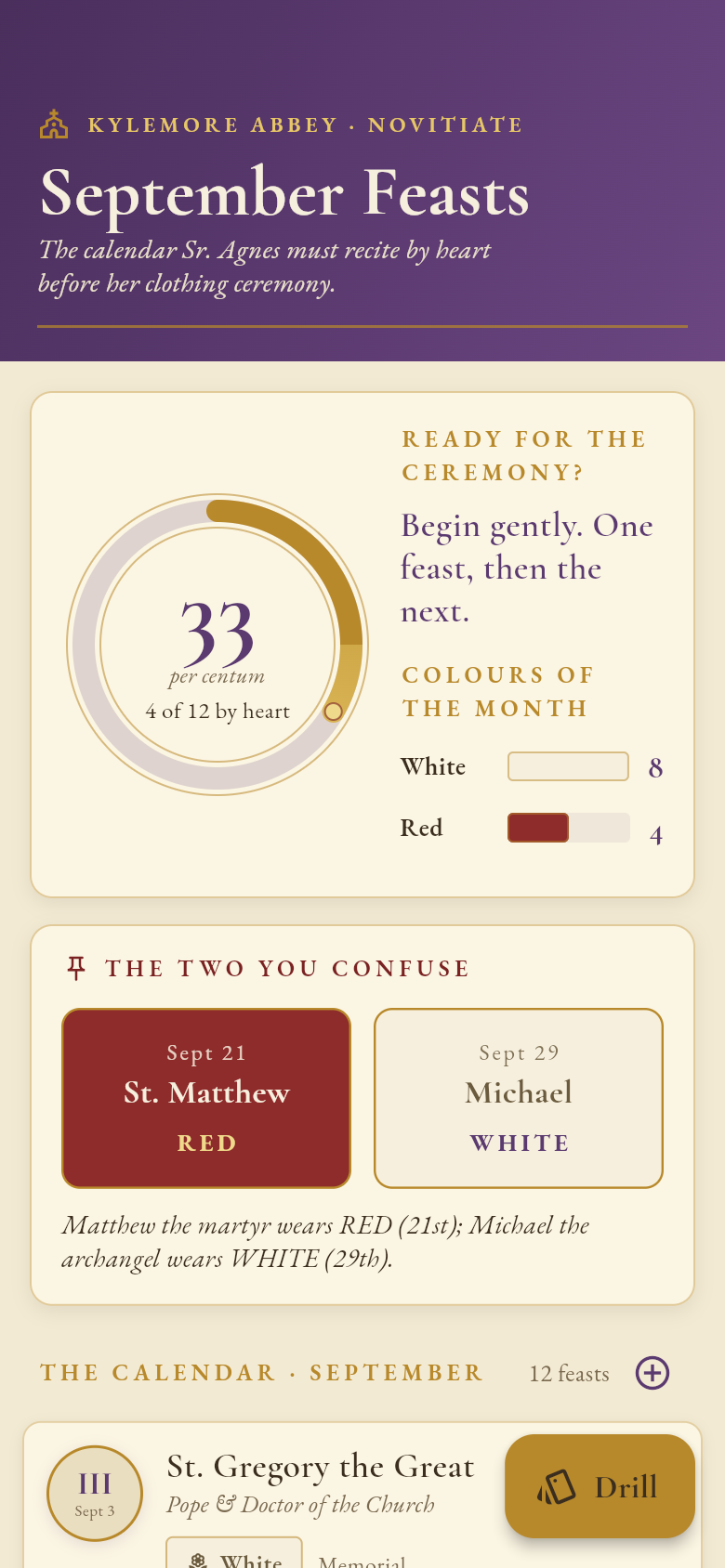
Sister Agnes knows September's feast days well enough on paper. But when recitation comes, the same two names trip her up every time: St. Matthew on the 21st, red, and St. Michael on the 29th, white. They sit just eight days apart, both are major feasts, and the colours feel backwards until they don't. Her clothing ceremony has a date. The calendar does not care.
This app was built around that exact problem. It seeds the full September calendar, liturgical colours, ranks, and antiphons included, so there is nothing to enter. It tracks which feasts she knows by heart and shows a readiness percentage for the ceremony. And it calls out the Matthew/Michael pair directly, side by side, so the distinction becomes muscle memory rather than guesswork.
Live demo
The September Calendar, Already Loaded
Open the app and every feast is already there. The Birthday of the Blessed Virgin on the 8th, the Exaltation of the Holy Cross on the 14th, St. Matthew on the 21st, Sts. Cosmas and Damian on the 26th, St. Michael with Gabriel and Raphael on the 29th, St. Jerome on the 30th. Each entry shows the feast's rank (Solemnity, Feast, Memorial, Optional Memorial), its liturgical colour, and the proper antiphon for the day.
Nothing is blank, nothing needs filling in. The calendar is the General Roman Calendar as observed in the ordinary form, and it does not change between sessions. This matters for study before Compline: there is no setup, no account, no loading screen. The app opens to the list and you are already working.
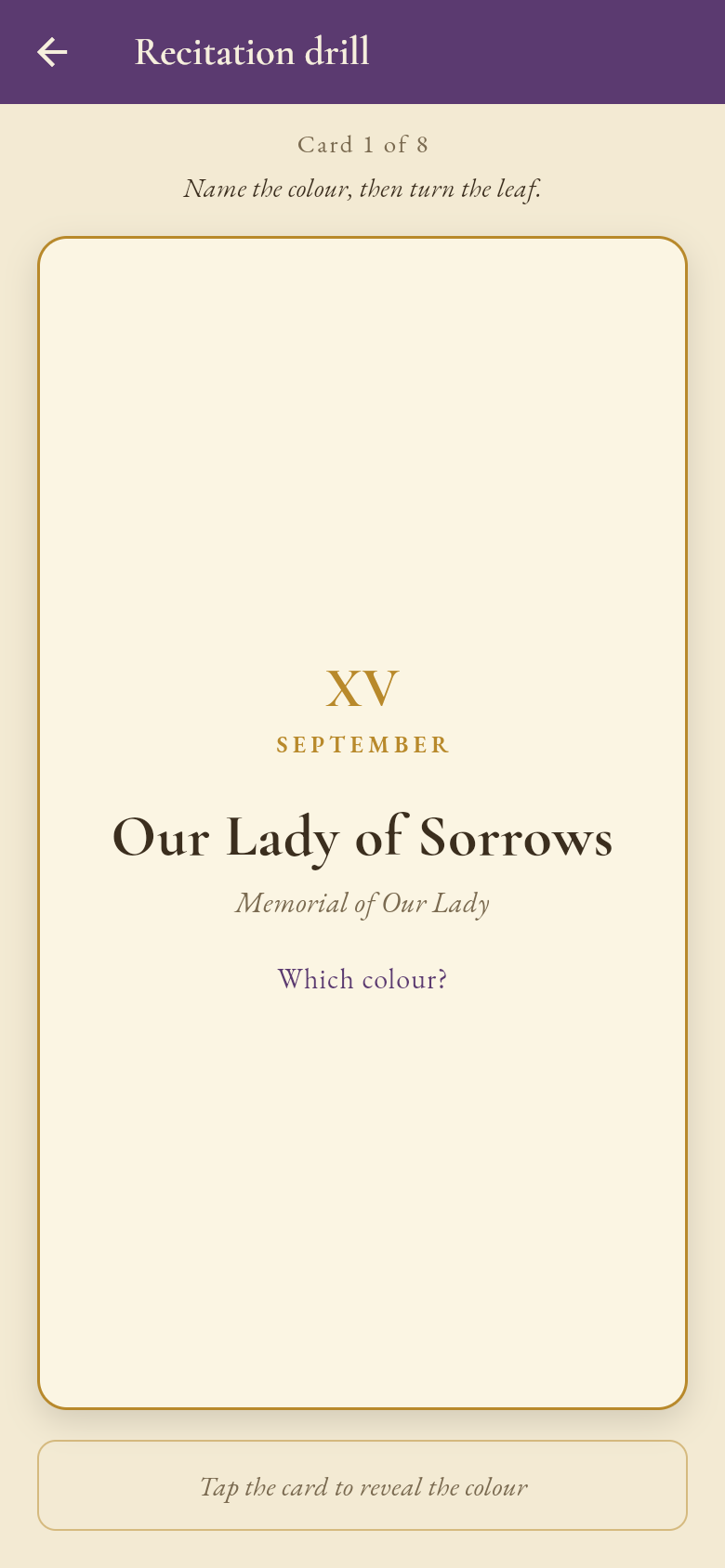
The Flip-Card Drill
The core of the app is a simple quiz loop. A feast name appears on the front of the card. You recall the colour, then flip. Green or red tells you immediately whether you had it right. If you did, you can mark that feast as known by heart and it moves off the active drill deck. If you did not, it stays in rotation.
The Matthew/Michael pair gets its own treatment. When either card appears, the app shows a small contrast note alongside the answer: Matthew, Apostle and Evangelist, red because he shed blood for the faith; Michael, Archangel, white because angels are not martyrs. That distinction is the whole reason this app exists, and it is baked in rather than left as a footnote.
Try the drill in the embedded demo below. Flip a few cards and mark one or two as known. The readiness bar at the top will move. The goal is to get it to 100 percent before the ceremony, which means every feast in September confirmed by heart, not just the ones you were already confident about.
Readiness at a Glance
Above the drill, a colour tally shows how many feasts fall under each liturgical colour for the month: how many white, how many red, how many green, how many violet. Below that, a single percentage tells you what fraction of the calendar you have marked as known.
This matters because readiness for a recitation is not a feeling, it is a count. A novice studying the calendar needs to know whether she has three days of drilling left or three weeks. The percentage makes that concrete. When it reaches 100, the ceremony preparation is done, at least for September.
Built for the Quiet Before Compline
The app works entirely offline. Progress is saved across restarts, so a session interrupted by the bell for Vespers does not mean starting over. There are no notifications, no accounts, no cloud sync. It is a single-purpose tool that opens, does one thing, and closes.
That constraint is a feature. Study before the night office benefits from low distraction. A general flashcard app with folders and settings and social features is a different kind of tool. This one is scoped to exactly one month and one task, and that scope is what makes it useful in a setting where simplicity is not a style choice but a way of life.
Sacristans preparing colour assignments, choir religious learning the proper order of October feasts, or anyone preparing for a liturgical role in a community that observes the Roman Calendar will find the same pattern useful. The September scope is specific to Sr. Agnes; the idea of a drillable, offline, colour-coded calendar is not.
From a Single Confusion to a Working Tool
This app started as a description of one problem: a novice, two adjacent feasts, a clothing ceremony approaching. From that description, a working tool was built in a short session, with the calendar pre-seeded, the specific confusion flagged, and the readiness signal wired up.
The same approach works for any narrow, recurring problem where a custom tool would help but building one from scratch is not realistic. A sacristan tracking which vestments need pressing before a feast. A cantor drilling Psalm tones. A monastic guest master keeping notes on dietary needs for retreat guests. The idea does not need to be large. It needs to be specific.
39
files in the build
40.5 MB
app bundle
Flutter Web
runs in any browser
Have a specific problem that needs its own tool?
Describe the problem in one sentence and Leanfinit will build the app from it. No account needed to start.