
medication tracker
Babcia's Pills: A Simple Tracker for Multi-Pill Daily Routines
When you're suddenly responsible for a grandmother's five-pill regimen, this offline checklist keeps morning and evening doses clear, named, and never double-counted.
Artem
Founder
· 5 min read
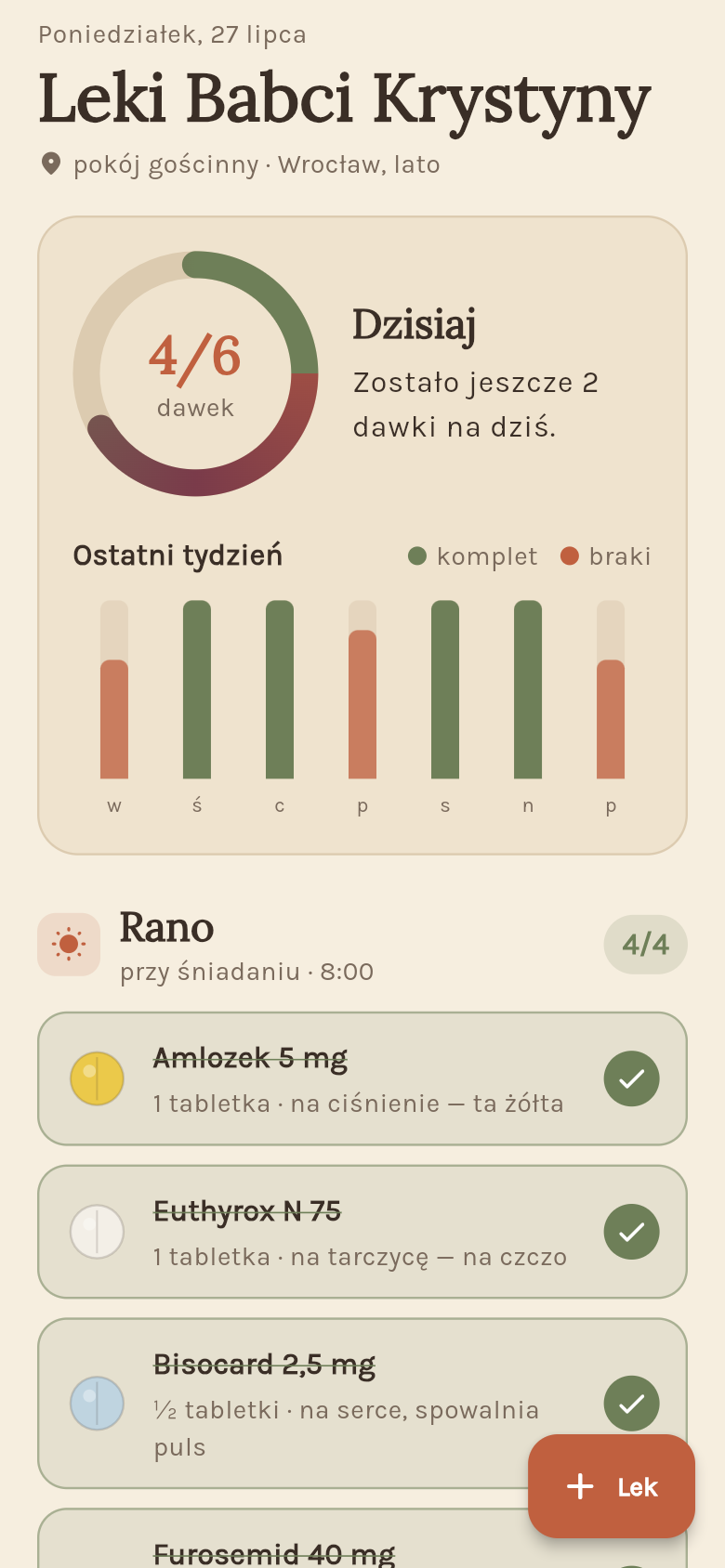
Babcia Krystyna takes five pills a day: two at breakfast, three at supper. One is half a tablet. One has to be taken on an empty stomach. The yellow one is for blood pressure, not the thyroid, and you only discover the difference matters when you're standing in her kitchen at 7 a.m. holding two very similar-looking yellow tablets. After her fall last spring, her grandchild took over the medication routine for the summer, and the first challenge wasn't the pills themselves — it was just keeping track.
This app was built around that exact situation. It opens already loaded with Babcia's real regimen, shows each pill by name and colour, and lets you tick off morning and evening doses with a single tap. No sign-up, no cloud sync required, no medical jargon. Just a clear daily record you can glance at and trust.
Live demo
The problem with similar-looking pills
Most medication errors at home don't happen because someone is careless. They happen because several pills look almost identical, the household routine gets disrupted, and a second person has to manage a regimen they didn't set up. 'Did she take the evening dose?' is a question that should have an obvious answer, but when you've had a long day and Babcia is certain she already took them, certainty on both sides isn't the same as a fact.
The app solves this by making the state of each dose explicit and persistent. Morning doses are their own checklist; evening doses are their own checklist. Once you tap a pill as given, it stays ticked until midnight, when the slate resets for the next day. There's no ambiguity left to argue about, and no risk of a double dose because someone forgot the first one was already given.
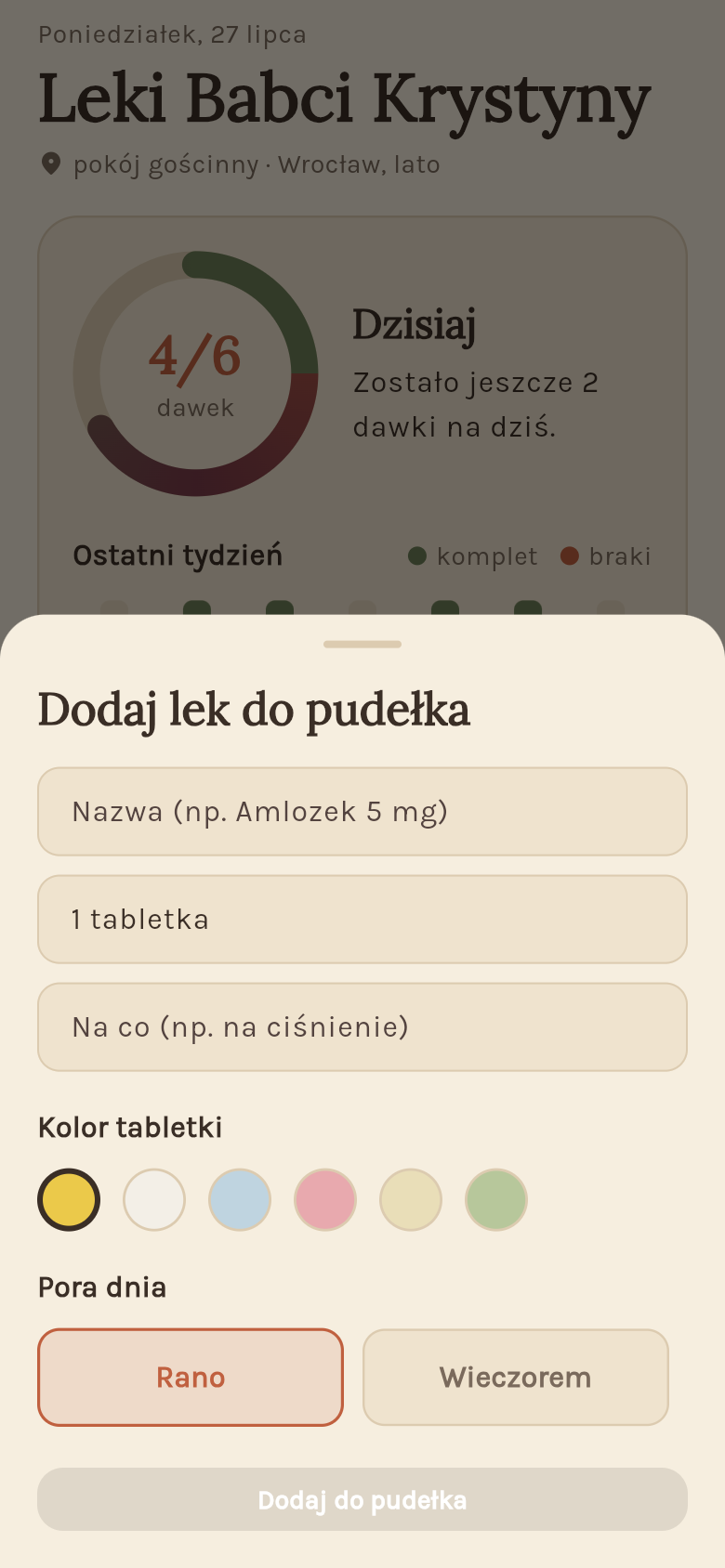
What you see when you open it
The live demo embedded above shows the app exactly as a first-time carer would see it: not an empty screen asking you to set everything up, but Babcia Krystyna's actual regimen, ready to use. Each pill has its name, a plain-language note on what it's for, and the colour of the tablet as it actually looks in the blister pack. The half-tablet is labelled as such. The one that must be taken on an empty stomach has that note right there, next to the pill name, where you'll actually read it.
Try tapping a pill in the morning column. It ticks off immediately and the row settles into a quieter colour — done, no longer needing your attention. Do the same for the evening column at supper. The whole interaction takes about four seconds per round, which is about the right amount of friction for something you'll do twice a day, every day, for weeks.
The weekly view: reassurance at a glance
The daily checklist handles the moment. The weekly adherence view handles the bigger question: is she actually on track, or have there been gaps we haven't noticed? Seven days of morning and evening dots, filled or empty, give the whole family a shared picture without anyone having to ask. If a cousin visits on Thursday and wants to know how Babcia's been doing since Monday, the answer is right there.
This kind of overview matters especially after a disruption, like a fall or a hospital stay, when the usual routine breaks and more than one person starts making decisions. A shared record that everyone can see — even just handed across a table on a phone screen — replaces the fragile verbal handoff that usually fills that gap.
Offline, in Polish, on the phone you already have
Babcia's apartment has decent internet most of the time, but 'most of the time' isn't good enough for a health routine. The app stores everything locally on the device, so a dropped connection between breakfast and supper doesn't break anything. Tick the morning doses, put the phone in your pocket, and the record is still there at 7 p.m.
The interface is entirely in Polish, which matters for two reasons. The carer reads faster in their own language, especially under stress. And if Babcia herself glances at the screen, she can understand what she's looking at. That small dignity — a medical tool that doesn't feel like it was made for someone else — is part of what makes the app feel like it was built for this household, not adapted from a generic health template.
Built from a one-line idea, ready for a real summer
This app started as a description of a specific problem: a grandchild, a grandmother, five pills, two rounds a day, Wrocław, summer. From that, Leanfinit generated a working tool with real pill names, real colours, real Polish copy, and a data model that persists across the days of a stay. It took minutes, not months.
If you're in a similar situation — caring for a parent, a spouse, or a grandparent with a multi-pill regimen — the same approach applies. The app doesn't have to be about heart and thyroid medication. It can be for diabetes management, post-surgery recovery, or any other fixed daily routine that needs a reliable second pair of eyes. The starting point is just a description of the problem you're actually trying to solve.
39
files in the build
40.6 MB
app bundle
Flutter Web
runs in any browser
Have a care routine that needs a simple tool?
Describe the situation — who the person is, what they take, when, and what keeps going wrong — and we'll turn it into a working app you can use the same day.