
elder care
Babcia's Meds: A Drill App for Caregiver Audit Readiness
When a district nurse arrives to check your competence, you need more than a list. This app turns Halyna's nine-pill regimen into a quiz you can actually pass.
Artem
Founder
· 4 min read
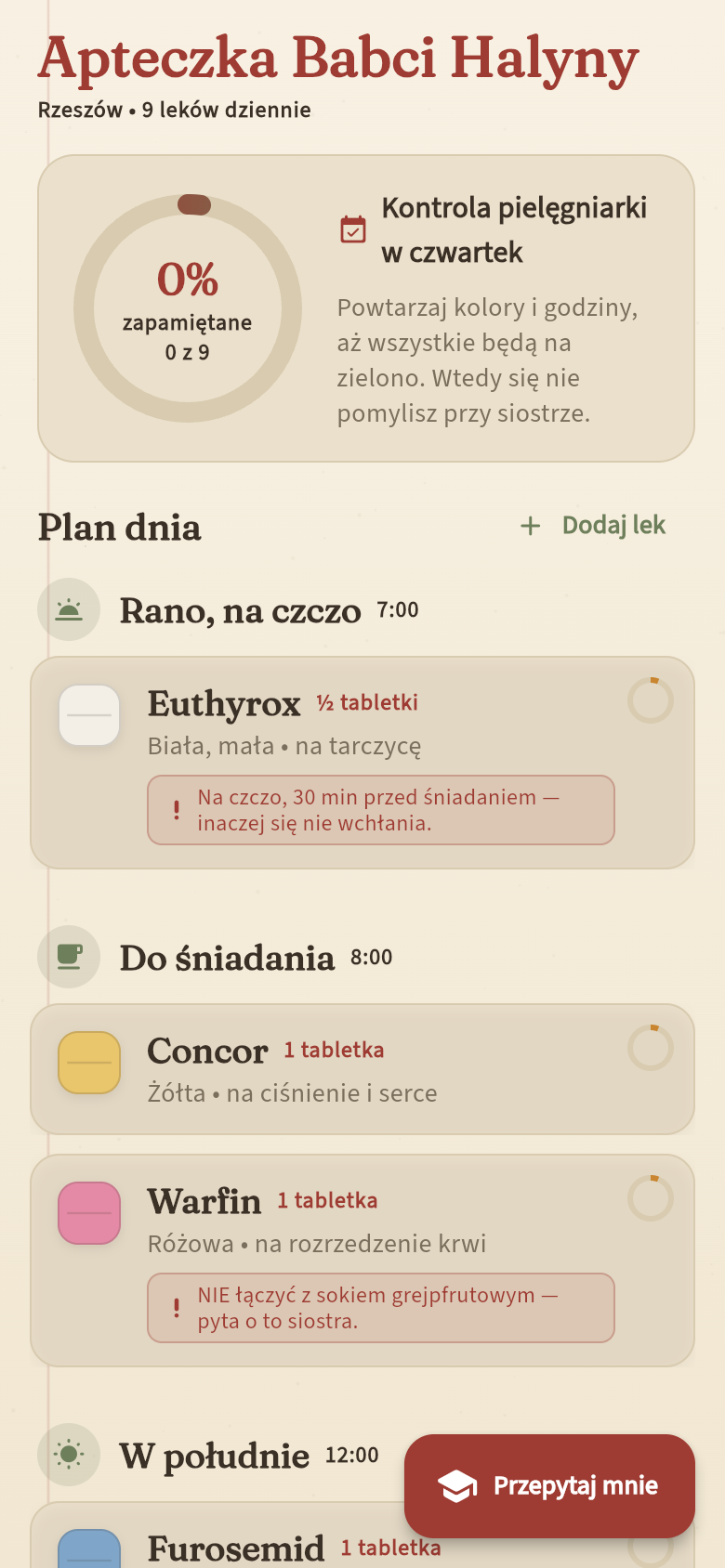
If you are the one who actually knows which pink tablet goes with breakfast and which small white one waits until supper, you already carry a lot in your head. Babcia Halyna takes nine medications a day. Some look nearly identical. A few interact with food. And sooner or later, the district nurse will sit down across from you and start asking questions.
Babcia's Meds was built for exactly that moment of preparation. Open it and you find the full nine-pill regimen already loaded, each pill described by its real color, shape, timing, and plain-language purpose. Work through the quiz a few evenings in a row and the audit stops feeling like a test you might fail.
Live demo
The problem with a list on the fridge
Most families start with a handwritten schedule. It works until Atoris and Polprazol arrive in the same weekly pill organizer, both small, both white, and you are no longer sure which slot is which. A static list tells you the answer once. It does not tell you whether you have actually learned it.
The district nurse (pielęgniarka środowiskowa) visit is a real deadline. She may ask you to name the purpose of the pink tablet, or explain why grapefruit is off the table on warfarin days, or describe what supper-time looks like in terms of pills. If you hesitate, that hesitation is noted. The pressure is concrete and the schedule for it is not always announced far in advance.
How the app turns the regimen into something learnable
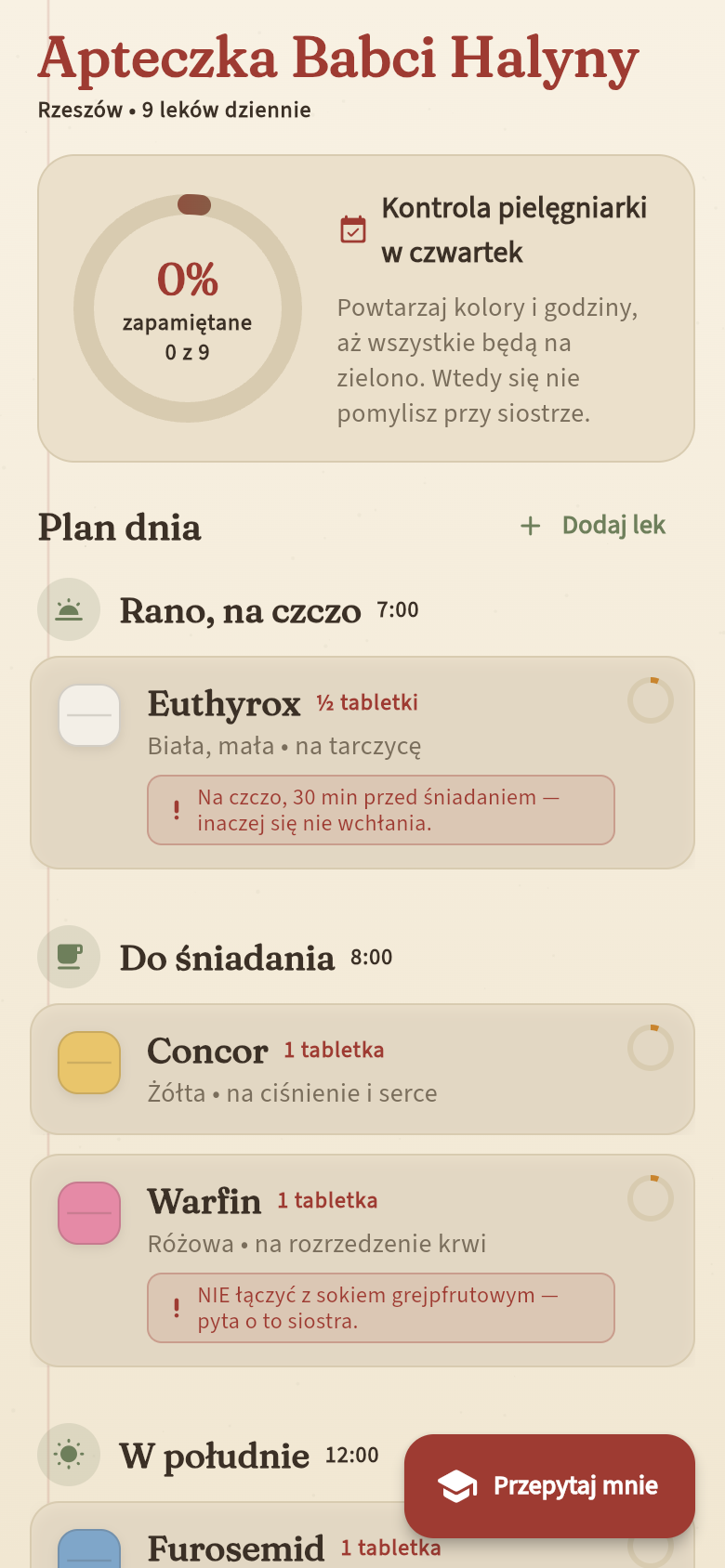
On first open, the app seeds Halyna's full nine-pill schedule. You do not start with a blank form to fill in. You start studying. Each entry shows the physical description of the pill, the exact time slot it belongs to, and a sentence about what it is doing in her body. The pink Warfin at breakfast, the Atoris before sleep, the small oval Polprazol well before the morning meal so it has time to work.
The quiz mode asks the kinds of questions a nurse actually asks. Match the color to the time. Name the purpose from the shape. Identify which drug has a grapefruit interaction. After each answer you get immediate feedback, not a score at the end that leaves you wondering where you went wrong. The app tracks mastery per pill, so you can see at a glance which ones you are solid on and which ones need another evening.
Try the live demo embedded here. Tap through a few quiz rounds and notice how quickly the repetition starts to feel different from reading a list.
Why physical description matters more than drug names
In a real caregiving situation, you pick up a pill from the organizer and look at it. You do not look at a package. Drilling the color and shape alongside the timing is what makes the knowledge stick in the moment that counts, not in the calm of reading.
Look-alike tablets are a documented mix-up risk in polypharmacy households. Atoris and Polprazol are a real example, not a hypothetical. An app that maps the physical reality of the pill, what your hand is actually holding, to the correct slot and purpose is doing something a spreadsheet cannot.
Offline, persistent, and ready for next week's visit
The app works without a connection. Evening study sessions after Halyna is asleep do not depend on the home wifi behaving. Progress saves between sessions, so the mastery you built on Tuesday is still there on Thursday when you pick it up again.
The readiness indicator gives you an honest read on where you stand. When every pill shows solid mastery, you go into the nurse's visit knowing the material, not hoping you remember. That is a different feeling, and it shows.
Built from a real situation, not a product brief
This app came from a specific, named problem: one caregiver, nine pills, an upcoming audit. It was built quickly from that description and it does nothing beyond what that situation actually requires. There is no medication database to browse, no general health tracker, no notifications asking you to log symptoms. It is a focused drill tool for a focused problem.
That specificity is what makes it useful. A caregiver preparing for a district nurse visit does not need a feature list. She needs to know the pink Warfin goes with breakfast and she needs to be able to say it without thinking.
39
files in the build
40.5 MB
app bundle
Flutter Web
runs in any browser
Have a specific problem that needs its own tool?
Babcia's Meds started as a one-sentence description of a real situation. If you have a caregiving routine, a workflow, or a tracking need that does not quite fit any existing app, describe it and get something built for exactly that.