
health fitness
Cycle Almanac: Period Tracking Without the Noise
A calm, private app that predicts your next period and fertile window from a single tap — no account, no ads, no data leaving your phone.
Artem
Founder
· 5 min read
Most period-tracking apps ask for a lot before they give you anything. Create an account. Accept the privacy policy. Decide whether to log your mood, sleep, cravings, and skin texture. By the time you get to the question you actually came with — when is my next period? — you've clicked through six screens and handed over your email address.
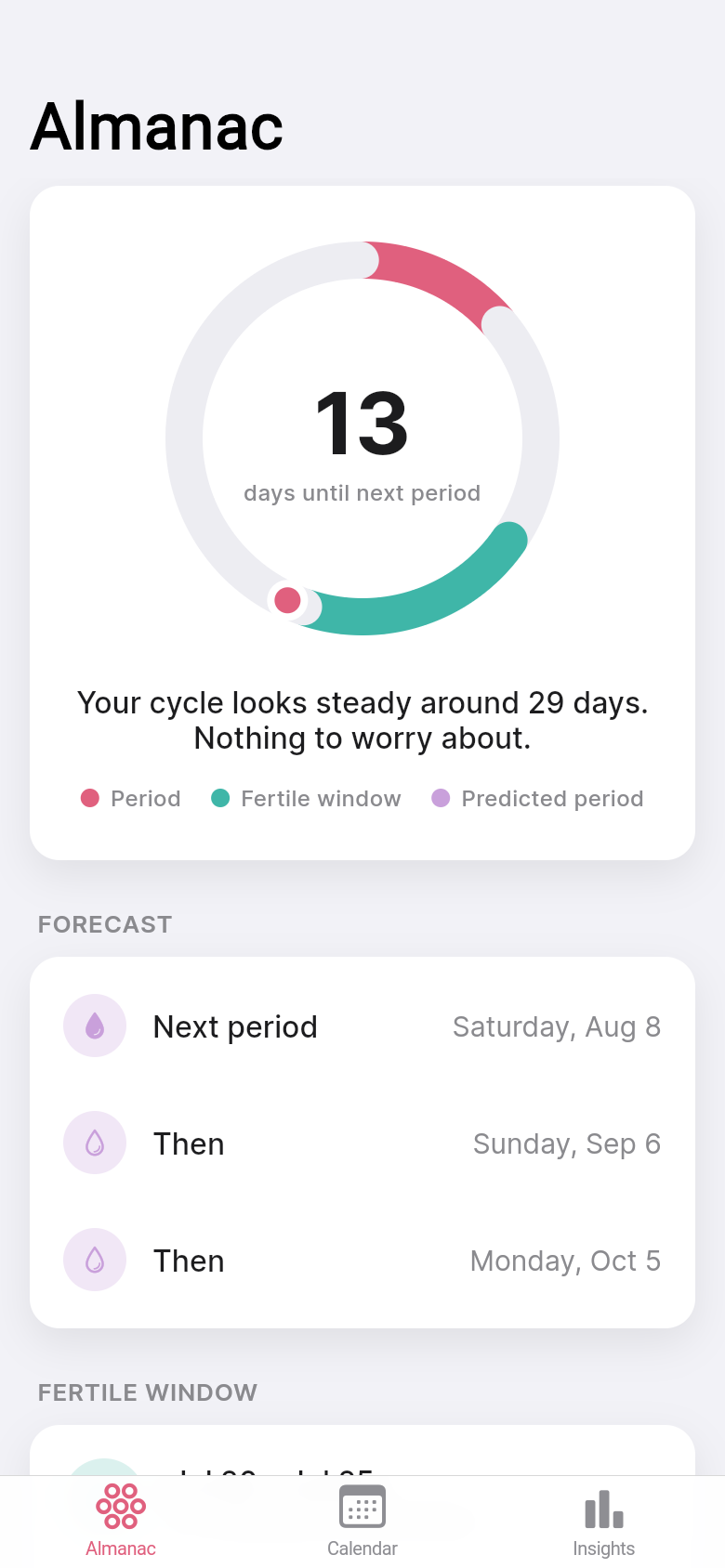
Cycle Almanac strips that back to the one thing that matters. You tap the day your period starts. The app learns your pattern and tells you, calmly and privately, when to expect the next one and when your fertile window falls. Everything stays on your phone. There is no account, no subscription, and no data going anywhere. Try the live demo embedded in this page and see how fast it gets out of your way.
Live demo
One tap, then a clear answer
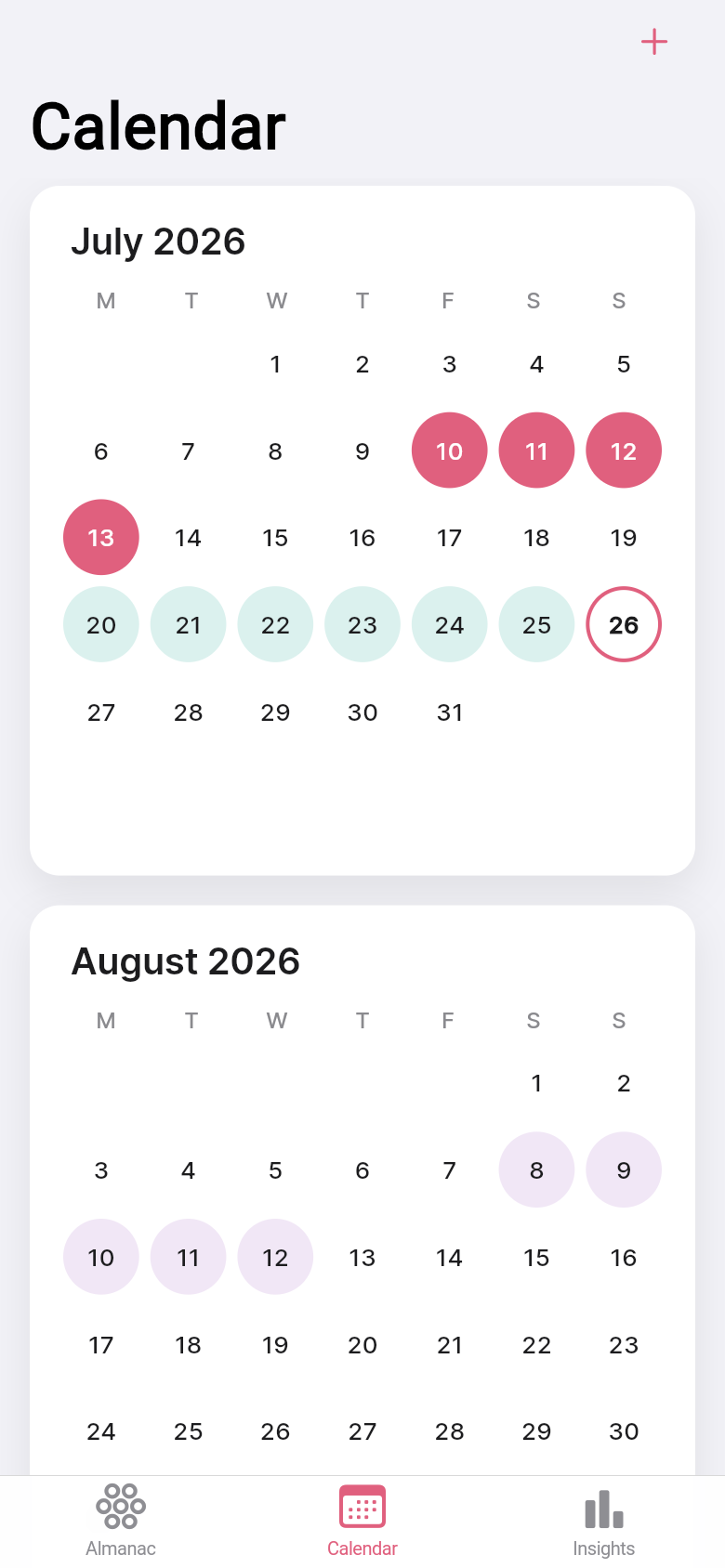
The main screen opens on a calendar that already feels familiar. The current month is in view, past period starts are marked, and the predicted next period is highlighted in a muted color that reads as 'coming soon' rather than 'alarm'. You do not have to configure anything to get that prediction — the app seeds believable history on first open so the screen is never empty and the logic has something to work with.
To log a new period, you tap the day it started. That is the whole interaction. If you got the date wrong, tap again to edit or remove it. The app recalculates immediately. No save button, no confirmation dialog, no sync spinner. The prediction updates in place and you can put your phone down.
How the prediction works, and why that is enough
Cycle Almanac uses the calendar method: it averages your logged cycle lengths and projects the next few periods from that average. The fertile window is estimated as the days around ovulation, which typically falls roughly 14 days before the next expected period. This is the same math your doctor would sketch on a notepad, and for the large majority of people with reasonably regular cycles it is accurate enough to plan around.
The app does not claim clinical precision. It does not correct for irregular cycles by pulling in temperature data or hormone tests. What it does is give you a honest, readable estimate based on your own history — and it does that entirely on-device, with no model training, no anonymized data pools, and no server that could be breached or sold.
Scroll the calendar forward a few months in the demo and watch how the predicted windows extend. The fertile window is shown clearly but without the clinical urgency that fertility-focused apps often apply. Whether you are avoiding pregnancy, planning for it, or just want to know when to pack supplies, the display gives you the information without editorializing.
Why privacy in a period app is not a niche concern
Reproductive health data is among the most sensitive categories of personal information. Several high-profile investigations have found that mainstream period-tracking apps share data with advertisers, data brokers, or employers — sometimes by design, sometimes through third-party SDKs embedded for analytics. The business model of a free app with millions of users almost always involves monetizing that data in some way.
Cycle Almanac has no business model that requires your data. There are no ads, no premium tier unlocked by a subscription, and no SDK phoning home. The app works offline because it does not need to be online. Your cycle history lives in local storage on your own device. Delete the app and it is gone. This is not a privacy marketing claim — it is just what happens when an app is built to do one thing and does not need to grow beyond it.
The small details that make it pleasant to use
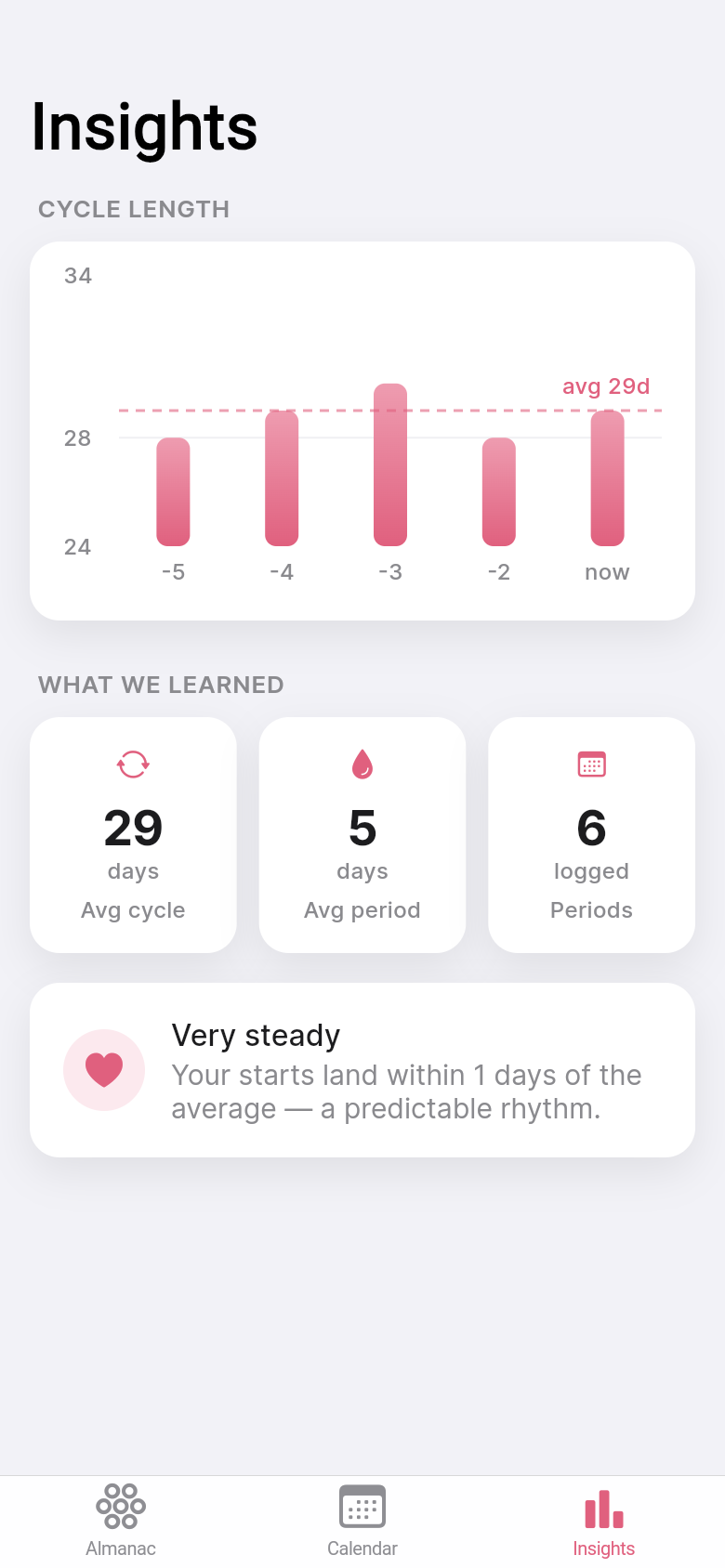
The screenshots show a few things worth noting when you try the demo. The color palette is calm, not medical. Period days use a warm tone rather than red-alert red. Predicted days use a softer shade that reads as approximate, which is the right level of confidence for a calendar estimate. The fertile window gets its own distinct color so the three states — past period, future period, fertile window — are readable at a glance without a legend.
Navigation is month-by-month with swipe or tap. There is no year view, no symptom log, no mood emoji grid, no export button. Every feature that is not there is a deliberate choice to keep the core interaction fast. If you open the app in the morning to check whether this week is a good time to schedule something, you get your answer in about two seconds.
The app also handles the first-open experience well. Rather than showing you an empty calendar and asking you to start logging, it renders with a few months of plausible history already in place. You can see immediately what the marked days look like, what the prediction looks like, and how the fertile window is displayed — before you have entered a single real data point.
Who reaches for an app like this
The people who find Cycle Almanac useful tend to have left a bigger app behind. Maybe the app they were using started surfacing ads after a policy update. Maybe it added a social feed or a community feature that felt jarring. Maybe they read a news story about period data and decided they would rather have a tool that could not possibly share what it does not collect.
Some users want a secondary tracker — a simple private log alongside a more feature-rich app they use for other reasons. Some are looking for something to recommend to a teenager who does not want to set up yet another account. Some just want the lightest possible tool for the one job of knowing when their period is due. Cycle Almanac fits all of those situations without asking you to explain yourself.
39
files in the build
39.9 MB
app bundle
Flutter Web
runs in any browser
Have a tool you wish existed?
Cycle Almanac went from a one-line idea to a working, interactive app without writing a line of code. If there is a simple, focused tool you have been looking for and never found quite right, you can build it the same way.