
productivity
Klatka Rota: The Stairwell Schedule That Fits in Your Pocket
A simple app for Polish apartment blocks that replaces the paper grafik by the mailboxes with a phone that shows whose turn it is, right now.
Artem
Founder
· 4 min read
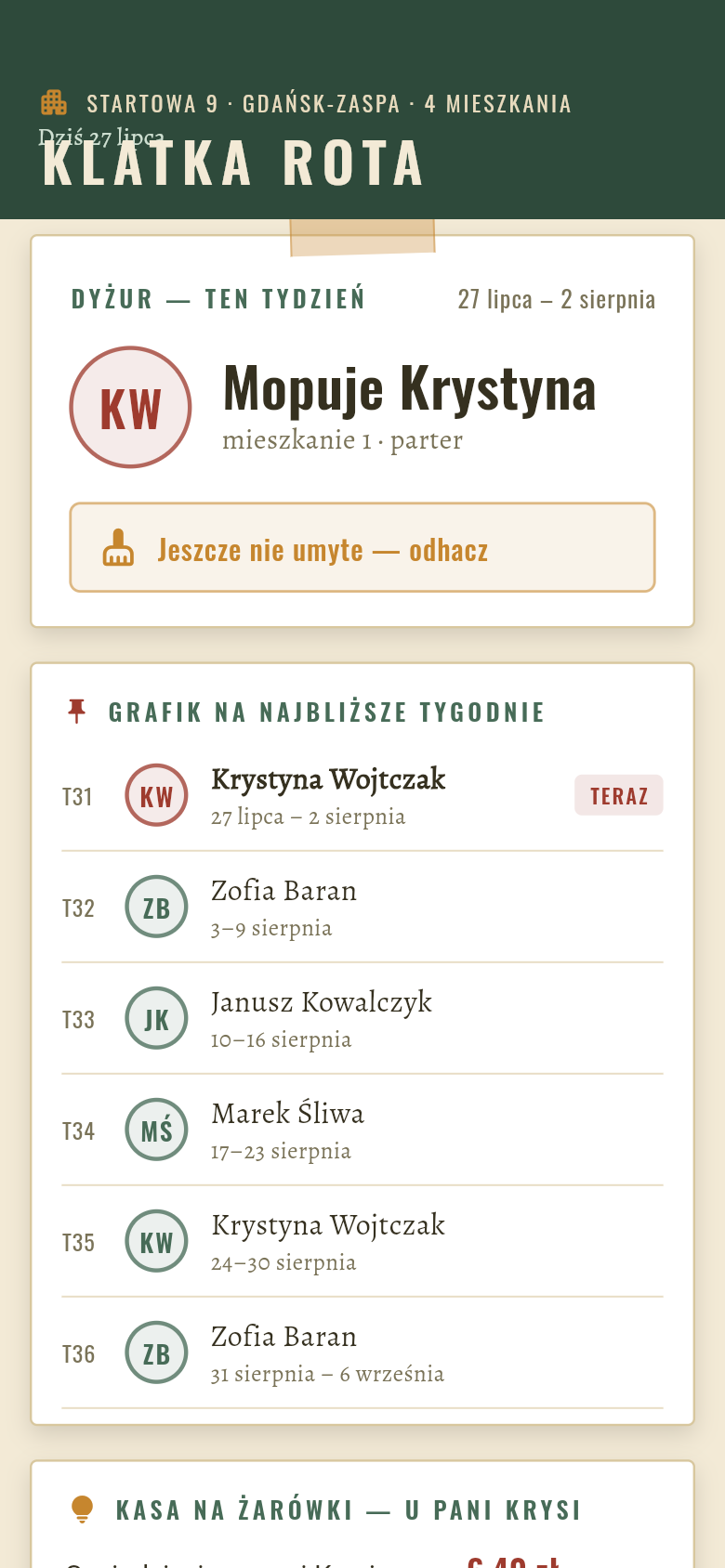
Every Polish klatka has one: a folded sheet of paper taped to the wall by the mailboxes, listing which flat mops the stairwell each week. It works until someone's biro smudges the ink, or the neighbour from the third floor swears it was definitely the second floor's turn. The argument happens on the landing, in slippers, at 8 in the morning.
Klatka Rota is a small app built for exactly this situation. It keeps the grafik, tracks who owes whom for shared costs like landing light bulbs, and works entirely offline. No accounts, no cloud, no subscription. Just the schedule, always readable from your sofa.
Live demo
Open it and know immediately whose week it is
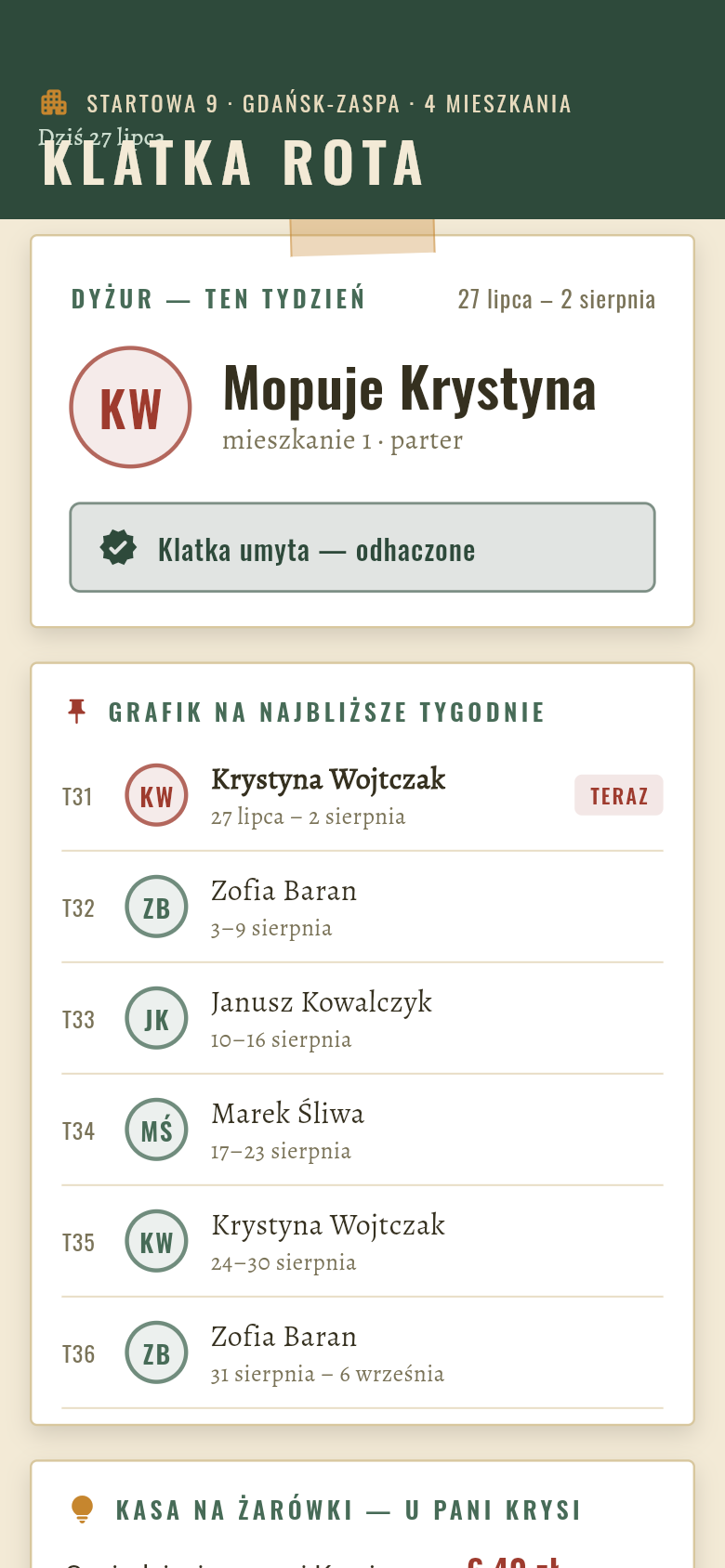
The first screen shows one thing clearly: whose flat is responsible for mopping this week. The current week is highlighted so there is no scanning, no counting rows. If you are the rota keeper for your building, you open the app and you know, before you have put your glasses on.
Below that sits the upcoming schedule, the grafik, a few weeks out. When neighbours swap weeks at the landing, which happens constantly, the keeper can reassign without crossing anything out. The paper grafik was always a negotiation; the app just makes the result stick somewhere cleaner than a whiteboard marker on a sticky note.
The light-bulb ledger that nobody ever had a clean solution for
Shared micro-costs are a quiet source of friction in small blocks. Someone buys a replacement bulb for the landing, or a bottle of stairwell cleaner, and then spends the next two weeks trying to collect two or three zloty from each flat. It is not that anyone refuses; it is just that nobody has exact change, or they forgot, or they were not home.
Klatka Rota keeps a simple ledger for this. When the bulb-buyer fronts the money, the keeper logs it. Each flat gets a small indicator showing what they still owe, and there is a running total so the buyer can see at a glance how much is still outstanding. When someone pays up, the keeper ticks it off. It is the same mental model everyone already uses; it just stops living in someone's head.
Try the app in the frame above
The live version embedded in this page is the real thing. Tap through to see the week view, find the upcoming schedule, and open the ledger. You can tick a week as mopped and mark a debt as settled, exactly as a rota keeper would. Nothing is saved to a server; all state is local to your browser session.
The flows are short by design. A retired resident who checks her phone mainly for messages and weather should be able to use this without a tutorial. The keeper who maintains the grafik should be able to hand it off to a neighbour if she goes on holiday, without any explanation beyond 'here, use this instead of the paper one'.
Why this fits a four-flat building and nothing else does
Property management software exists for buildings with dozens of units, a management company, a maintenance budget, and someone whose job it is to log in. A klatka with four flats has none of that. It has a neighbour who volunteered, or was volunteered, to be the keeper, and a piece of paper.
Klatka Rota sits in the gap. It is not trying to be a building management system. It does not have a calendar integration, a payment gateway, or a group chat. It tracks the rota and the shared costs for a handful of flats, persists everything locally so there is nothing to set up, and runs offline because not everyone has strong signal in an older block's stairwell. The scope is the feature.
Built from an idea in an afternoon
This app started as a one-line description of a problem, the smudged paper by the mailboxes, and was built from that into a working tool quickly. That is what Leanfinit does: you describe the thing you actually need, and it becomes a real app you can open on your phone.
If you have a similar problem, something too small for existing software but real enough that you have been solving it with paper or a shared notes file, you can build your own version. The starting point is a sentence about the problem you want to fix.
39
files in the build
40.5 MB
app bundle
Flutter Web
runs in any browser
Have a problem that paper keeps solving badly?
Describe it in one sentence. Leanfinit turns it into a working app you can use today.