
church
Coffee Hour Rota: Fair Turns for the Parish Volunteers
A simple, offline-first app that shows who brings the koulourakia each Sunday — and makes sure Thea Voula doesn't carry the coffee urn three weeks running.
Artem
Founder
· 5 min read
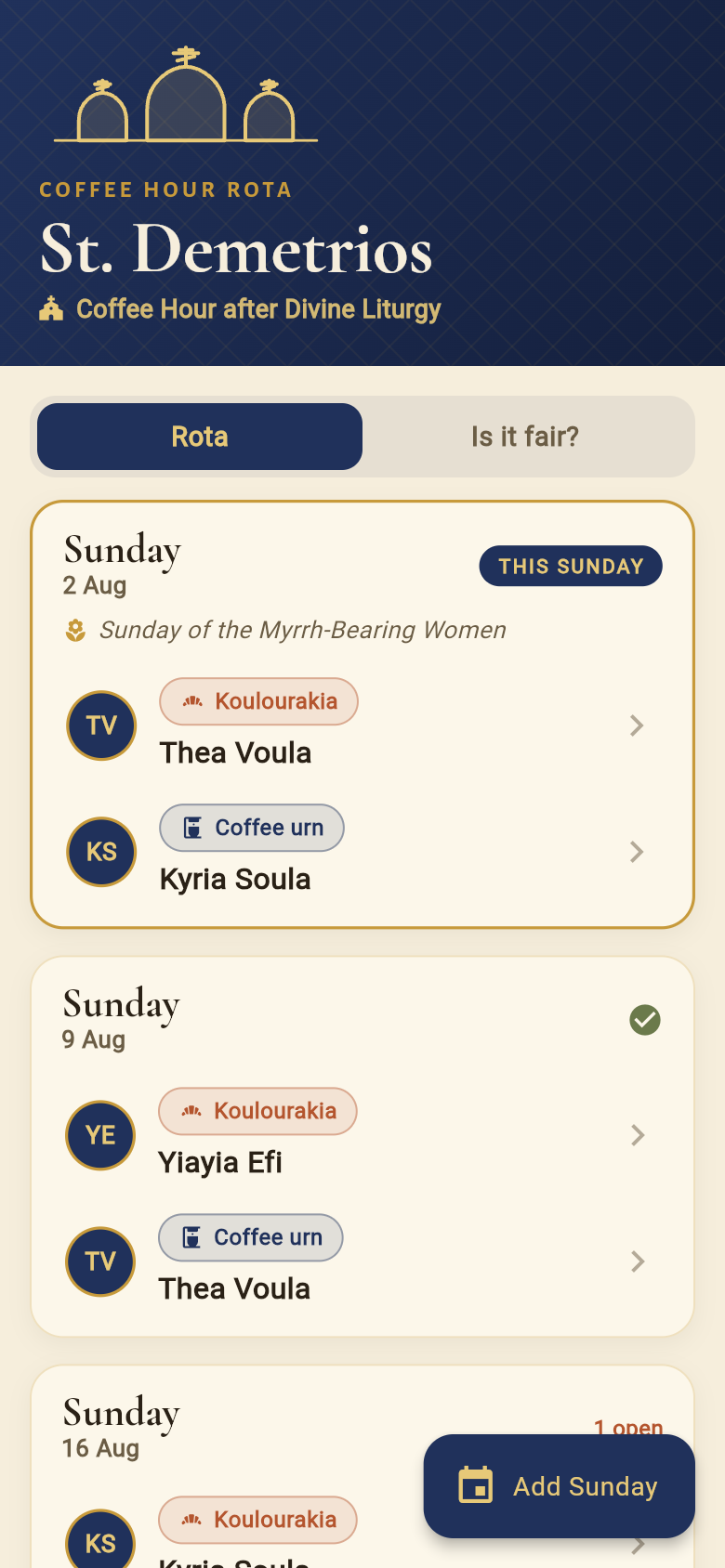
Every Sunday after Divine Liturgy, someone has to set up the coffee urn, someone has to bring the koulourakia, and somehow it always ends up being the same two or three people. Not because they love it most — because they're the ones who won't say no. The paper sign-up sheet on the bulletin board goes out of date by Tuesday, nobody checks it, and by Saturday there's a flurry of phone calls to figure out who's actually coming.
Coffee Hour Rota is a small app built for exactly that problem. It keeps a clear, rolling schedule of upcoming Sundays, shows who has each role, flags when someone is carrying too much, and lets any parishioner sign up or swap a slot in a couple of taps — no account, no internet connection required, no learning curve. It looks and feels like a parish bulletin, not a project management tool.
Live demo
The Problem with the Paper Sheet
A sign-up sheet works fine for a one-time event. For a recurring weekly commitment shared among a rotating cast of volunteers, it breaks down fast. Names get crossed out, someone forgets to update it after they swap, and the sheet itself goes home in someone's bag. The result is invisible imbalance: Thea Voula has served three Sundays in a row, the coordinator doesn't realize it until someone mentions it over loukoumades, and by then there's a quiet resentment brewing in the fellowship hall.
The problem isn't that people are unwilling. It's that there's no shared, glanceable view of who has done what and who is next. Once that visibility exists, most people are happy to step up — they just need to see the gap.
What You See When You Open the App
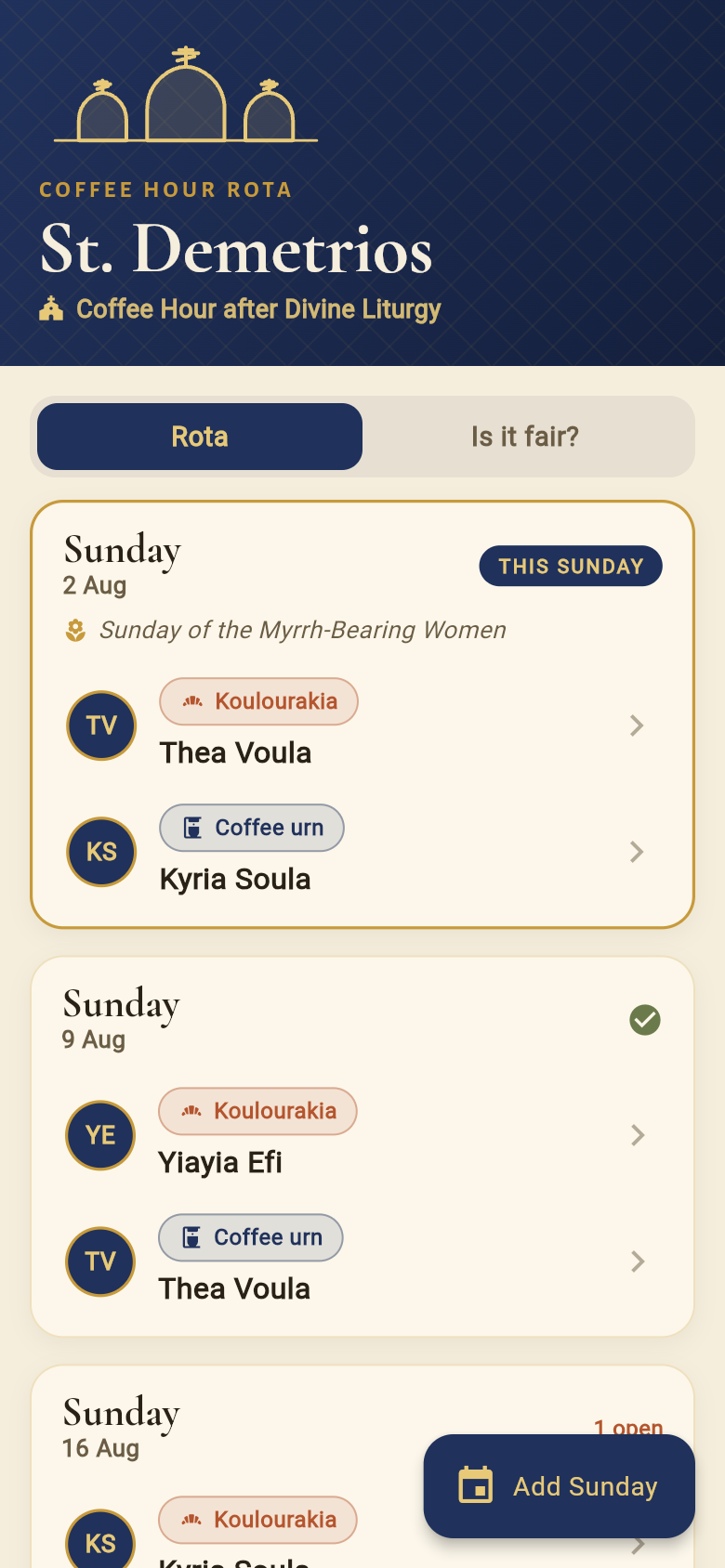
The main screen shows the next several Sundays laid out as a clean list. Each Sunday has two slots: koulourakia (the pastry contribution) and coffee urn (setup and running the urn). Filled slots show the parishioner's name. Open slots show a clear 'Volunteer' prompt — easy to spot, easy to tap.
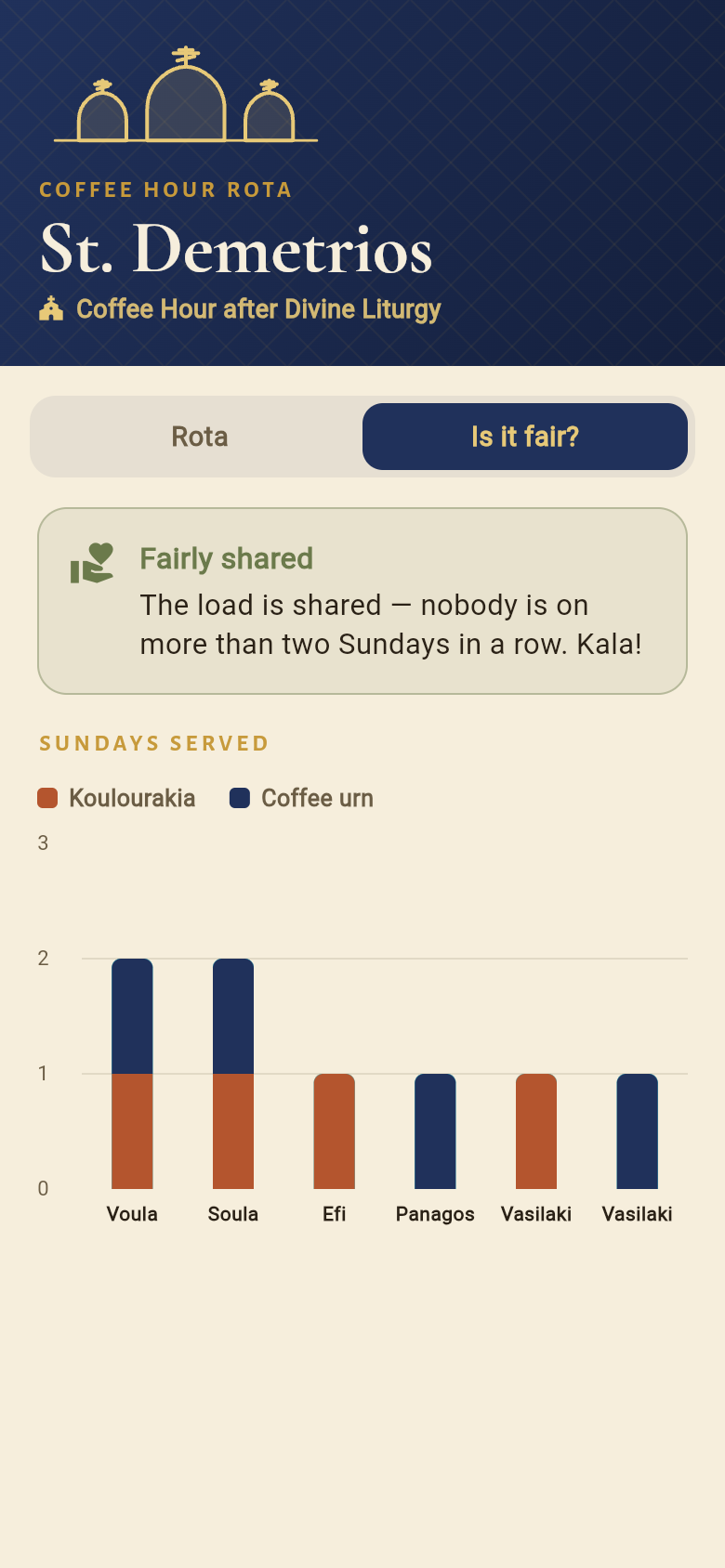
Scroll down a little and you'll see the full picture of who is scheduled when. If one name appears on back-to-back Sundays, a small indicator marks the overload, so the coordinator can reach out before it becomes a problem. Try tapping an open slot in the live demo above and you'll see how quickly a new volunteer can be added — just a name and a tap to confirm.
There's also a quick way to add a parishioner you haven't seen before. New families join, a relative is visiting from Thessaloniki for a few weeks — anyone can be added on the spot and assigned to a slot immediately.
Built Around How Parish Life Actually Works
Parish coordination at a small church is offline and local. The coordinator is a volunteer herself. The yiayias who bring the koulourakia don't have corporate email addresses or time for onboarding flows. The app works entirely offline: everything is saved on the device between opens, nothing is lost when the phone goes to sleep, and there's no account or password to forget.
The visual language is intentional, too. The warm tones, the Sunday headings, the Greek terminology — koulourakia, feast notes for major celebrations — all reflect the context the app lives in. Using a generic calendar tool for this would feel out of place. This feels like it belongs in the parish hall.
For coordinators who want to share the schedule, the app is designed to be passed around. Hand a phone to a parishioner, they see the rota, they tap to sign up, done. No invitation link, no waiting for an account confirmation email.
Fairness Without the Awkward Conversation
The hardest part of volunteer coordination isn't logistics — it's the social awkwardness of telling someone they've done enough for now and asking someone else to step in. A visible rota changes the dynamic. When everyone can see that Kyria Maria has already covered three of the last five Sundays, it becomes natural for others to volunteer. The fairness is in the data, not in a coordinator having to advocate for it.
The overload flag is the most practically useful feature in the app. It doesn't send notifications or generate reports — it just makes the pattern visible at a glance. That's usually enough. People are fair when fairness is easy to see.
From One Idea to a Working Tool
This app started as a single sentence: nobody volunteers for coffee hour and the same yiayias keep getting stuck with it. From that description, Leanfinit built a working, phone-ready tool with the exact features the situation calls for, nothing extra. No accounts, no cloud sync, no analytics dashboard — just a rota that works.
If your parish, neighborhood group, or community organization has a recurring chore with the same invisible imbalance, the same kind of tool can be built from your description. The live demo embedded above is the real app — try signing up for a Sunday, reassigning a slot, or adding a new name and see how it handles the flow.
39
files in the build
40.5 MB
app bundle
Flutter Web
runs in any browser
Your Group Has a Version of This Problem
Whether it's a church rota, a building cleaning schedule, a neighborhood task list, or something else entirely — if the same few people keep ending up with the load, a simple shared tool can fix it. Describe your situation in one sentence and Leanfinit will build the app.