
family
Maya's Hunt: Plan a Treasure Hunt Trail in Minutes
Stop scribbling clues on scrap paper the night before the party. This little app keeps your whole trail in order, tracks what's written, and counts down to go time.
Artem
Founder
· 5 min read
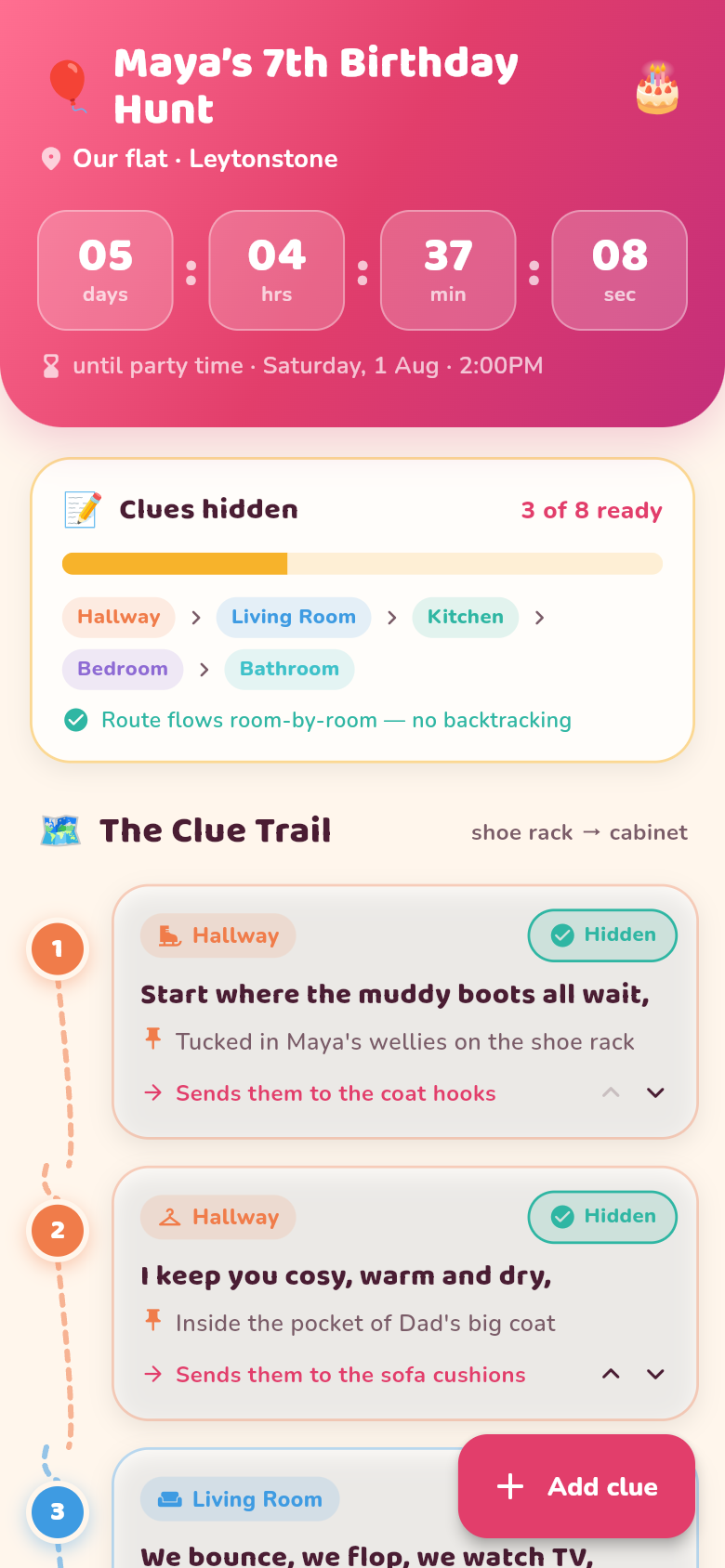
It's the night before the birthday party. You've got eight hiding spots in your head, a rough idea of the riddles, and a kitchen table covered in sticky notes. The problem is that clue four sends the kids to the fridge, which is right next to the pantry where clue two already lives, and now the whole trail loops back on itself. You reshuffle. One rhyme stops making sense. You start again.
Maya's Hunt was built for exactly that moment. It's a focused little planner, one screen for the whole trail, where you can see every clue in order, drag them around until the route flows cleanly from front door to prize, and tick off each clue as you write it and hide it. Try the live version embedded below and you'll have a working trail in the time it takes to finish your tea.
Live demo
The trail, start to finish, on one screen
The hardest part of any treasure hunt isn't writing the riddles, it's the logistics. Which room comes first? Does the route cross itself? Are kids going to blast through the bedroom twice before they even reach the kitchen? Maya's Hunt shows you the whole trail as a numbered list, each clue card showing the room, the hiding spot, and where it points next.
When you open the app you'll see a ready-made eight-clue trail seeded with real spots around a home: the bookshelf, the bath, under the stairs. Scroll through it. The sequence already tries to keep things moving in one direction. Drag a card to a different position and you can immediately see whether the route now doubles back somewhere it shouldn't. That single view, the whole trail at once, is the thing that was missing from the sticky-note method.
Reorder without breaking the logic
Every clue is a pointer. Clue three doesn't just describe a hiding spot, it has to point toward the next one. The moment you move clue three, the chain shifts. In the paper version, that means reading through every card again from scratch to check nothing's broken.
In the app, each card shows its 'points to' field alongside the room and spot. When you drag clue three below clue five, you can see in one glance whether the updated sequence still flows. Edit the 'points to' text right there, tap done, and the trail is consistent again. It sounds small. At eleven at night with a party starting at noon, it's the difference between a trail that works and one that kills the momentum three clues in.
Track what's written, what's hidden, what's left
There are two distinct jobs the morning of a treasure hunt: writing the clue papers (often from memory, which means typos and crossed-out lines) and actually hiding them. Maya's Hunt gives each clue a two-stage checkbox, written and hidden, so you can move through the flat systematically rather than trying to hold both lists in your head.
The countdown timer at the top of the screen ties it all together. Party starts at two o'clock. It's half eleven. You have four clues written, two hidden, and the timer tells you exactly how long the remaining prep has to fit into. That quiet piece of information, how long you actually have, turns vague anxiety into a manageable checklist.
Tap into the app now and try checking a clue off as written, then hidden. Notice how the card changes state. It stays visible in the trail rather than disappearing, so you can still see the sequence clearly while you work through the flat.
Add a clue, fix a rhyme, change a room
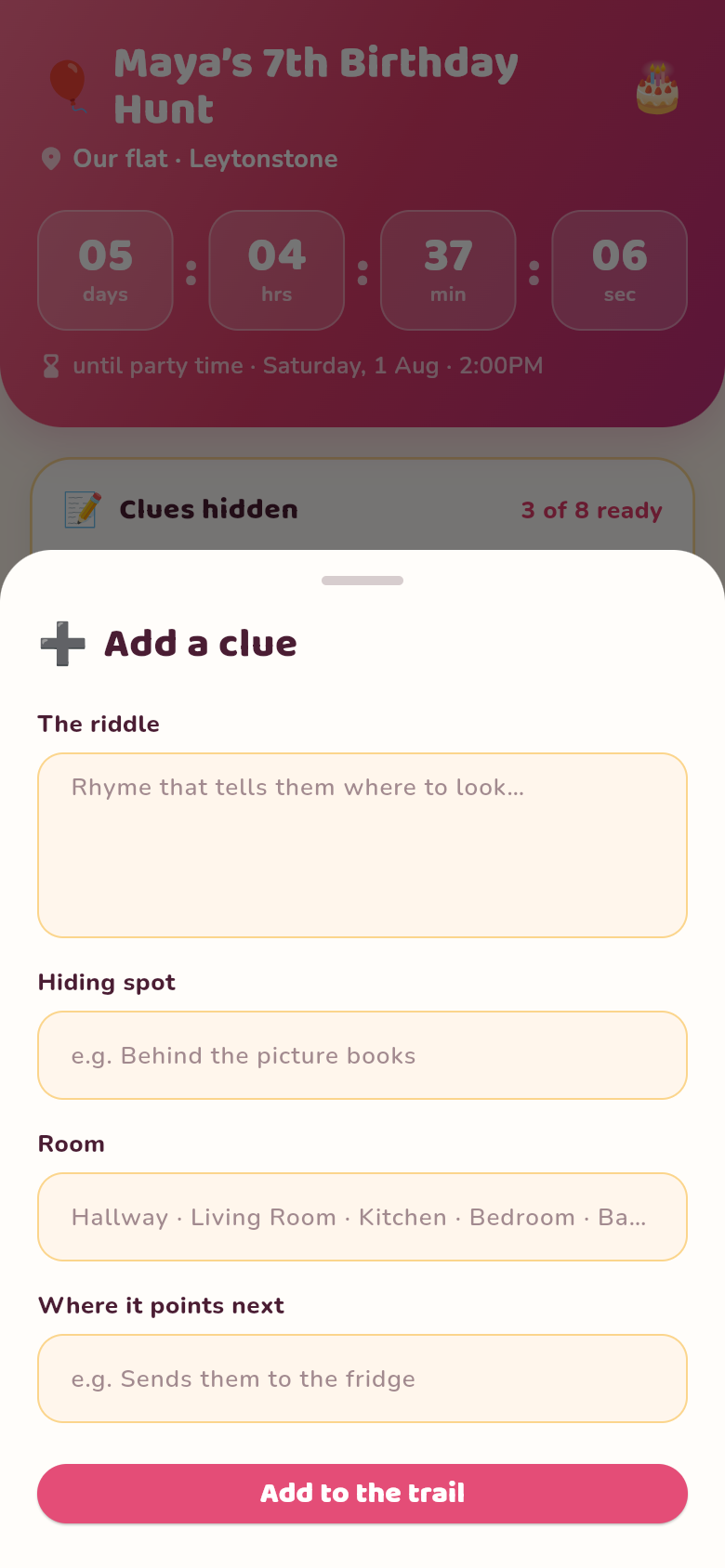
Editing any clue is a tap away. Each card opens a small form: the riddle text itself, the room, the hiding spot, and the 'points to' field. You might realize the bookshelf clue rhyme doesn't quite scan, or that you want to add a ninth clue because the living room is big enough to have two stops. Both take about twenty seconds.
The app ships with a real set of clues, not placeholder text, so even if you're blanking on rhymes you have something to work from and adapt. Swap in your child's name, adjust the spot to match your actual flat, and the clue is yours. That starting point, real clues you can edit rather than a blank form you have to fill from nothing, is what makes the difference at eleven at night.
Built from one idea, ready the same afternoon
Maya's Hunt started as a single sentence: a parent needs a way to plan an eight-clue treasure hunt around their flat without the trail looping back on itself. From that sentence, the app was put together in a single session. The trail view, the drag-to-reorder, the written/hidden checklist, the countdown, the inline clue editor, all of it follows directly from the actual problem.
That's the thing about a focused tool built around one specific job. There's no clutter, no onboarding screens, no account to create. You open it, you see your trail, you get the party ready. If you're reading this the night before a birthday, scroll up to the live demo, replace a clue or two with your own spots, and you're done.
39
files in the build
40.5 MB
app bundle
Flutter Web
runs in any browser
Have an idea for your own tool?
Describe the problem you're trying to solve, one sentence is enough, and Leanfinit will build you a working app around it.