
tools
Shed Loans: Tracking Shared Tools on Miller Pond Road
Five houses, one shared tool shed, and a chainsaw that's been 'somewhere down the road' for two weeks. This app fixes that with a simple, offline lend-and-return log.
Artem
Founder
· 5 min read
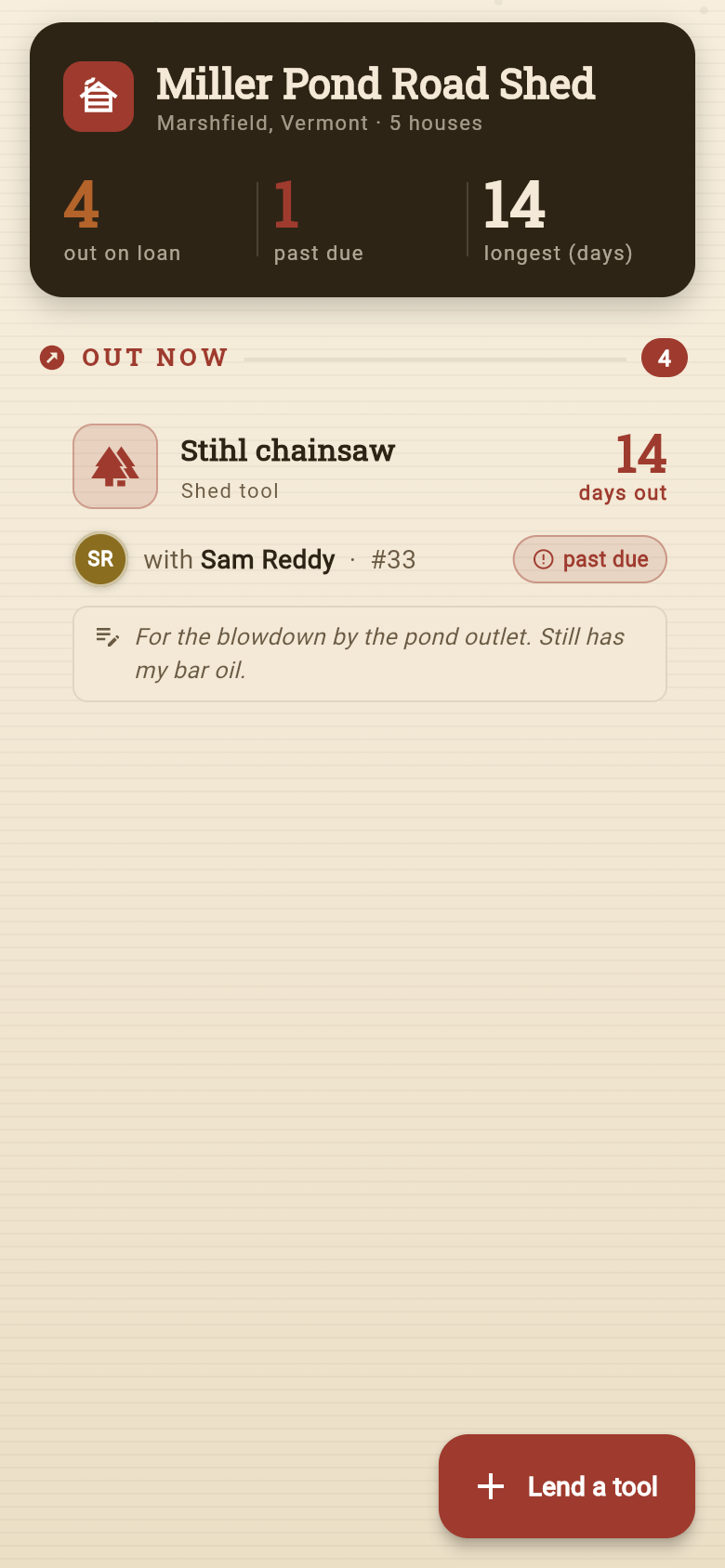
On Miller Pond Road in Vermont, five households share a tool shed the way neighbors have always shared things: on the honor system, with a handshake, and a vague promise to bring it back by the weekend. It works fine until the chainsaw has been 'somewhere down the road' for two weeks and nobody can remember who took it. The tracker, whoever plays that role, has to either call around or just hope it shows up.
Shed Loans is a small app built for exactly that person. It keeps a running list of what's out, who has it, and how long it's been gone. No spreadsheet, no group chat, no scrap of paper tacked to the shed door. Just a clear, honest record that lives on one phone and works without any internet connection.
Live demo
The problem is smaller than it sounds, and more annoying
Shared tools don't go missing because neighbors are irresponsible. They go missing because borrowing is informal and verbal, and nobody keeps a written record. You mention it when you grab the log-splitter, and the person you mentioned it to forgets by Tuesday. Three weeks later the tracker needs the splitter for a cord of firewood and has to think: was it Terry, or was it the Hendersons?
Some tools make this worse. Dale's extension ladder belongs to Dale, not the shed, so when it disappears it's not just inconvenient, it's someone else's property. The pressure to track returns is higher, but the system for doing it is the same: nothing.
The app you see embedded here was built from a description of that exact situation. Try scrolling through the tool list, tapping a loan to see its details, or recording a return. The flows are short on purpose because the real-world action is short.
What the app shows you the moment you open it
The main screen is a single list: every tool currently out, sorted so the longest-overdue ones sit at the top. The two-weeks-gone chainsaw doesn't hide in the middle. It's flagged and front and center, which is the only reason to build an app instead of a note.
Each row tells you the tool name, which house has it, and how many days it's been out. If a promised-back date has passed, the row turns visually loud. You don't have to calculate anything or remember when it was taken.
Below the active loans, there's a ledger of recent returns. This matters more than it sounds. When the same tools cycle through a small group of households over months and years, a short history makes the whole system feel trustworthy. You can see that the post-hole digger came back fine last October. That context makes people more comfortable lending again.
Recording a loan or a return takes two taps
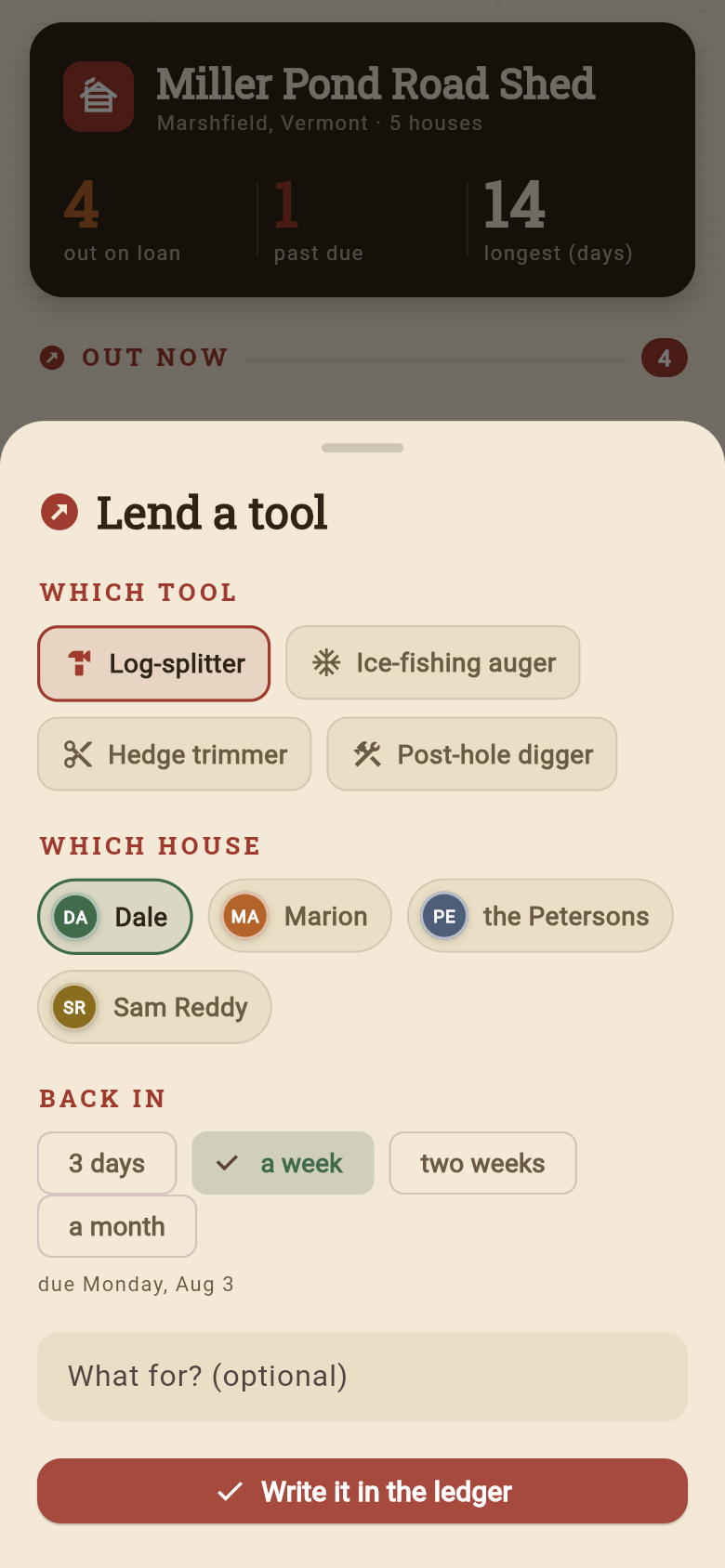
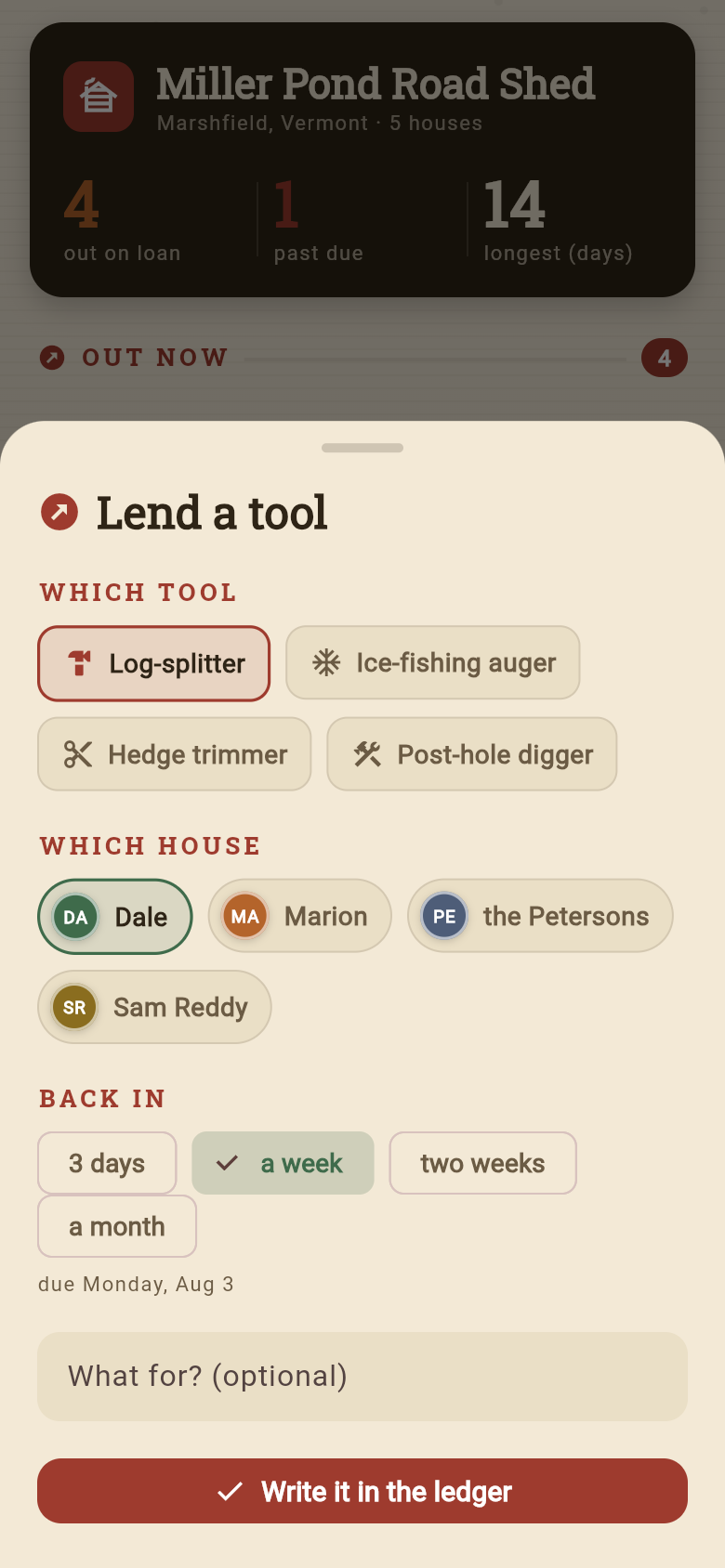
When someone knocks on the shed door and borrows the shop vac, you open the app, hit the lend button, pick the tool, pick which house, and set a date you expect it back. Done. The whole thing takes about ten seconds, which is the only speed that works when someone is standing there with a hand on the shop vac handle.
Marking a return is the same: find the tool in the list, tap return. The app moves it out of the active loans and into the history ledger with today's date. If a tool doesn't appear in the list because it was added before you had the app, you can add it on the spot.
There's no account, no login, no sync. The data lives on the phone. For a five-household shed on a quiet road, that's exactly right. The tracker is one person. The app is their tool, not a shared platform.
Why offline matters here
Rural Vermont is not always well-served by cell coverage, and the shed is probably not next to a router. An app that needs a connection to load its data is useless at the exact moment you need it: standing in the shed, trying to remember whether the splitter is at Terry's or the Hendersons, before you go drive over to get it.
Shed Loans remembers everything between opens and works with no signal at all. Open it in the shed, on the road, in the barn. The list is always there.
Built from a one-line idea, shaped around a real situation
This app started as a description of a problem: five houses, one shed, a chainsaw nobody can locate. From that, a working app with a full lending ledger, overdue flags, and offline storage was built in minutes. The live version embedded in this article is the real thing, running in your browser inside a phone frame. You can add a fake loan, mark it returned, and see the history update.
The specific details matter here. The overdue flag exists because of the chainsaw situation specifically. The history ledger exists because of Dale's ladder specifically. A generic 'inventory app' wouldn't have those priorities. Matching the app to the actual friction is what makes it useful rather than just functional.
39
files in the build
40.5 MB
app bundle
Flutter Web
runs in any browser
Have a shared shed of your own?
Describe your situation in one sentence and get a working app built around it. No spreadsheet, no monthly fee, no features you don't need.