
dementia care
Nonna's Days: Tracking Clarity Between Memory Clinic Visits
A simple daily log that turns a caregiver's scattered notes into a four-week picture of a grandmother's cognition, ready to share at the next appointment.
Artem
Founder
· 5 min read
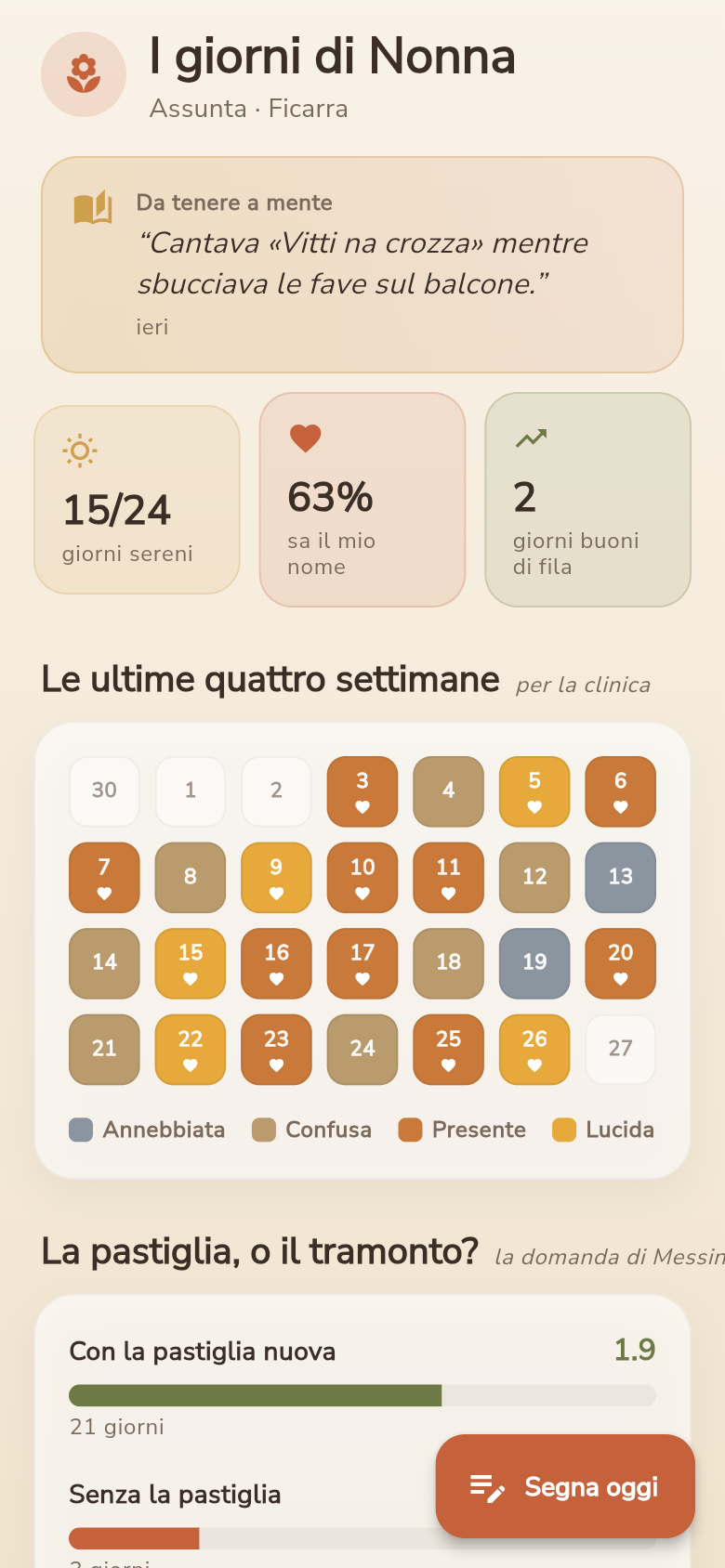
When her Nonna Assunta was diagnosed with Alzheimer's, Sofia started keeping a notebook. A small spiral-bound one she carried everywhere. She'd jot things down at the kitchen table after visits: 'Called me by my uncle's name again. Agitated after 4pm. But this morning she laughed at an old joke and said it herself.' The notebook filled up fast, and when the memory clinic asked how the new tablet was going, she'd flip through pages trying to remember if things were better or worse.
Nonna's Days turns that notebook into something a clinic can actually use. You rate each day on a simple human scale, note whether she knew your name, capture one moment worth keeping, and record whether she took the new medication. Over four weeks, the app draws a clarity heatmap and shows you the pattern. Was sundowning more frequent before the tablet? Are the clear mornings getting clearer? Try scrolling through the calendar embedded here and you'll see what Sofia sees.
Live demo
One question that matters most
Every caregiver develops their own shorthand for a good day versus a bad one. For Sofia it was the name test: did Nonna call her Sofia, or did she call her by someone else's name, or not recognize her at all? That single moment, repeated day after day, is one of the most emotionally weighted and diagnostically useful signals a family can track.
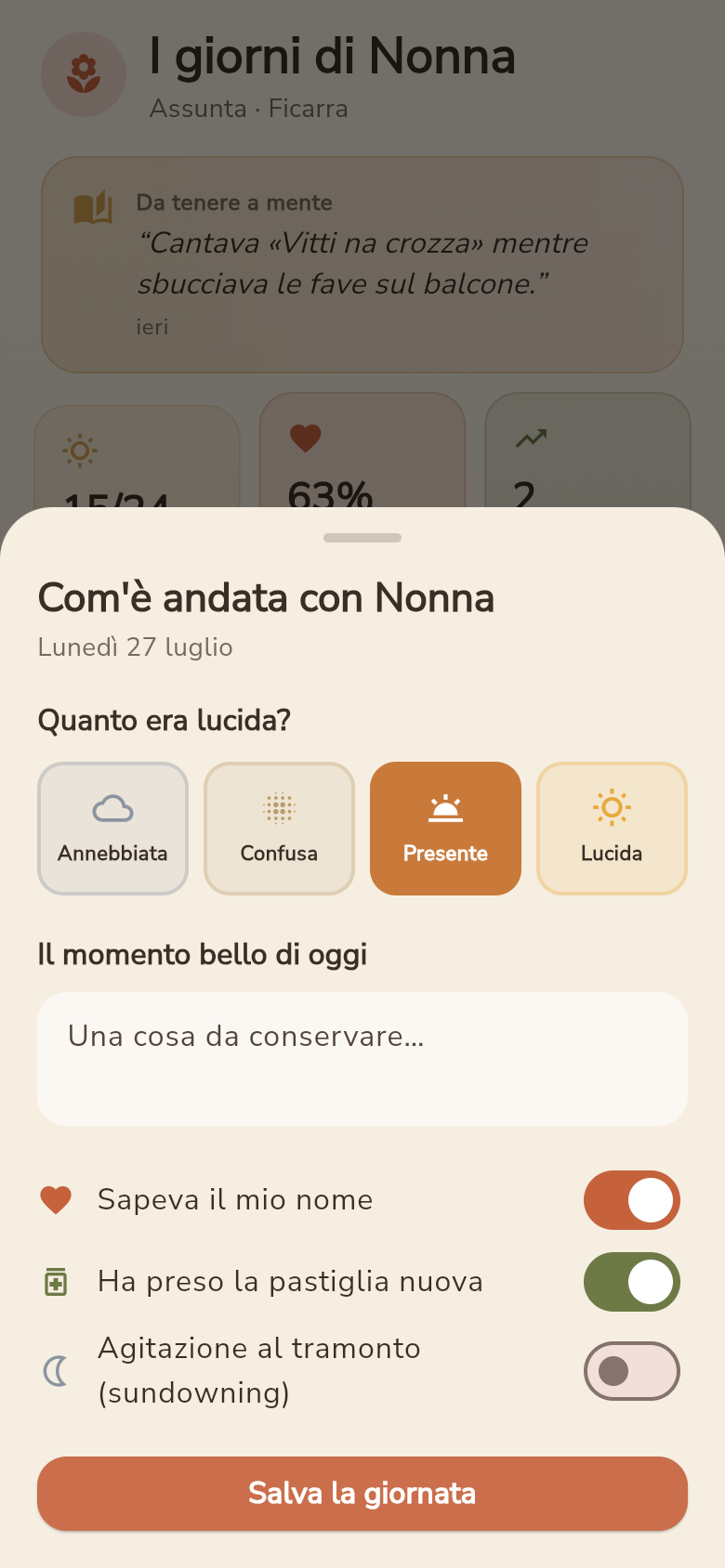
The app builds its daily entry around exactly this. You tap in your clarity rating, mark whether she knew your name, and there's space for one specific moment, a detail that's worth remembering. Not a medical report. Just: 'She asked me to sit and have coffee. She was herself.' The entry takes under a minute, which matters when you're also managing medications, appointments, and everything else.
Tap today's date in the app above and try filling in an entry. The rating scale is deliberately human, not clinical. You'll see what it feels like to use it every day.
The heatmap your clinic actually needs
The hardest part of a memory clinic appointment is the summary question: how has she been? Caregivers are exhausted and working from memory themselves. They know things have changed, but they can't always articulate the shape of the change.
The four-week heatmap changes that. Darker squares are harder days; lighter ones are clearer. When you bring the app to an appointment, the pattern is immediately visible. Three difficult afternoons in a row last week. A run of better mornings after the tablet dose was adjusted. The clinic isn't guessing anymore, and neither are you.
New cholinesterase-inhibitor medications like donepezil can take several weeks to show a clear effect. The app tracks which days the tablet was taken and overlays that against the clarity trend. You might not notice the shift day to day, but the heatmap will show it, or show that it hasn't happened yet, which is equally important information.
Sundowning, named and tracked
Sundowning is one of those things caregivers discover before they have a word for it. Late afternoon arrives and something changes. Nonna becomes restless, or confused about where she is, or more agitated. It feels random until you start tracking it and realize it's almost a daily pattern.
Each daily entry in the app includes a sundowning flag. Over weeks, the calendar view makes the time-of-day pattern hard to ignore. You might find it correlates with whether she napped, or when she ate, or with the medication timing. You might find it's unrelated to all of those. Either way, you have something concrete to discuss rather than a vague impression.
Scroll through the sample history already loaded in the app above. You'll see days marked with afternoon agitation alongside days that were clear all the way through. That contrast is the kind of data that helps a neurologist make a real decision.
Private, offline, and never empty
This kind of log only works if you trust it with the hard days and the sad moments. Nonna's Days runs entirely offline. Nothing leaves your device. There's no account, no cloud sync, no one reading your entries. The good moments you record and the difficult ones stay with you.
The app also comes seeded with four weeks of realistic sample history, so when you first open it, you're not staring at a blank calendar wondering where to start. You can see immediately how the heatmap reads, what a full month of entries looks like, and how the medication contrast chart works. Then you start replacing the sample entries with your own.
The screenshots here show the clarity calendar and the day entry screen side by side. The live embed above lets you interact with both.
What this app is, and what it isn't
Nonna's Days is a documentation tool for a family going through something hard. It doesn't give medical advice, doesn't diagnose anything, and doesn't replace the memory clinic. What it does is give caregivers a way to show up to those appointments with four weeks of organized observations instead of fragments from a notebook.
Sofia described the problem simply: she knew something was changing with Nonna, she just couldn't explain it clearly. Now she can hand her phone across the desk and let the heatmap speak for itself. That's the whole point. Not to add more work to a caregiver's day, but to make the work they're already doing visible and useful.
39
files in the build
40.7 MB
app bundle
Flutter Web
runs in any browser
Have a tool you need built?
Nonna's Days started as a one-line idea: a clarity log for dementia caregivers, ready to show at clinic appointments. If you have a specific problem you're solving for yourself or your family, you can describe it and have a working app the same day.