
welsh
Emyn Practice: Drill Welsh Hymns Before the Cymanfa
A quiet tool for chapel singers who know every tune but blank on the words when it matters — built around twelve real hymns and your shakiest verse.
Artem
Founder
· 5 min read
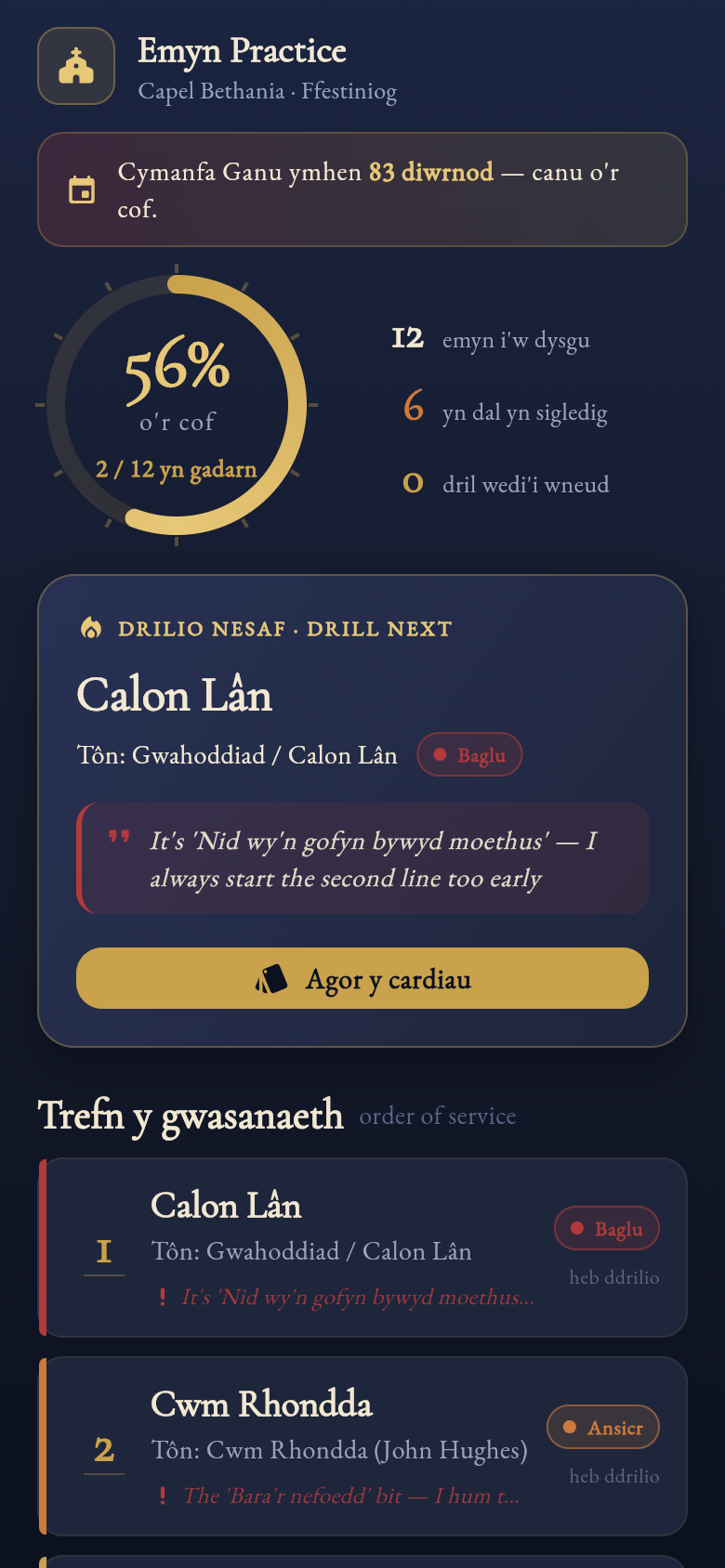
The Cymanfa Ganu at Capel Bethania is pencilled in the diary. The order of service is pinned to the vestry noticeboard. Twelve hymns, sung from memory, the whole congregation together. You know the tunes — you have known them since childhood — but when the organ strikes up Blaenwern, certain lines dissolve and you mouth along, hoping no one notices.
Emyn Practice was built for exactly that situation. Open it in the vestry, on the bus to Ffestiniog, or at the kitchen table on a Tuesday evening. No signal needed, no account to create. Just the twelve hymns, your honest confidence rating for each one, and the line you keep fumbling waiting on screen whenever you need it.
Live demo
The problem with learning Welsh hymns whole
Most singers do not need to re-learn a hymn from scratch. They know the shape of it. They know when the melody lifts and when it drops back. What trips them is a particular phrase in the second verse, or the transition into the final chorus — the moment where muscle memory runs out and the words are supposed to appear and do not.
Practising the whole hymn again from the top is inefficient and a little demoralising. It buries the one hard line inside three minutes of singing you already have right. Emyn Practice works differently: it lets you flag exactly which line you keep stumbling on, and it will quote that line back to you on every practice run so you cannot skate past it.
The app knows you by tune name, not by hymn number. Calon Lân, Cwm Rhondda, Blaenwern — these are the handles chapel singers actually use, and the app uses them too.
What you will see when you open it
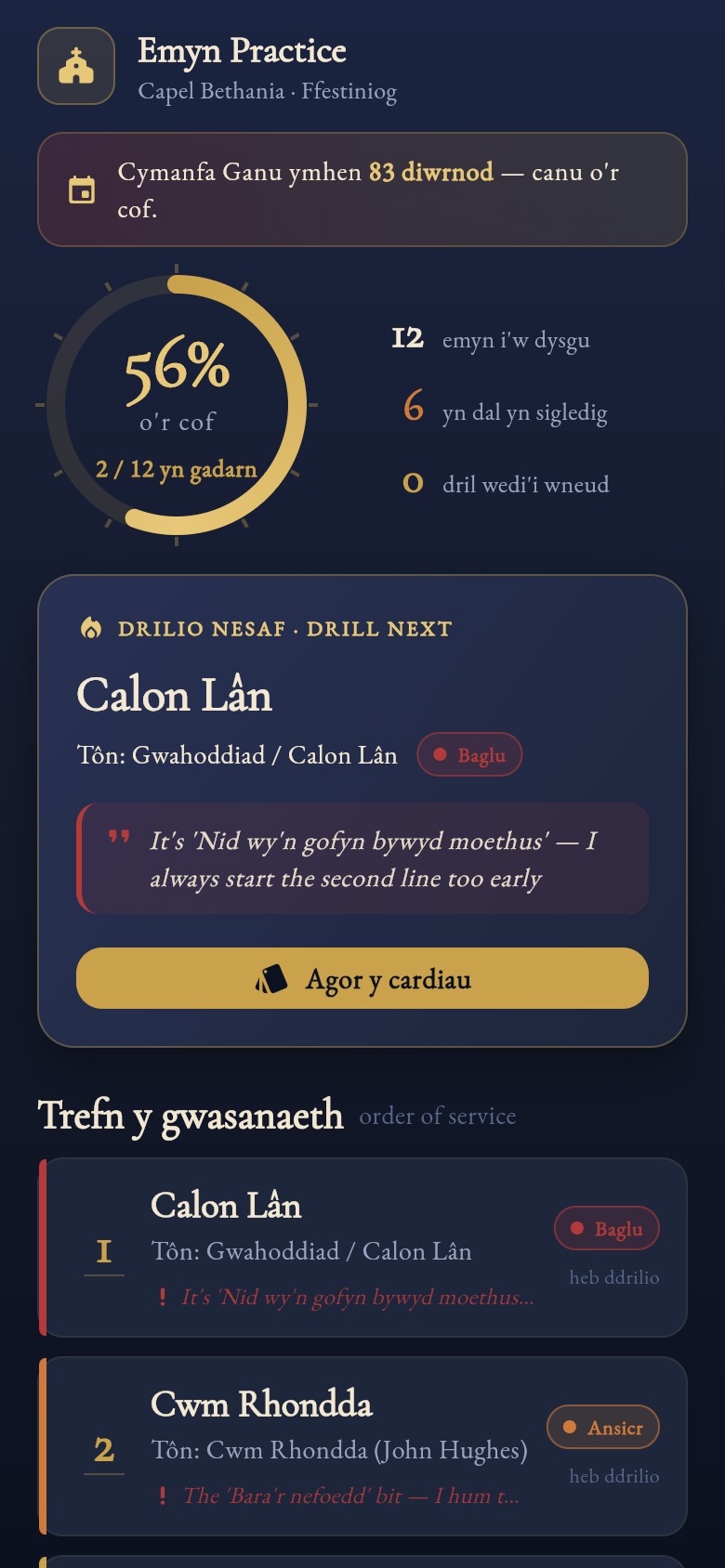
The first screen is not empty. All twelve October hymns are already loaded — traditional tunes, Welsh verses in full — so there is nothing to set up and nothing to import. The one surfaced at the top is whichever you last rated as your shakiest, so the hardest work comes first rather than getting shuffled to the end of a session.
Each hymn opens to its Welsh text, verse by verse. Tap the flip button on any line and a plain English gloss or mnemonic appears on the reverse — not a translation in the literary sense, just enough of a hook to stop the blank. When you have drilled a verse, you rate your own confidence on a simple scale. The app remembers that rating and reorders your practice queue accordingly.
The interface itself is in Welsh, with light English glosses for any term that might catch a learner mid-thought. It is a small thing, but it means the tool does not feel like an outsider's approximation of chapel culture. Try the demo below and you will get a sense of the rhythm: hymn list, select a tune, drill a verse, flip for the hint, rate yourself, move on.
Built for a vestry without Wi-Fi
Rural chapels in Gwynedd are not always well served by mobile signals. The practical constraint was taken seriously from the start: Emyn Practice stores everything on-device. Your confidence ratings, your flagged lines, your practice history — none of it needs a connection, and none of it lives on a server you do not control.
There are no accounts and no passwords. You open the app and you are straight into the hymns. When the organist wants a quick run-through before the doors open, you can pull the app out and use it without waiting for anything to load.
This also means the app is genuinely private. Chapel singing is social, but the anxiety about miming through a verse you cannot recall is personal. Practising alone, on a device that does not phone home, feels different from practising in front of a log-in screen.
A deadline that focuses the mind
Cymanfa Ganu has a fixed date. That is unusual for a memorisation task — most language or music practice apps are open-ended, designed for ongoing habit. This one is built around the knowledge that there is a Sunday in October when you will stand in a pew and either sing or mime.
That deadline changes how the confidence ratings feel. When you mark Nid Wy'n Gofyn as shaky, the app is not just logging a preference — it is telling you where to spend the remaining sessions before the festival. The queue reorders around your gaps, not around whatever you feel like practising. It is a gentle version of spaced repetition, calibrated to a real event rather than an abstract retention curve.
If you work through the twelve hymns steadily over a few weeks, rating honestly each time, you will arrive at the Cymanfa knowing precisely which lines you have drilled and which ones still need a run. That is a different feeling from hoping for the best.
From a one-line idea to a working tool
The whole app came from a single description: a chapel-goer in Ffestiniog who keeps miming through the words. From that, Leanfinit built a working, interactive tool — twelve hymns seeded, offline-first, Welsh UI, confidence tracking — in one session. No template, no assembly required.
If you have a similar problem that is too specific for a general app — a fixed deadline, a niche community, a task that only makes sense if someone already knows the context — that is exactly the kind of thing this approach is good at. The demo above is the real app. Try it, drill a verse, flip a card. If it feels like the kind of tool that should exist for your own situation, the link below is where you start.
39
files in the build
40.5 MB
app bundle
Flutter Web
runs in any browser
Have a tool only you need?
Describe the problem in a sentence — who you are, what you are trying to do, what keeps going wrong. Leanfinit builds the app from that.