
family recipes
Nonna Assunta's Recipe Cards, Saved Before They Fade
A 91-year-old's Scannese dialect recipes were unreadable to younger family members. This app turns fragile handwritten cards into a living family archive.
Artem
Founder
· 5 min read
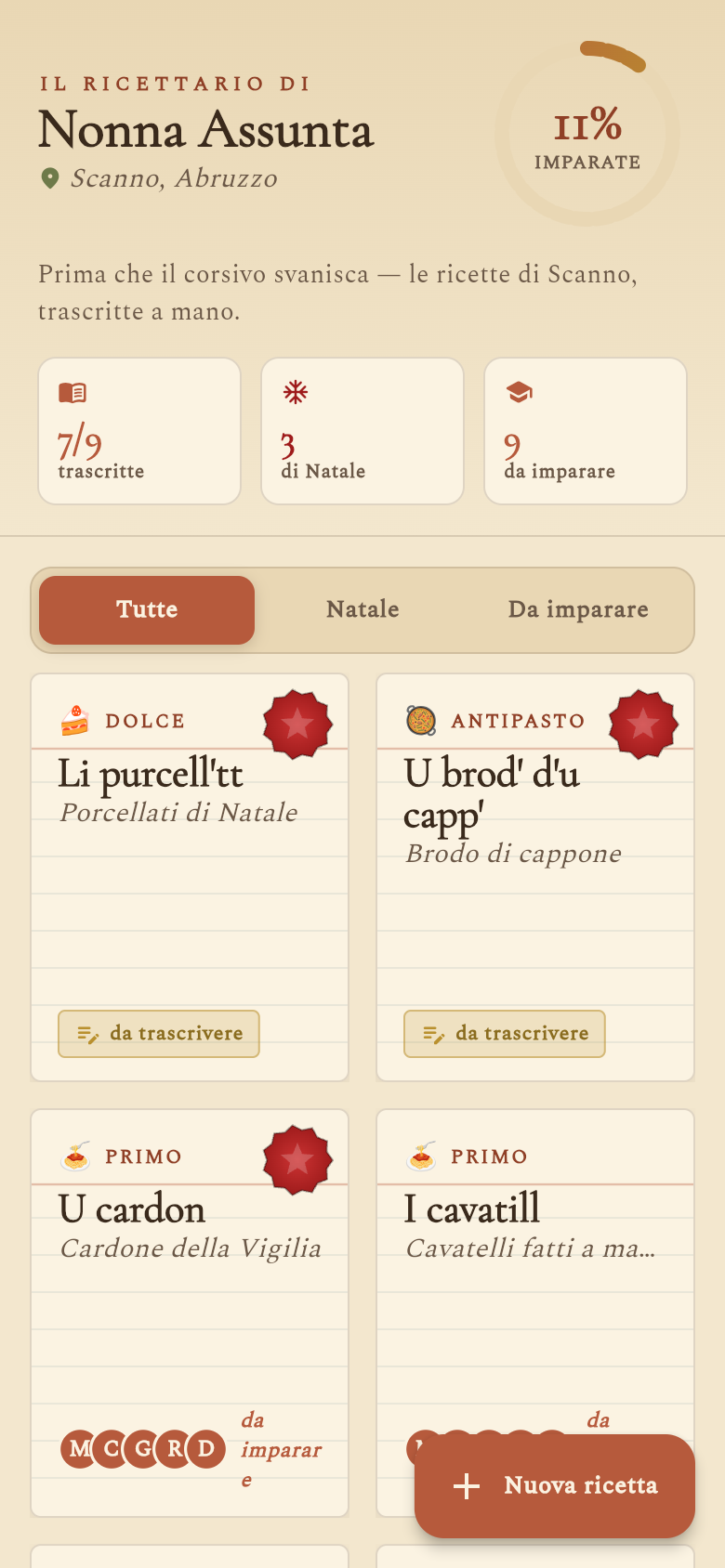
Nonna Assunta is 91. She learned to make cavatelli by watching her own grandmother's hands, and she wrote her recipes in a cursive Scannese dialect that nobody under 70 in the family can read. The cards are soft at the edges now, the ink going pale. Her granddaughter knew that once those cards became illegible, the recipes would be gone, not just from the family table but from the world.
This app started as a single practical question: where do we put this knowledge before we lose it? The result is a quiet, offline recipe archive built around one family's actual dishes, with the Christmas-only ones clearly marked and a running record of which grandchildren have actually learned to make each one.
Live demo
The problem with handwritten recipe cards
Physical recipe cards are surprisingly fragile. Grease, steam, and decades of handling soften the paper and blur the ink. But the bigger challenge with Nonna Assunta's cards was the language itself: Scannese is a local dialect from the mountain town of Scanno in Abruzzo, with its own spellings and terms that standard Italian dictionaries don't carry. Even family members who speak Italian fluently find the handwriting opaque.
The usual solutions don't quite fit. A shared notes app means a cloud account and an internet connection. A recipe website is built for discovery, not preservation. What the family needed was something that felt more like a private archive: no sign-up, no feed, no suggestions, just the recipes themselves.
What you can do in the app
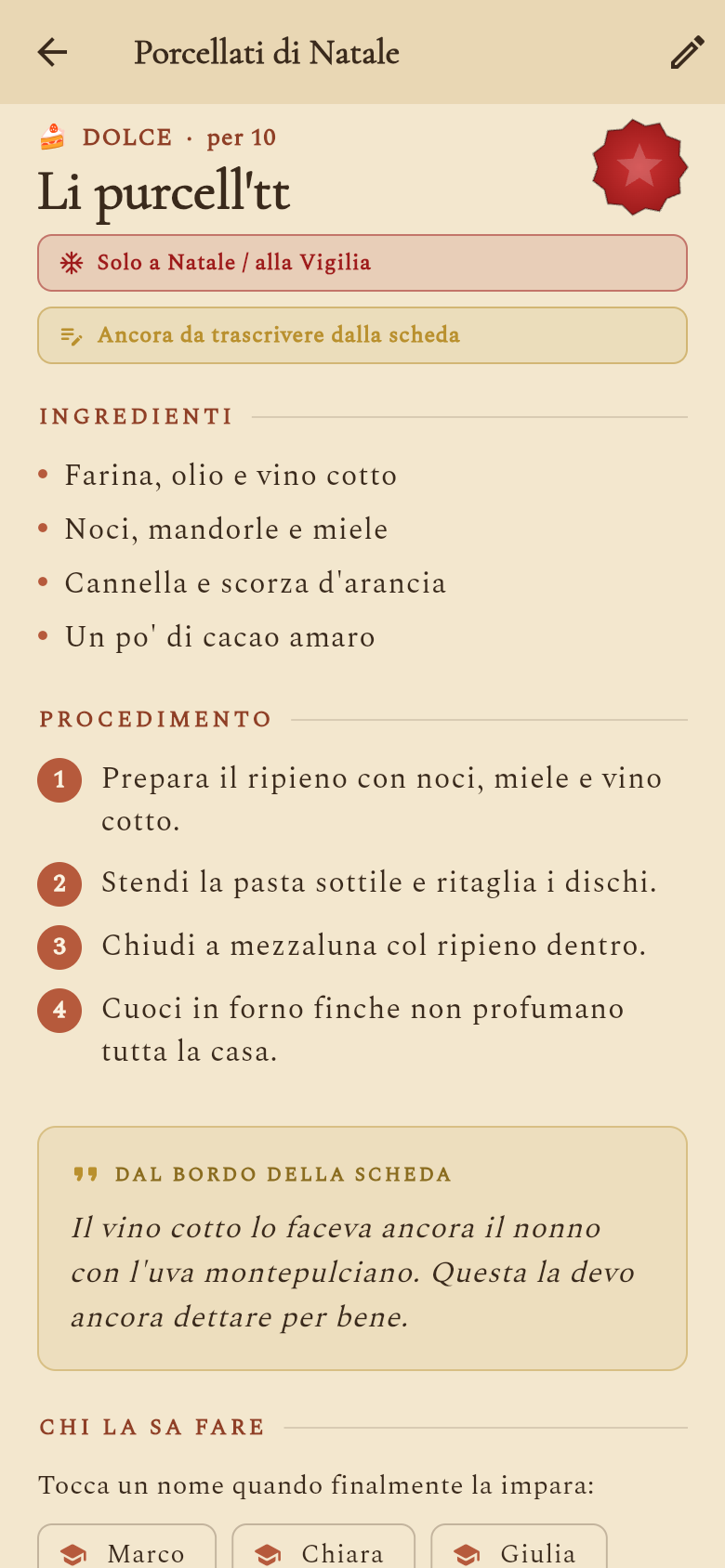
Each recipe entry holds both names: the dialect name as Nonna Assunta wrote it, and the standard Italian equivalent so younger family members can follow. You type in the ingredients, the steps, and a personal note, which is where the real texture lives. One card might note that Nonna always adds a pinch more peperoncino than the recipe says, or that this dish only works with the pecorino from a specific shop in Scanno.
Christmas-only and feast-day recipes get a visual flag so they stand out immediately. In an Italian family, the Vigilia dishes and the Christmas lunch plates carry a different weight than everyday cooking, and the app treats them that way. You can browse the archive and tell at a glance which recipes belong to the feast calendar.
The part of the app that surprised the family most was the learning tracker. For each recipe, you can list the family members who still need to learn it and mark them off when they do. Cavatelli, for instance, had five names on it. As cousins visit and spend an afternoon in the kitchen, they get checked off. It turns out that tracking who has inherited what is something the family was already doing in their heads; the app just makes it visible.
Try it in the frame below
The live demo is seeded with real recipes in the style of the family archive: dialect names, personal notes, feast-day tags, and the learning tracker already populated with names. Tap into any recipe to see how the detail view is laid out. Try marking a family member as learned, or browse the Christmas dishes by their flag.
The app works fully offline. There is no empty loading state, no spinner waiting for a server. You open it and the archive is there, the same way a box of recipe cards would be.
Why this works better than a generic recipe app
Most recipe apps are built for cooks who want to discover new dishes. This one is built for a family that already knows what it wants to preserve and needs a place to put it that will still work in ten years without a subscription or a login. The offline-first design is a deliberate choice: the recipes belong to the family, not to a service.
The dialect-name field is a small detail that carries a lot of meaning. When you record 'ciciulelle' alongside 'cicerchie', you're preserving not just the ingredient but the word Nonna Assunta uses for it, the way the language sounds in her kitchen. That's the kind of thing a generic app would strip out in favor of standardization.
The idea took shape in an afternoon and the app was built the same day. That speed matters here: the urgency around Nonna Assunta's cards is real, and the family didn't have months to wait for a custom software project.
Keeping the recipes alive
An archive like this works best when it's used regularly, not just built once. The goal isn't to finish transcribing the cards and put the app away; it's to reach a point where the cavatelli recipe has all five names checked off, where a grandchild in another city can open the app and make the Christmas eve fish dish without calling for help. The app is a scaffold for that ongoing process.
Nonna Assunta's handwriting may keep fading. But the recipe for cavatelli, with her note about the peperoncino and the list of grandchildren who still need to learn it, doesn't have to fade with it.
39
files in the build
40.5 MB
app bundle
Flutter Web
runs in any browser
Have something worth preserving?
If there's a person in your family whose knowledge lives only in their hands and their memory, you can build a tool around it. Describe the problem in one line and see what comes back.