
folk art
Madhubani 40: Tracking 40 Wedding Panels to Beat the Chhath Deadline
Priya paints 40 Mithila panels for her cousin's wedding wall in short nightly sittings. This small app keeps count so she never loses the thread.
Artem
Founder
· 5 min read
Forty panels. Three motifs. One wedding wall. And a deadline that arrives with Chhath Puja whether you are ready or not. Priya, a folk-art painter in Madhubani town, Bihar, takes on big family commissions the way most artists do: with full heart and no spreadsheet. After her shop shutters come down each evening she sits with her brushes, mixes natural pigments, and slowly fills another fish or peacock or lotus onto handmade paper. The problem is not the painting. The problem is keeping the whole picture in her head.
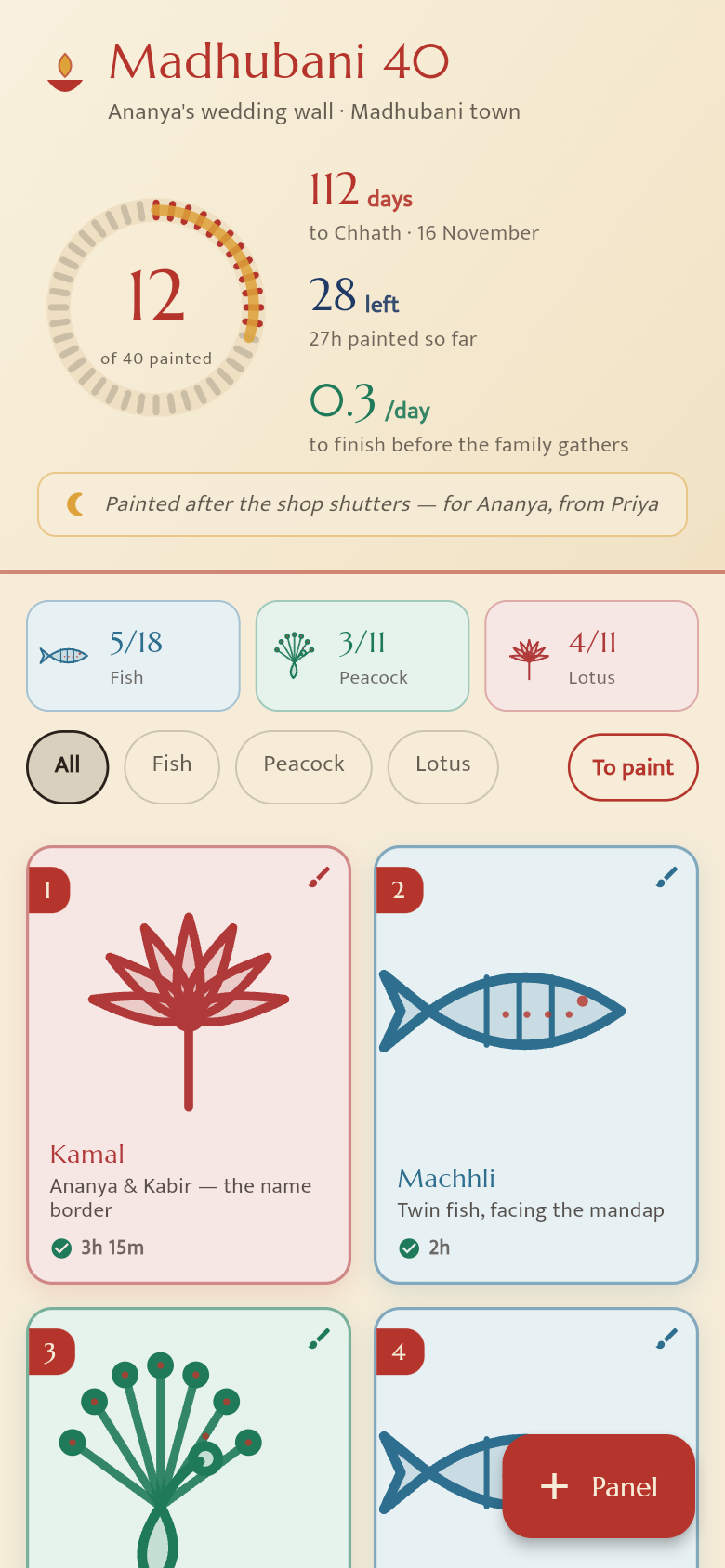
Madhubani 40 is the small tool she built in an afternoon to hold that picture for her. Open it and you see her 40 panels already seeded, sorted by motif, with a live countdown to the wedding date and a daily pace figure that tells her exactly how many panels she needs to finish each night to make it. No account, no internet, nothing to set up. Tap the panel below and see for yourself.
Live demo
A wall that lives in your pocket
A physical wall of 40 panels is hard to hold in your head. You finish one late at night, set it aside to dry, and by morning you have lost count of whether that brings the fish to seven or eight. The done/remaining tally at the top of the app answers that question the moment you open it, without you having to count the stack on the shelf.
The three motifs, fish, peacock, and lotus, each have their own section so Priya can see at a glance whether she is letting one category fall behind. A wedding wall in the Mithila tradition needs balance across its auspicious symbols, and that balance is easy to lose when you are working panel by panel in short nightly sessions. The motif breakdown keeps the whole composition honest.
Logging time in 15-minute steps
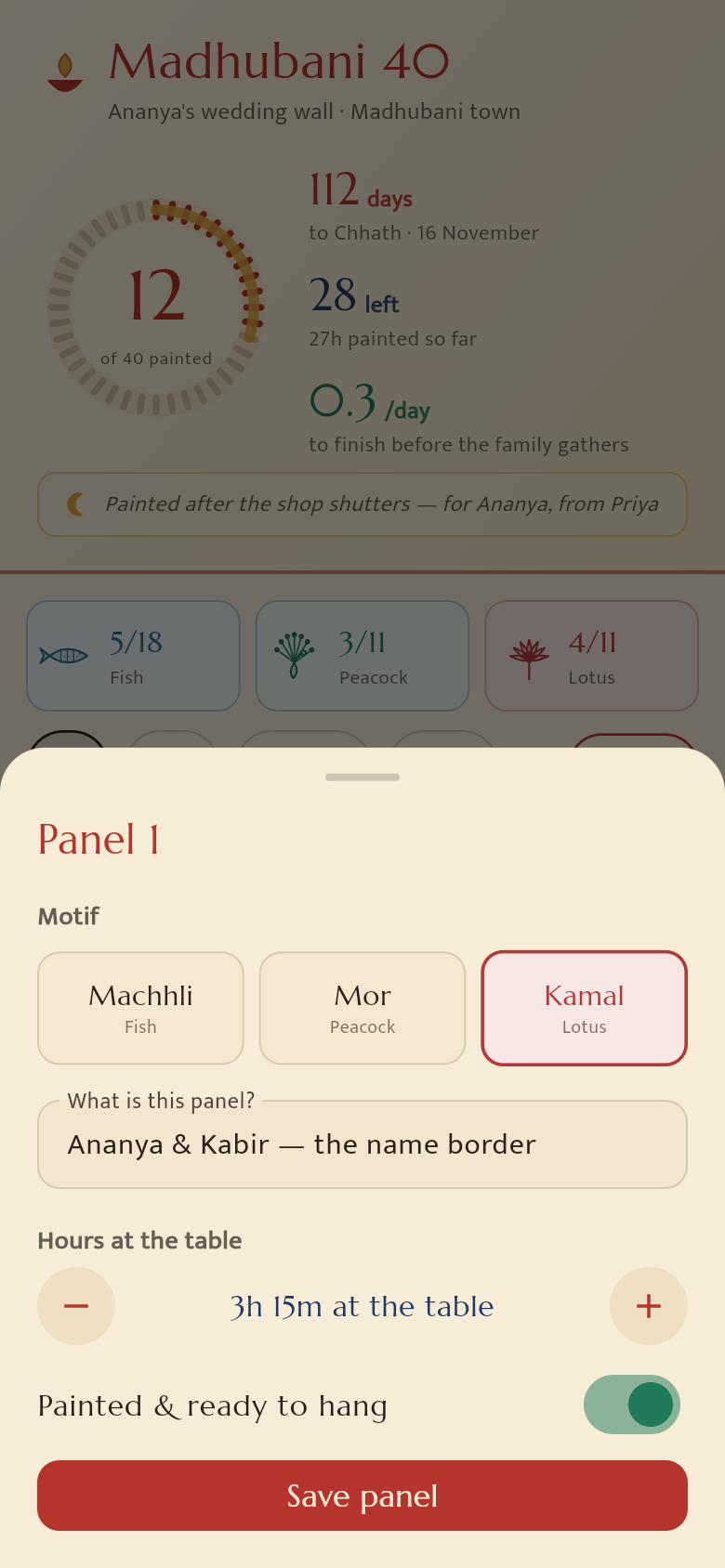
Each panel holds a simple time log. Priya taps how long she sat with it, in quarter-hour increments, and the app records the total. Over a week she can see which panels are eating more time than expected. A particularly detailed peacock with its tail feathers might run three hours; a cleaner lotus might be done in ninety minutes. Knowing that history helps her plan the rest of the commission without over-promising herself a nightly pace she cannot sustain.
Everything is stored locally on her phone. There is no account to create, no sync to worry about, and no internet needed. She can log a session at midnight with the shop Wi-Fi router switched off and it will all be there in the morning. For someone working in a craft tradition that predates electricity, that kind of simplicity feels right.
The countdown her aunt does not need to give her
The top of the screen shows the number of days remaining until Chhath Puja and, directly below it, the panels-per-day pace she needs to finish in time. This is the number her aunt keeps quoting at family dinners. Now Priya has it too, recalculated every time she marks a panel done, so she can walk into those conversations with something concrete.
The pace figure updates live. Mark three panels done on a good Saturday and the daily target drops. Let a week slip and it climbs. It is not a pressure mechanism so much as an honest mirror. The deadline is real; the app just makes it visible instead of vague and looming. Try marking a panel complete in the demo and watch the counter shift.
Built from one specific problem, useful for any big handmade project
Madhubani 40 started as a very particular idea: one painter, one commission, one deadline tied to a festival date. But the shape of the problem, a fixed number of handmade items, divided into categories, logged in short sittings against a hard deadline, turns up in a lot of creative work. A ceramicist throwing 60 bowls for a market. A weaver finishing a set of table runners before a family gathering. A block-printer fulfilling a wholesale order between teaching days.
The app does not try to be a general project manager. It stays close to the original problem: count the panels, track the time, show the pace. That specificity is what makes it immediately useful on first open rather than something you have to configure for twenty minutes before it helps you. The panels are already there. The motifs are already sorted. You just start marking things done.
What it feels like to use
Scroll through the panel list in the demo above. Each entry shows the panel number, its motif, whether it is done, and the hours logged so far. Tap a panel to log a session or mark it complete. The summary bar at the top updates immediately. It is the kind of app that earns its place on a phone's home screen because it does exactly one thing and does not ask anything of you in return.
There is something satisfying about watching the done count climb toward 40 over the weeks before a wedding. Priya will finish Ananya's wall. The fish, peacocks, and lotuses will be hung in the right balance. And when her aunt asks how many are left, she will know the answer before the question is finished.
39
files in the build
40.5 MB
app bundle
Flutter Web
runs in any browser
Have a project that needs its own tracker?
Madhubani 40 started as a single sentence: a painter who needed to track 40 panels against a festival deadline. Describe your own project in plain words and we will build you a working tool in minutes.