
nitnem
Nitnem Paath Tracker: Morning Banis, Kept
A quiet app built for Sikhs at Guru Nanak Darbar, Southall — track your five morning banis, time Sukhmani Sahib sittings, and count down to Baba ji's barsi.
Artem
Founder
· 5 min read
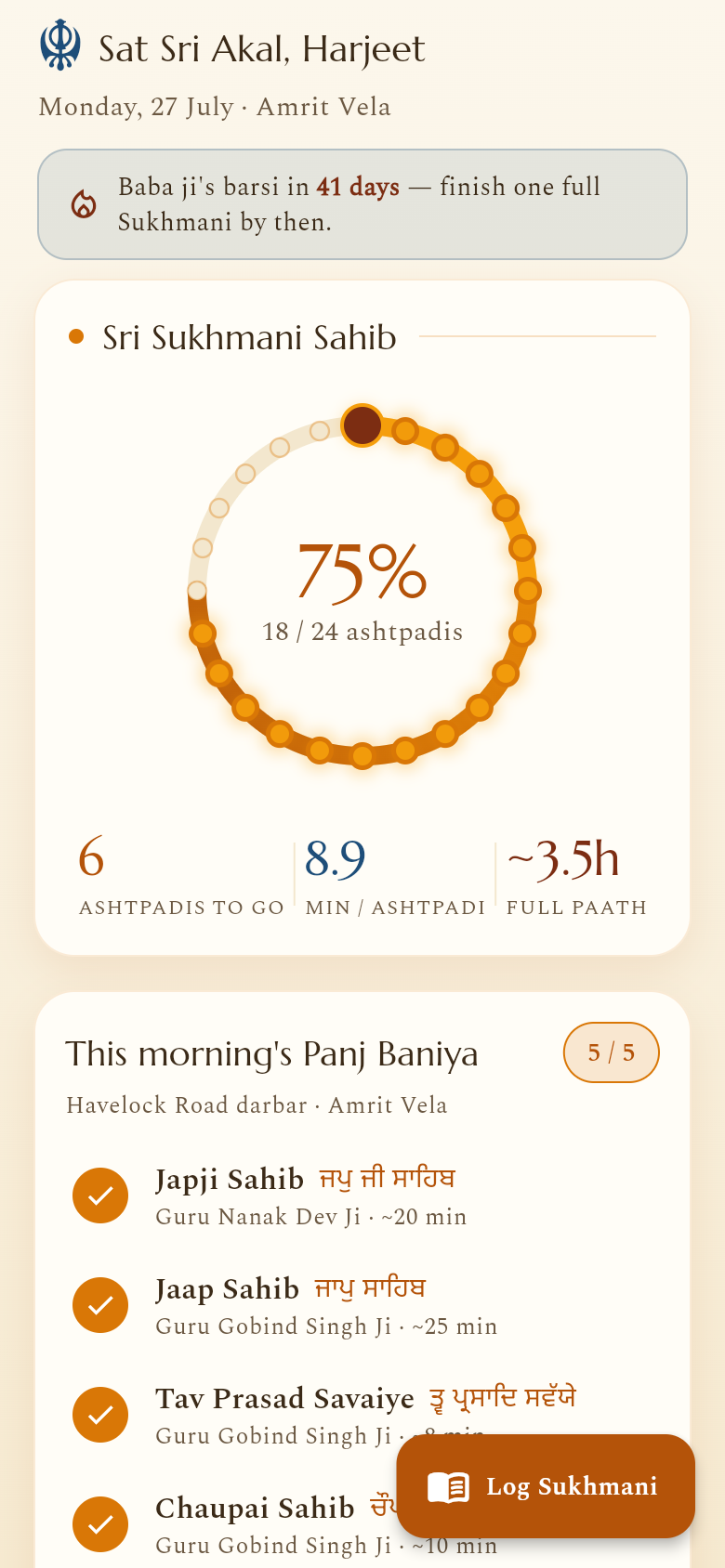
Most mornings begin with the best of intentions. You wake at Amrit Vela, settle into the first bani, and somewhere between Jaap Sahib and Chaupai Sahib the day catches you, and you are out the door. The five banis are not completed. You know them, you love them, and still the routine slips. This app exists for exactly that moment, the small, honest gap between intention and action.
Built for the sangat at Guru Nanak Darbar on Havelock Road, Southall, the Nitnem Paath Tracker lets you mark off each of the panj baniya as you recite them, watch a streak of full mornings build over the weeks, time your Sukhmani Sahib sittings, and keep a steady eye on the countdown to Baba ji's barsi. Try the live app in the frame on this page, it opens with seeded history so you can see immediately what a real practice record looks like.
Live demo
The Five Banis, One by One
The core of the app is a simple checklist of the five Nitnem banis: Japji Sahib, Jaap Sahib, Tav-Prasad Savaiye, Chaupai Sahib, and Anand Sahib. Each is shown by its Gurmukhi name alongside the roman transliteration, so the app feels like it belongs to the practice rather than sitting outside it. You tap a bani once you have recited it. That is the whole interaction.
What the app adds is memory. It records which banis were completed on each day and surfaces your streak of full panj-baniya mornings in a single, honest number at the top of the screen. On a morning when you only finish three, that is recorded honestly too. There is no judgment, just the record. But seeing a streak of eight full mornings makes it noticeably harder to break on day nine, and that is the whole point.
Timing Your Sukhmani Sahib Sitting
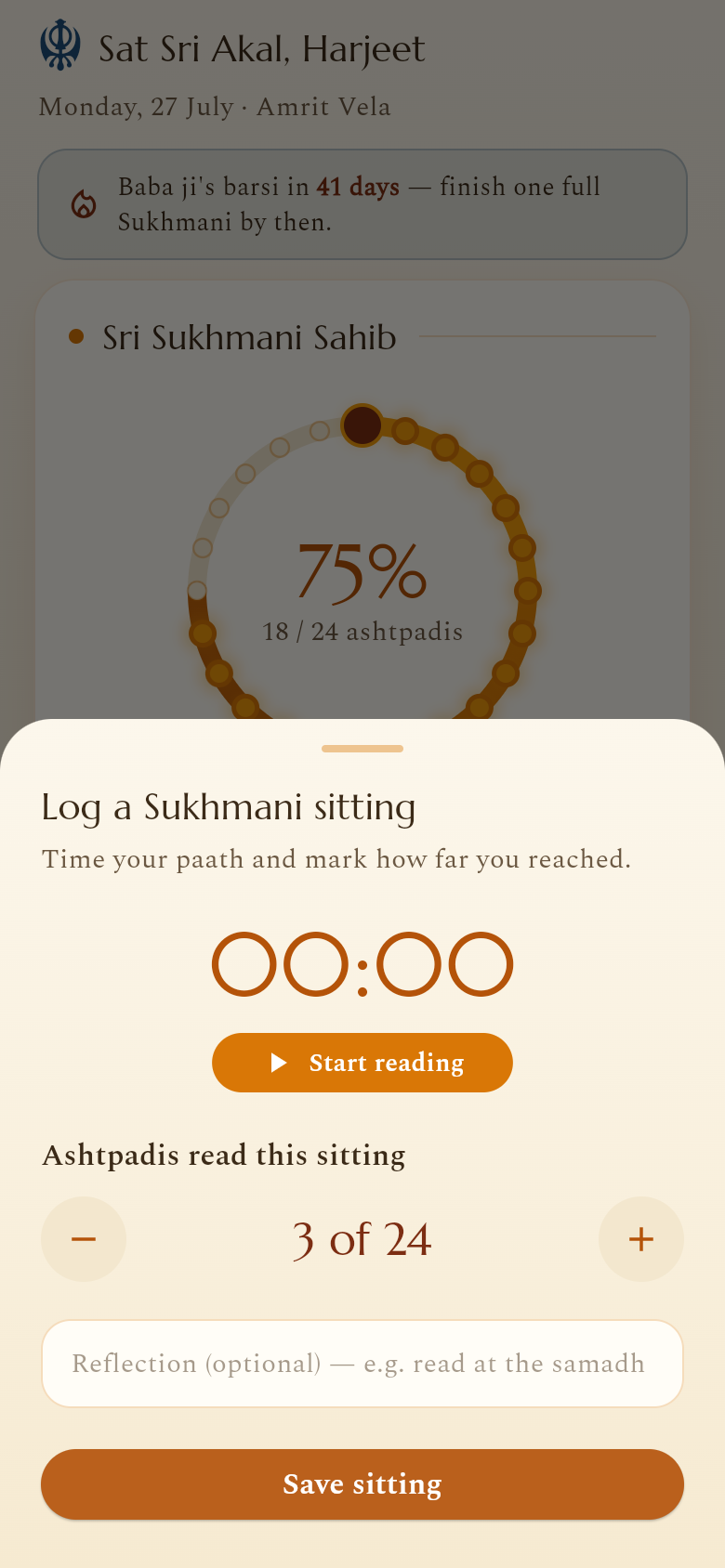
The second half of the app addresses a different kind of commitment. Reading a complete Sukhmani Sahib before a specific date, Baba ji's barsi, is a goal that can feel both sacred and logistically unclear. How long does a sitting take you? How far through the 24 ashtpadis can you read in the time you have on a given morning?
The built-in timer lets you start a sitting and pause it when life intervenes. Afterward, you log how many of the 24 ashtpadis you completed. The app totals your progress across all sittings and shows you how many remain before a full sehaj paath is done. With the barsi date set, a countdown at the top of the Sukhmani section tells you how many days you have left and whether your current pace will get you there.
You can see this in action in the embedded app. Start the timer, mark a few ashtpadis, and watch the progress bar fill. It is a small thing, but having that number visible, and the deadline real, changes how a sitting feels.
Built for the Gurdwara Community in Southall
Generic habit-tracking apps ask you to configure everything from scratch: create your habits, name them, set reminders. This app skips all of that. It arrives knowing what Nitnem is, knowing the names of the banis, knowing what Sukhmani Sahib is and that it has 24 ashtpadis. The language throughout uses the terms a practising Sikh would use, not translations designed for an outside audience.
It also opens with believable seeded history, a few weeks of partial and full morning records, so the streak counter and the Sukhmani progress are already alive on first open. You are not staring at an empty screen wondering how to start. You are stepping into a practice that looks like yours, and adjusting from there.
What Consistency Looks Like, Made Visible
There is a specific kind of motivation that comes from seeing your own record laid out plainly. Not a gamified points system, not push notifications asking if you have prayed yet. Just a calendar view of which mornings were full and which were partial, the streak number, and the countdown to a fixed devotional deadline.
The app is fully offline. It does not need a login, does not sync to a server, does not ask for your email. Your paath record stays on your phone. That matters for a practice that is personal, for a community where the focus is the bani itself, not the app. The tool stays in the background, useful when you reach for it, invisible when you do not.
From One Idea to a Working App
This tracker began as a single sentence: a Sikh devotee at Guru Nanak Darbar wanted a way to see whether they were actually finishing their banis each morning, and wanted to track progress toward Sukhmani Sahib before Baba ji's barsi. From that sentence, in a short time, came a working app with the right language, the right structure, and real data.
That is what Leanfinit does. If you have a specific, personal need, something that a generic app does not quite fit, you can describe it and have something working the same day. The embedded demo on this page is the real thing, not a mockup. Interact with it, complete a bani, start the Sukhmani timer, and see whether it fits a practice like yours.
39
files in the build
40.5 MB
app bundle
Flutter Web
runs in any browser
Have an idea for your own devotional or personal tool?
Describe what you need in a sentence or two, and Leanfinit will build it for you. No template, no configuration, just a working app built around your specific situation.