
lifestyle
Cihangir Kediler: Making Sure the Shy Cat Gets Fed
Four neighbours, three street cats, and one recurring problem: the bold ones get fed four times while the timid black cat goes hungry. Here's the app that fixed it.
Artem
Founder
· 5 min read
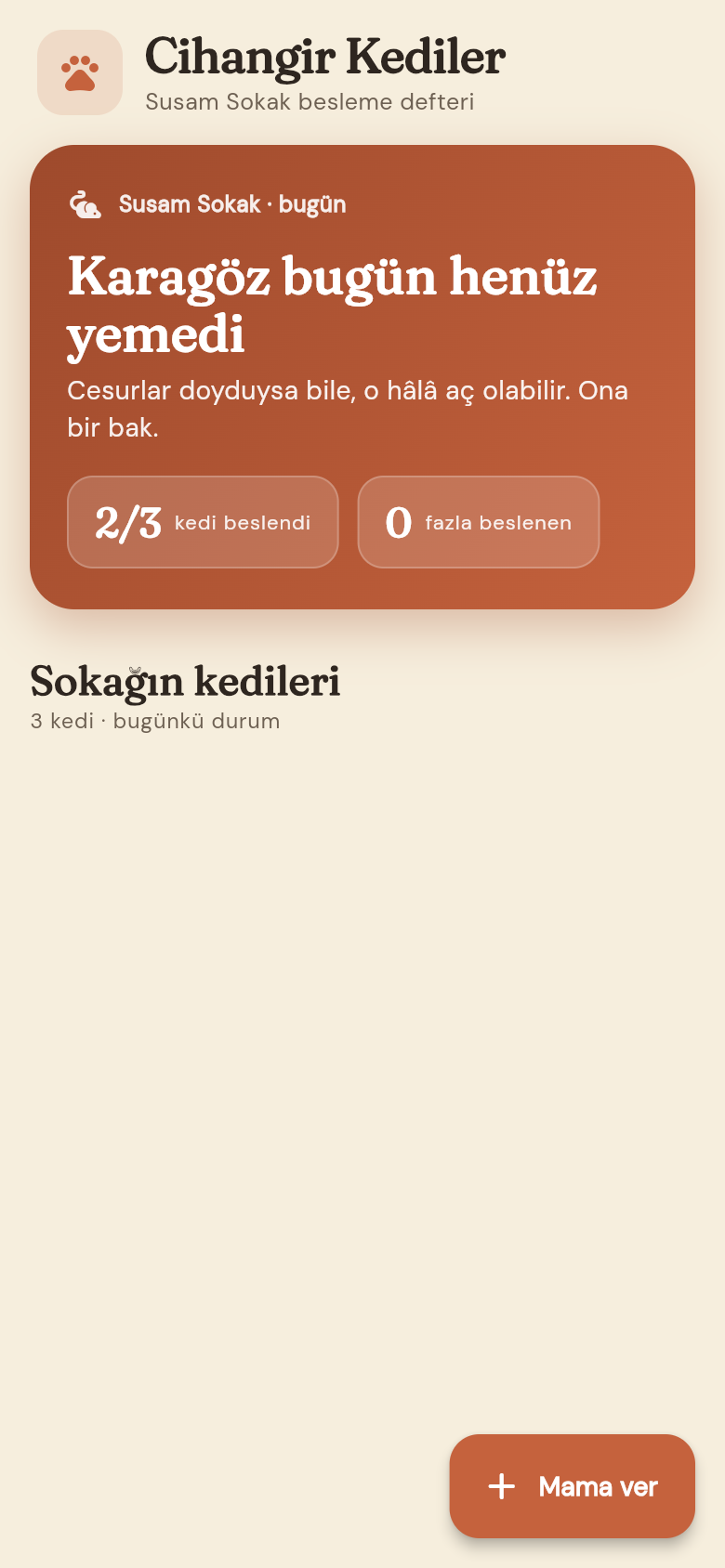
On Susam Sokak in Cihangir, the cats are famous. Tekir, the tabby, has worked every tourist and local within a two-block radius. Sarman knows exactly which café table to sit under. And then there is the black cat by the antique shop, whose name nobody has quite agreed on, who vanishes under a parked car the moment a stranger looks her way.
Four neighbours share loose, informal responsibility for all three. The problem is that 'loose and informal' meant Tekir and Sarman were getting fed three or four times a day, full and happy and slightly smug about it, while the shy one was going unnoticed. Nobody was doing anything wrong. There was just no way to know, at eight in the morning, whether she had already eaten. So Deniz built a small app to fix exactly that.
Live demo
The question the app answers first
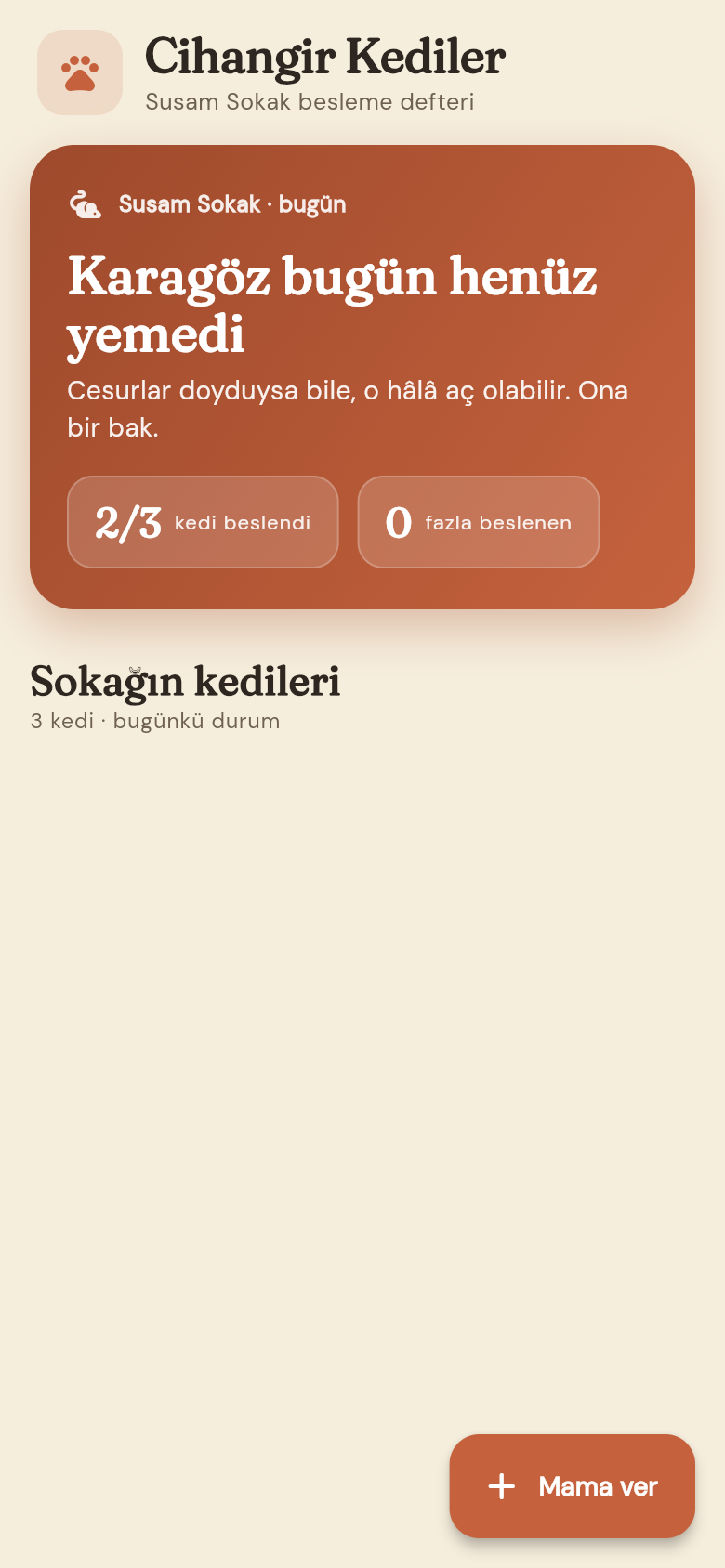
Open Cihangir Kediler and the first thing you see, before anything else, is whether the shy black cat has been fed today. Not a dashboard, not a list, not a menu: just the one piece of information that actually changes what you do next. If she has eaten, you can relax over your morning coffee. If she has not, you know to check on her before you leave.
That choice, putting the most at-risk animal first, is what makes the app feel like it was made by someone who actually knows these cats rather than by someone designing a generic pet tracker. Try the live version embedded above and you will see it immediately: the layout is opinionated in exactly the right direction.
Logging a feeding in two taps
The other thing that tends to go wrong with shared-responsibility systems is that logging feels like homework. If recording a feeding takes more effort than just putting down the food and walking away, nobody does it consistently, and you end up with incomplete data that is worse than no data at all.
Here the flow is: tap the cat, tap your name, choose the food, done. Two taps if you are Deniz and you always bring the same dry food. The app does not ask for notes, timestamps beyond today, or anything else. It records what matters and gets out of the way. You can see the full history for any cat if you want it, including a multi-day trend that makes it obvious if the shy one went two days without eating last week, but you never have to dig into it just to log a meal.
Scroll through the cat list in the demo above and log a test feeding. The count updates immediately, and the daily target indicator shifts so over-feeding is visible at a glance.
No accounts, no setup, fully offline
This is an app for four people on one street. It does not need a server, a login screen, or a cloud sync architecture. It runs on a single phone, works without internet, and requires nothing from any of its users except opening it.
That constraint shaped everything. There is no registration flow because there is no registration. The four neighbours are named inside the app from the start. If you are building something similar for your own street or building, you would swap in your own names and your own cats when you create it, and then you are done. The app lives on whoever volunteers to hold the shared phone, or it gets passed around. Either way, no passwords, no onboarding, no 'check your email to verify your account'.
The history and trend data accumulate locally over time. After a few weeks you have a real picture of how often the shy cat actually ate versus how often she was just seen nearby, which turns out to be genuinely useful information.
Why the simple version is the right version
It would be easy to imagine a more elaborate tool: group chat integration, push notifications when a cat has not been fed by noon, a map showing where each cat was last spotted. Most of that would make the app harder to use and no more effective at solving the actual problem, which is that four busy neighbours need a shared, honest answer to 'has she eaten today?' without having to message each other.
The trend view is the one feature that goes slightly beyond the immediate question, and it earns its place because it surfaces something that the day-to-day view cannot: patterns. A single missed day is noise. Three missed days in a fortnight is a signal. Knowing that the shy cat reliably eats when Deniz checks in the morning but gets missed on days when Deniz is out of town is exactly the kind of thing a two-tap log reveals over time, and it is not something any of the four neighbours would have noticed otherwise.
What the app refuses to do is equally important. It does not track weight, vet visits, or food brands. It does not send reminders. It does not have a social feed. It does one job, which is making sure every cat on the list has a fair chance of being fed every day, and it does it without getting in the way.
From a WhatsApp message to a working app
The message that started this was something like 'did anyone feed the black one this morning?' sent into a group chat at 8am, answered four hours later by someone who had fed all three cats at 7am without thinking to mention it. That message, and the slightly guilty silence that followed it, is where the idea came from.
The app was built from that description in a single session, shaped around the actual people and actual cats involved. Tekir and Sarman are in there by name. The daily target counts reflect what the neighbours actually decided together, not some default figure from a generic template. The shy cat's priority placement at the top of the screen was a deliberate call, not a setting. That specificity is what makes it useful rather than just functional.
39
files in the build
40.5 MB
app bundle
Flutter Web
runs in any browser
Have a small problem that deserves a real solution?
Cihangir Kediler started as a question in a group chat and became a working app in an afternoon. If you have a shared responsibility, a coordination gap, or a recurring confusion that nobody has quite solved yet, you can build the right tool for it, for your people, your situation, your rules.