
wedding
Tob's Speech Cards: Time Your Best Man Speech, Card by Card
A cue-card timer built for one best man, one wedding, and a hard 6-minute slot. See exactly where your time goes before the ceilidh starts.
Artem
Founder
· 5 min read
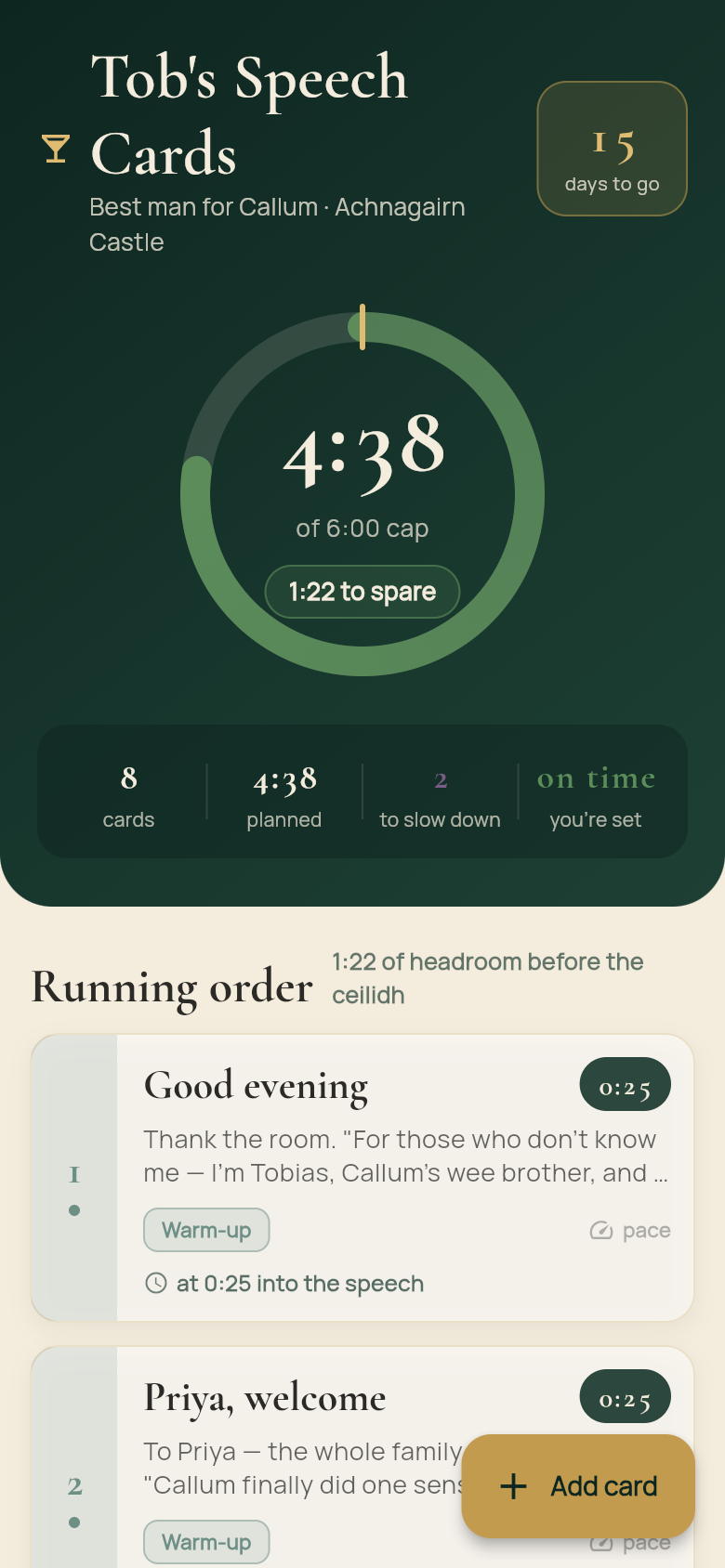
Tobias has two weeks, a daily bus commute, and a speech that has to land in under six minutes before the ceilidh band starts at Achnagairn Castle. He knows the stories cold. What he doesn't know is whether card four is eating thirty seconds he doesn't have, or whether the pause after the Callum-at-fourteen joke is long enough to let the room laugh before he moves on.
Tob's Speech Cards was built specifically for him, and for this exact problem: not just a timer, but a per-card running tally so every rehearsal tells him exactly which line is slow and where the budget is going.
Live demo
The problem with rehearsing from cue cards
Most best men don't read from a script. Reading feels stiff, and glancing down at a full page mid-story kills the moment. Cue cards are better, a word or phrase per beat, enough to jog the memory without anchoring you to a page. The trouble is that cards give you no sense of time. You know the speech runs about right when you're calm at your kitchen table. You have no idea what happens when you're standing up, heart going, and the room is quieter than expected after the joke.
The specific fear isn't overrunning by two minutes in total. It's the pause. The deliberate, held silence after the set-piece gag, the one that only works if the room has a beat to catch up. Too short and it feels rushed. Too long and it becomes awkward. Tobias needed a card that told him: hold here, this is the moment, wait for it.
What the app shows you
Open the app and Tobias's actual speech is already there, seeded as timed cards on first launch. No blank slate, no 'add your first card.' The speech exists from the moment the app does. Each card shows its own time allowance and a cumulative tally: by card three, you're at one minute forty. By card seven, you're at four minutes ten. The 6-minute cap is always visible, and the total status, under budget or overrun, is readable at a glance without doing arithmetic.
Two cards are marked differently. One flags the lines where the pace tends to drift long, a nudge to slow down and let the words breathe. The other is the pause card, the deliberate hold after the big joke. It's timed, not vague. It tells you how many seconds to wait before you continue. That specificity is the whole point. Try tapping through the cards in the embedded demo above and you'll see how quickly it becomes a rhythm, each card a small commitment rather than a floating guess.
Rehearsing on the bus
The app works entirely offline. That matters because the bus between Inverness and wherever Tobias is staying doesn't have reliable signal, and the last thing a rehearsal needs is a spinner. Every edit, every re-timing, every card you add or move, it all lives on the device. No account, no sync to worry about.
The rhythm of a commute suits this kind of practice well. One run-through takes six minutes if you're on pace. You can do two on a forty-minute journey and have time left to think about what felt off. After a few evenings the cumulative tallies stop feeling like numbers and start feeling like landmarks: by the university story I should be at three minutes, by the toast I should have forty seconds in reserve. That's the kind of spatial memory that holds up when you're nervous and the room is full.
Editing when the speech changes
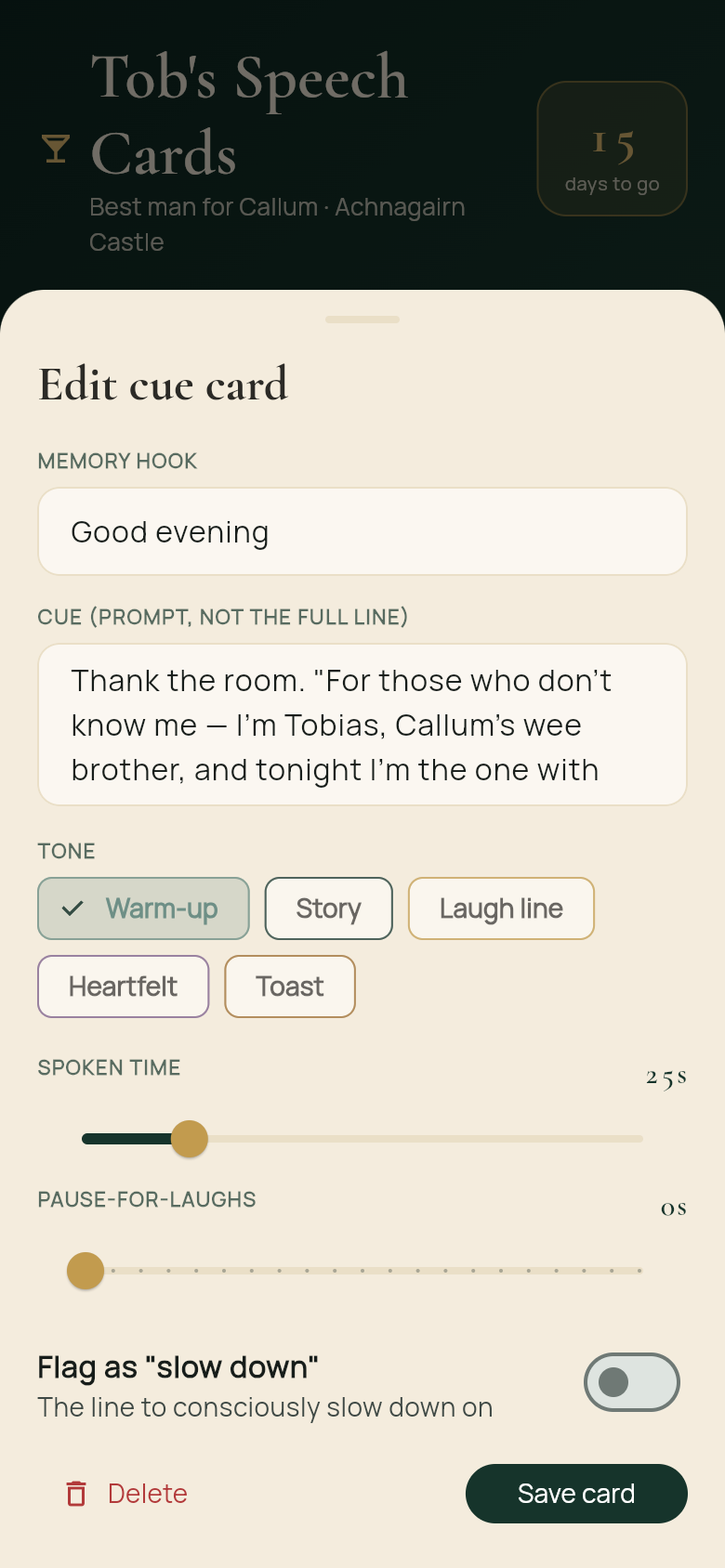
Speeches change. Tobias will cut a line that isn't working, tighten a setup, add something he thought of on Tuesday. Every card is editable directly in the app: the text, the time, the tone. If a new card pushes the total over six minutes, the overrun shows immediately. There's no separate 'calculate' step. The budget is live.
Re-toning a card, shifting something from warm to funny or from sentimental to dry, is a single tap. It doesn't rewrite the words, it changes how you're prompted to deliver them. For a speech that has to do three different emotional jobs in six minutes, that small flag is genuinely useful. The demo in the frame above is the real app. Add a card, change a time, see the tally move. It behaves the way a cue card stack should, except it's honest about the clock.
Built for one person, useful for anyone with a slot to fill
This app was built from a single brief: Tobias, Callum, Priya, Achnagairn Castle, 12 September, six minutes. Every decision, the seeded speech, the cumulative tally, the pause card, the offline-first storage, follows directly from that brief. It wasn't designed for a hypothetical best man. It was designed for this one.
That specificity is what makes it work. A generic speech timer tells you your total time. Tob's Speech Cards tells you which card is slow, where your reserve is, and when to hold. If you're giving a speech at a wedding, a work event, or anywhere else with a hard slot and a nervous room, the same logic applies. The cards know what the clock knows. Now so do you.
39
files in the build
40.5 MB
app bundle
Flutter Web
runs in any browser
Have an idea for a tool built around your specific problem?
Tob's Speech Cards started as a one-line brief and became a working app in a single session. If you have something you wish existed, describe it and see what gets built.