
utilities
Warranty Vault: Never Miss a Free Repair Again
A pocket-sized app that tracks every appliance and gadget you own, shows what's still covered, and flags what's expiring before you need to pay for a repair you didn't have to.
Artem
Founder
· 5 min read
The fridge starts making a strange noise. You bought it maybe two, maybe three years ago. Is it still under warranty? The receipt is probably in a drawer somewhere, or maybe in an email from a different address, or maybe it got thrown out. By the time you dig up the answer, you've already called a repair tech and agreed to a $200 visit fee, only to discover the manufacturer would have fixed it for free.
Warranty Vault is a small, focused app built around one insight: the information exists, it just isn't findable when you need it. Add each item once, and from then on you always know what's covered, what's running out, and what's already expired. Try the live version embedded in this article and see how fast it comes together.
Live demo
The drawer full of receipts problem
Most people own somewhere between five and fifteen mid-value items that came with a warranty, fridges, washing machines, laptops, TVs, dishwashers, and most of those warranties run one to five years. The manufacturer wants you to register the product, but registration lives on their website, behind an account, and it covers only their brand. There's no single place to see the whole picture.
The practical result is that warranty information exists in three forms: a physical card in a junk drawer, a confirmation email buried in your inbox, or a memory that's already fuzzy about the exact purchase date. None of those are useful at the moment a repair decision needs to be made. Warranty Vault solves the problem by being that single place, one that works offline and doesn't require you to hand your data to anyone.
What's inside: the main screen and what it tells you
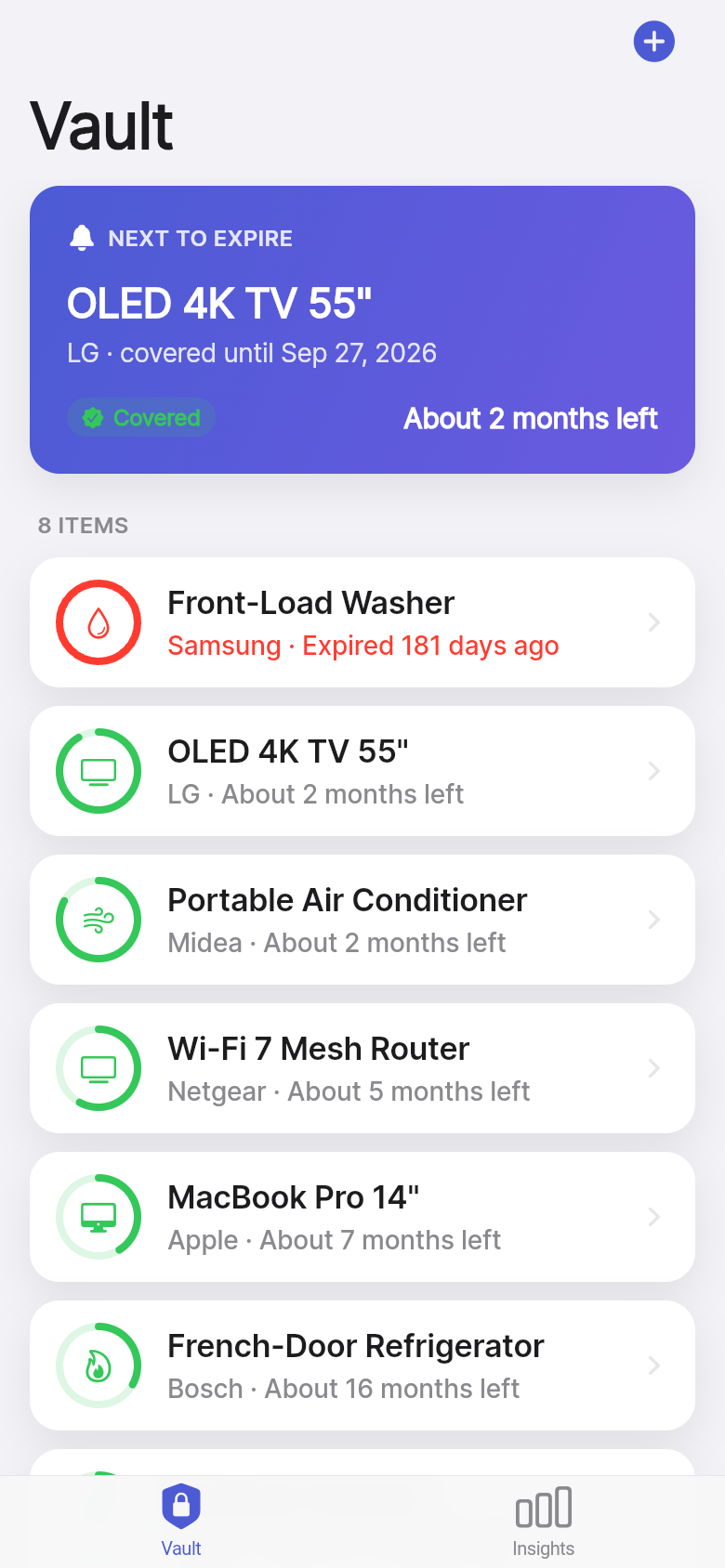
When you open Warranty Vault, you're not looking at an empty list with a prompt to get started. The app opens with a set of believable sample items already populated, a fridge, a laptop, a TV, so you can immediately see how the status system works before adding anything of your own. Each item shows a colored status badge: Covered, Ending Soon, or Expired. At a glance, the screen tells you the state of your coverage across everything you own.
Tap any item and you see the full detail: what you paid attention to when you bought it, the purchase date, the warranty length in months or years, and a calculated expiry date. The app derives the status automatically from those numbers. There's nothing to maintain, nothing to remember to update.
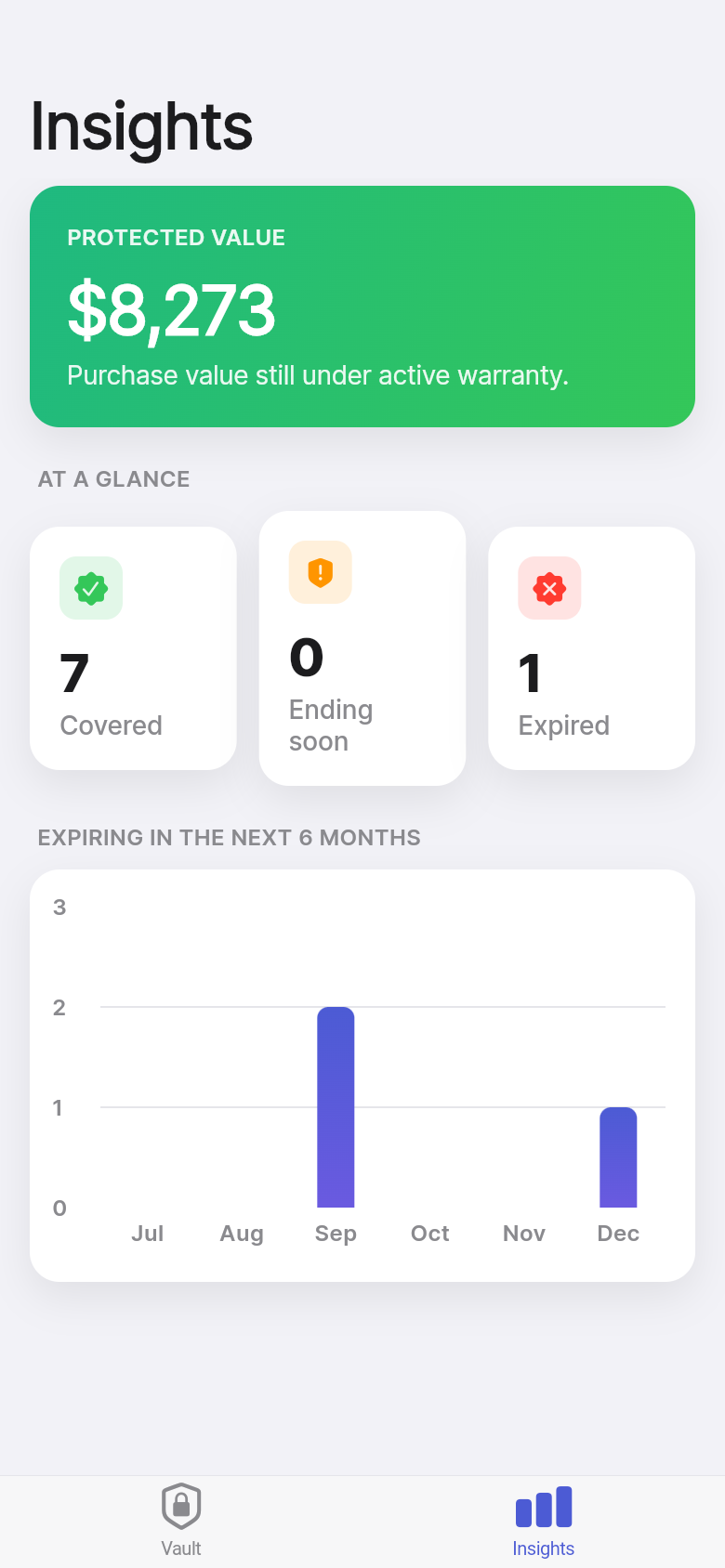
Scroll down to the Insights section and you get two things that require almost no effort but pay off the most. First, the total protected value: how much you'd be left holding if everything currently covered broke tomorrow and you had to replace it out of pocket. Second, a chart showing what expires over the coming months, useful if you want to think about extended coverage or just want to know when your coverage situation changes.
Adding your first real item: how quick it actually is
Tap the + button in the top corner. You'll see a clean form with four fields: item name, purchase date, warranty length, and an optional value. That's it. Name your item whatever makes sense to you ('Kitchen Fridge' or 'Samsung RF28' or just 'Fridge'), pick the date you bought it, type how long the warranty runs, and save. The item appears immediately in the list with its status badge already calculated.
The purchase date picker uses a native iOS-style wheel, which means it's fast to scroll back to the right month and year without having to type anything. Warranty length is entered in months, so a two-year warranty is 24, a five-year is 60. It takes about twenty seconds per item, which means you can add your whole household in a single coffee break.
If you already tried the embedded app above, you probably noticed that editing and deleting items is equally straightforward. Tap an item, tap Edit, change what you need. Long-press or swipe to delete. Nothing is hidden behind menus or confirmation flows that ask you to confirm you're really sure.
The 'expires next' view and why it matters
The most quietly useful feature is the one that surfaces the item whose warranty expires soonest. This matters because warranties don't announce themselves. You don't get a letter or an email. The coverage just lapses on a specific date, and if something breaks the day after, you're on your own.
Knowing what's expiring next gives you a short window to act. For high-value items, that might mean calling the manufacturer to ask about extended coverage. For others, it's just useful to know you're approaching the point where a repair is coming out of your own pocket. Either way, the decision gets made with accurate information rather than a guess.
The Insights chart makes this even more concrete by showing a bar for each of the next several months, so if three things expire in the same quarter, you can see that at a glance rather than discovering it item by item.
Offline, private, and already there when you need it
Warranty Vault doesn't require an account. It doesn't sync to a server. Everything you add stays on your device. That design choice is intentional: the moment you need this app is the moment something breaks, and that moment shouldn't depend on a login, a network connection, or a service that might not exist in three years.
The app was built quickly from a single idea, and that focus shows. It does one thing well: it keeps a clean, accurate record of what you own and how long each item is covered. There are no ads, no upsell prompts for a premium plan, no social features. Just a list, a status, and an expiry date for every item in your home. That's the entire product, and for the problem it solves, that's exactly enough.
39
files in the build
40.2 MB
app bundle
Flutter Web
runs in any browser
Have an idea for a tool you actually want to use?
Warranty Vault started as a one-line description of a problem. Leanfinit turned it into a working, installable app. If there's a small utility you've always wanted but never found, you can build it the same way.