
utilities
Enugu Tap Days: Know at 5am Whether to Haul
For households on Ngwo Street where mains water arrives unpredictably, this app gives a single morning verdict: catch it today, or rest your arms.
Artem
Founder
· 5 min read
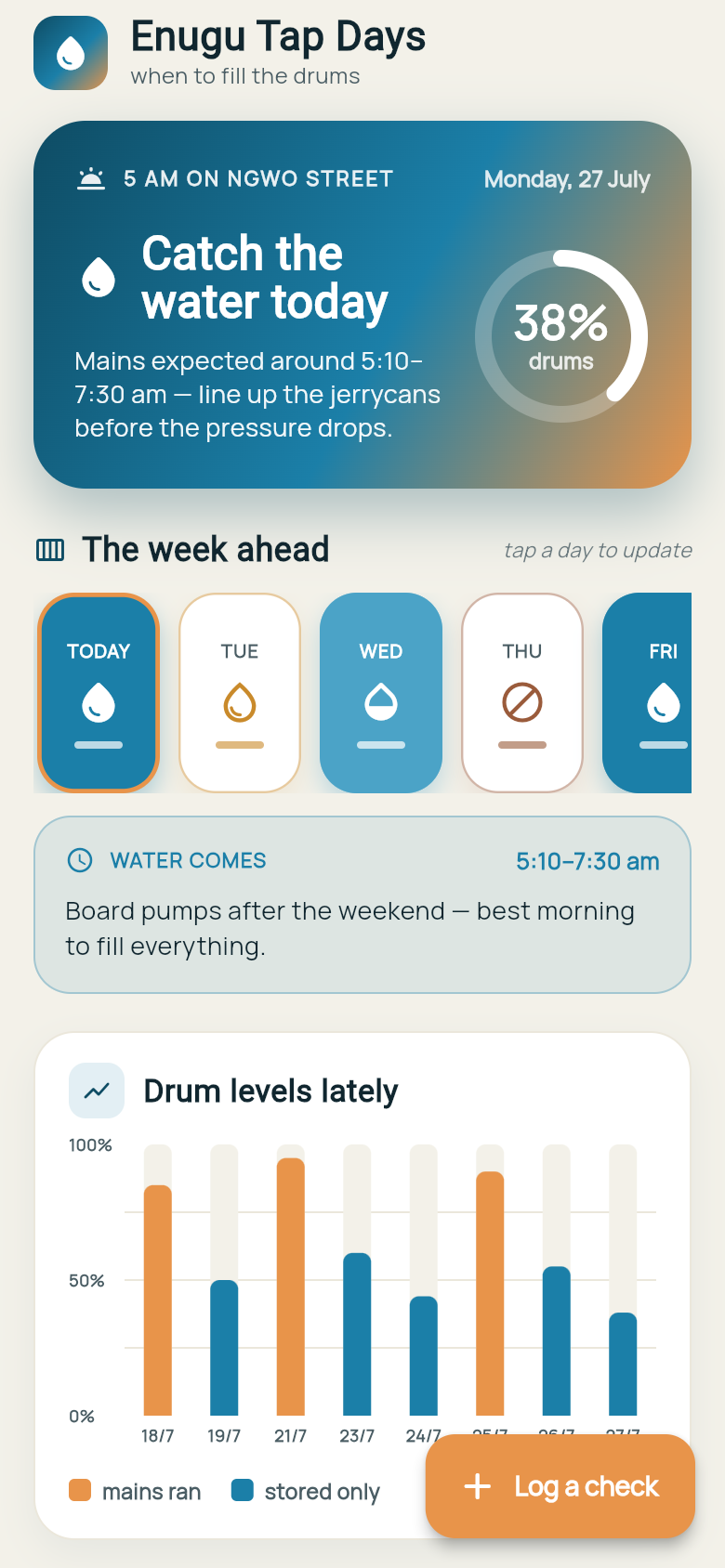
At five in the morning, before the street wakes up, Chiamaka is already calculating. Did the mains run on a Tuesday last week? Was it two Fridays ago or three? If she gets it wrong and hauls jerrycans down to the shared tank at number 14 only to find dry pipes, she has lost the morning for nothing. If she rests and the water comes, the blue drums stay half-empty and the family goes short by Friday.
Enugu Tap Days was built for exactly this moment. Open the app before dawn and it gives you one clear answer: haul now, or sleep another hour. Below that verdict sits the week's pattern, your drum levels, and a running log of whether the mains actually delivered. No account, no internet, no clutter. Just the information that matters at 5am.
Live demo
The problem with tracking by memory
Across Enugu and much of urban Nigeria, municipal water does not run on a posted schedule. It arrives in windows, usually early morning, usually on certain days more than others. Neighbours piece together the pattern by comparing notes at the gate: 'Monday and Friday are the good ones, avoid Wednesday.' That shared knowledge is real and useful, but it lives entirely in people's heads.
Memory is unreliable when you are tired, when a week has been unusual, or when a new family moves in and has no history to draw on. The cost of a wrong guess is not abstract: it is forty minutes of hauling, or a dry tank by Sunday evening when the weekend crowd needs to cook and bathe.
Enugu Tap Days turns that informal neighbourhood knowledge into a simple weekly grid. Each day of the week carries a reliability rating, reliable, likely, rare, or dry, that Chiamaka sets herself and updates as she learns. The app does not try to be smarter than she is about her own street. It just holds the pattern so she does not have to.
One verdict, one tap, every morning
The home screen is designed around a single question: should I haul today? The verdict at the top, catch the water, haul now, or rest, is computed from two things: today's reliability rating and how full the drums currently are. If it is a likely day and the drums are already at eighty percent, the app tells her to rest. If it is a reliable day and the drums are low, it tells her to move.
Below the verdict is the expected arrival window, typically the 5 to 8am slot that mains water tends to follow on Ngwo Street. That window is editable, because she knows her street better than any algorithm does.
Try it in the demo above: change the drum level slider and watch the verdict update instantly. Switch today's reliability from 'likely' to 'dry' and the app stops asking you to haul. The logic is simple on purpose. Simple logic does not need a tutorial.
Logging what actually happened
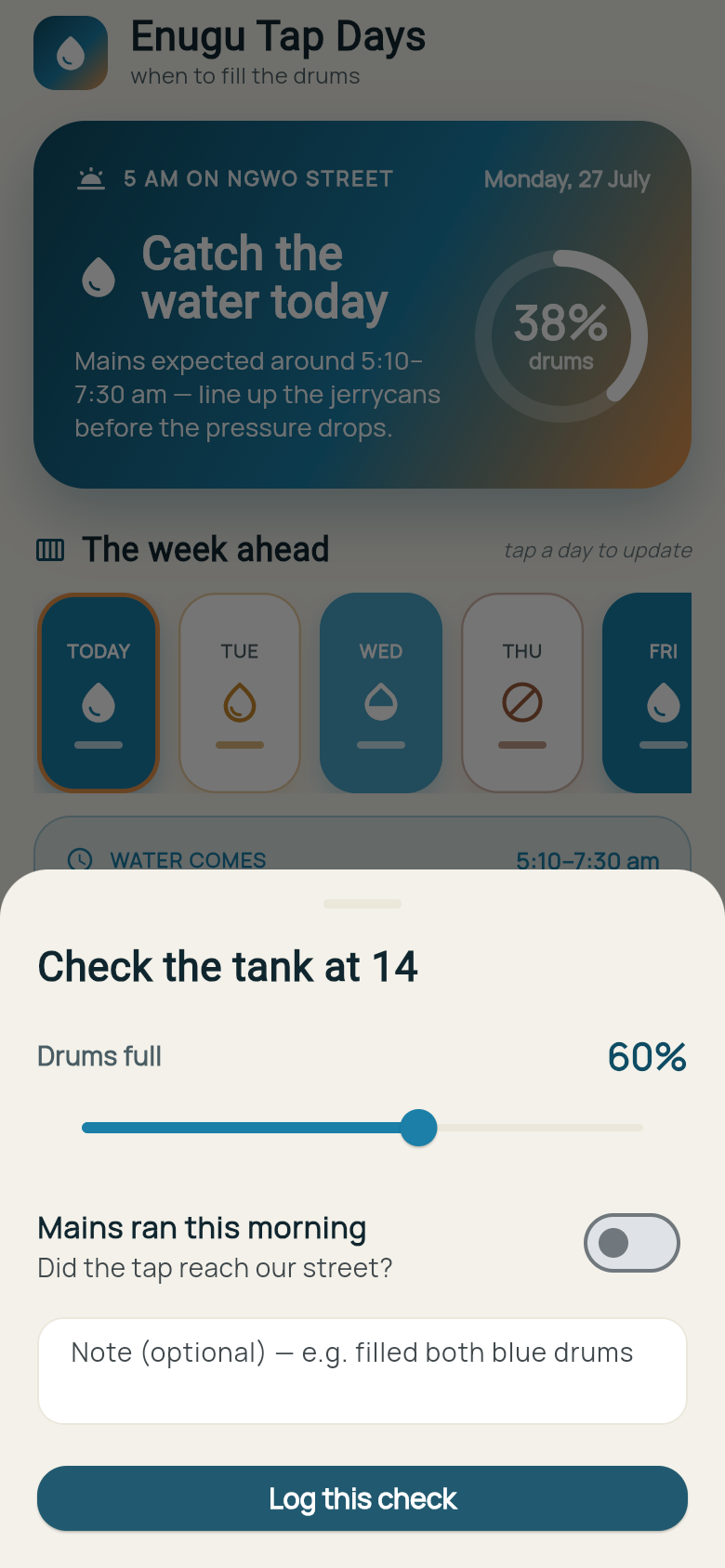
The second part of the app is a daily log. After the morning has passed, Chiamaka marks whether the mains ran and how far she topped up the drums. Over a few weeks, a real picture emerges: which days are genuinely reliable, which ones only feel reliable because they happened twice in a row, and which days the mains has not delivered in a month.
That log is also what keeps the drum level honest. Rather than asking her to track litres or measure with a stick, the app works in the same terms she already uses: the drums are full, half, or getting low. When she logs that she filled them this morning, the level goes up. When several days pass without a fill, it nudges downward to reflect real household use.
The whole history is visible as a compact week-by-week grid, colour-coded by whether the tap ran. Scroll back and the pattern is obvious in a way that memory never quite is. That is where the weekly reliability ratings come from: not a guess, but a record.
Built around her world, not a generic template
The app ships with Ngwo Street already in place. The shared tank at number 14 is named. The blue drums are the reference point. None of this is cosmetic: when the tool speaks in the same terms you already use, it takes no translation effort to trust it.
It also works fully offline from the first open, because a 5am water check cannot depend on a mobile data connection or a login screen. Everything is stored on the device. There are no accounts to create, no server to call, no ads timed to appear at the worst moment.
The editable weekly pattern means the app stays accurate as the mains schedule shifts, as they do, without any app update or support request. Chiamaka is the authority on her own street. The app just keeps the notes.
A tool this specific, built in an afternoon
Enugu Tap Days did not start with a product team or a funding round. It started with a one-line description of a real problem: the mains water comes on certain mornings and I need to know which ones. From that description, a working app with real data, real logic, and real copy was ready the same day.
That is what Leanfinit is for. If you have a problem this specific, one that no off-the-shelf app solves because it is too local, too personal, or too tied to the exact way you and your neighbours think about your lives, you can describe it in plain language and get a working tool back. No engineering background needed. Just the problem, clearly stated.
39
files in the build
40.6 MB
app bundle
Flutter Web
runs in any browser
What problem would you solve?
If there is a daily decision in your household that you are still tracking in your head or on a piece of paper, describe it and we will build the app for it. Takes about a minute to write the idea, and the tool comes back the same day.