
mood tracking
Inner Weather: A Two-Second Mood Check-In That Actually Sticks
Most mood trackers die after day three. Inner Weather replaces the clipboard with a weather emoji and one optional note, then shows you how your week actually felt.
Artem
Founder
· 4 min read
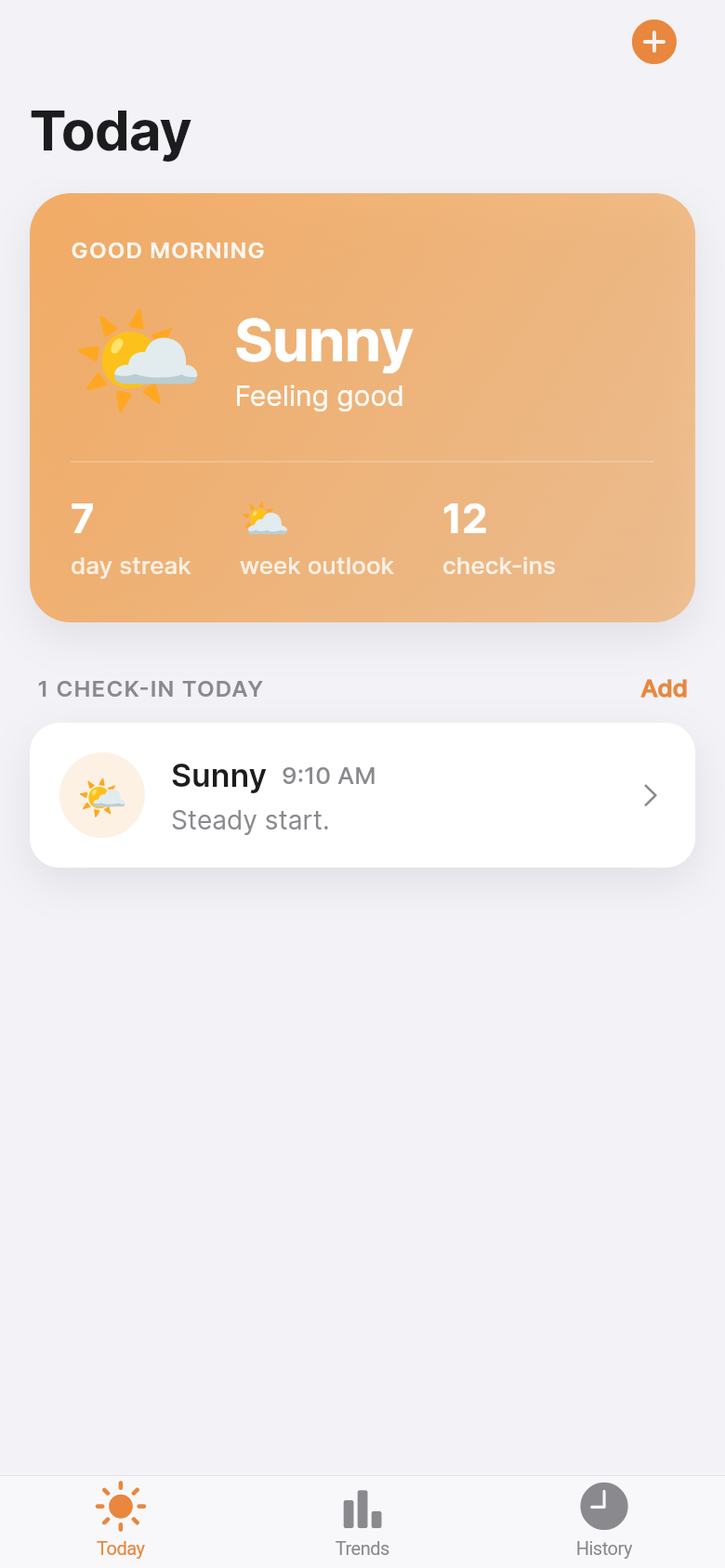
You already know when you're having a rough Tuesday. What you don't know, until you look back, is whether rough Tuesdays are becoming a pattern or whether last week was genuinely harder than usual. That's the gap Inner Weather fills: a quick emotional check-in that takes two seconds, requires no account, and shows you a single honest line chart of your week.
The app borrows the weather metaphor on purpose. Saying 'I'm at a thunderstorm right now' feels nothing like filling in a clinical scale from 1 to 10. It's playful, low-stakes, and true enough to be useful. Tap the emoji that fits, add a sentence if you feel like it, and move on. The app quietly builds a picture you can actually read.
Live demo
Why most mood trackers get abandoned
The apps that try to do everything, a multi-page intake form, color-coded correlation matrices, sleep and step integrations, end up feeling like homework. You open them on Monday with good intentions. By Thursday the notification is a source of guilt, not a nudge. By the following weekend the app is buried in a folder you never open.
The insight behind Inner Weather is that the bottleneck isn't the data you want to see at the end of the week. It's the cost of logging it in the first place. Drop that cost low enough, and the habit stops feeling like a habit at all. It becomes the kind of thing you do while the kettle boils.
How a check-in actually works
Open the app and you see today's entry front and center alongside your recent history. Pick a weather emoji from the row at the top: sunny, partly cloudy, overcast, rainy, stormy, and a couple of options in between. Each one maps to a mood range, but the mapping is gentle rather than clinical. You pick the one that fits.
Below the emoji row there's a small text field if you want to add context. 'Tight deadline and skipped lunch' tells future-you something a number never could. But the note is genuinely optional, not a barely-disguised required field. Log the emoji alone and the entry is complete in under two seconds.
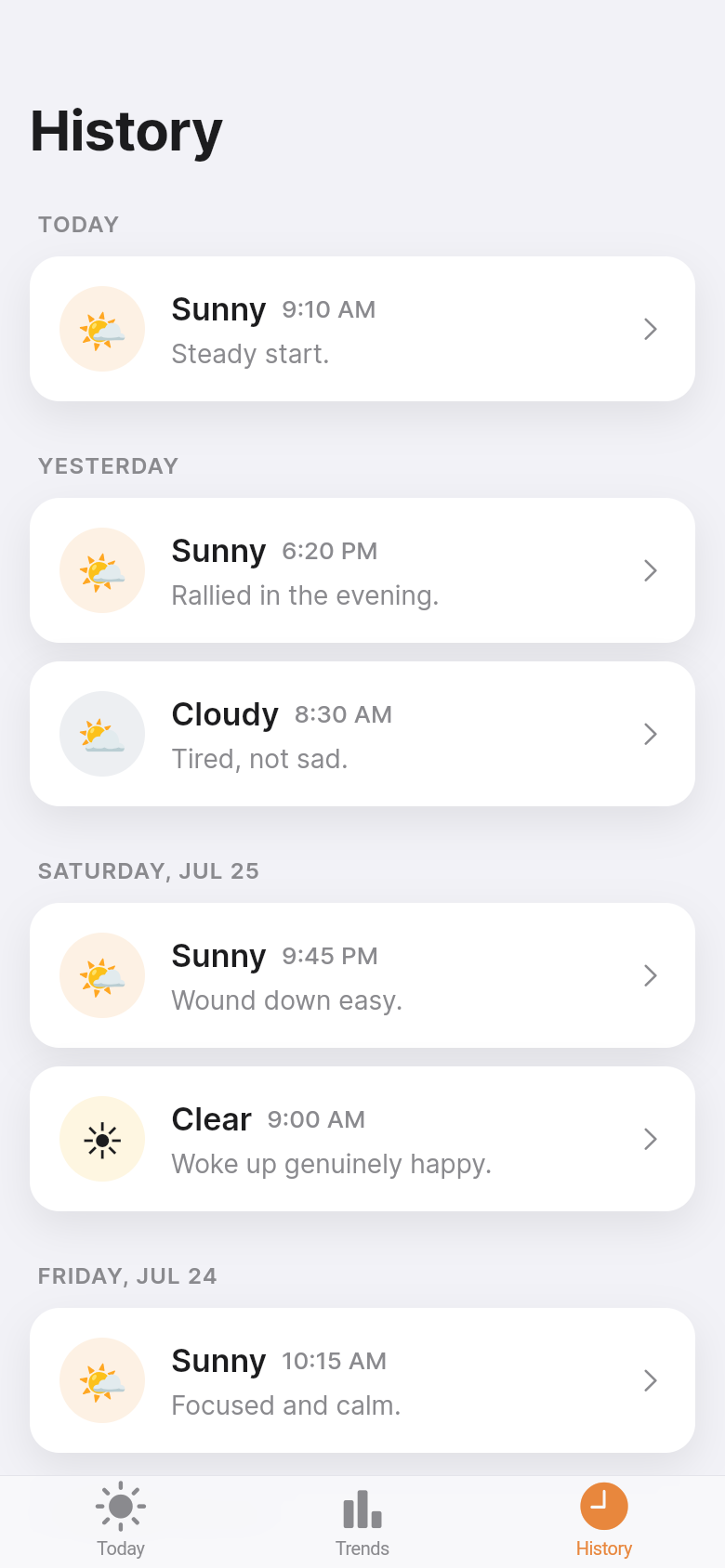
If your mood shifts between morning and afternoon, log again. Inner Weather supports multiple check-ins per day and averages them into a single point on the chart, so one rough hour doesn't wreck the whole day's picture.
The weekly chart: one line, no noise
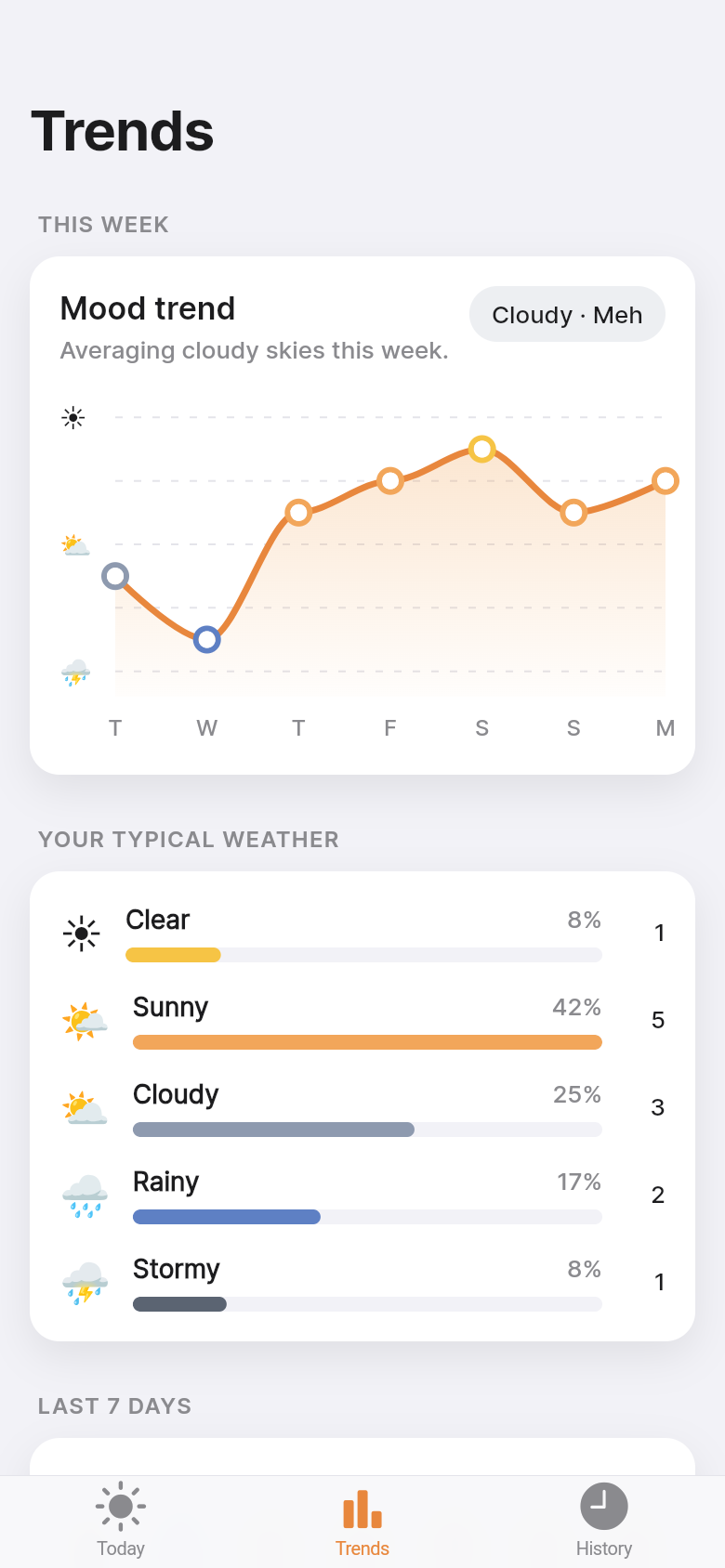
Scroll down from the log view and you reach the weekly trend. It's a single line across seven days, nothing else. No stacked bars, no correlation overlays, no average-versus-median toggle. Just: how did Monday compare to Wednesday, and is Friday looking better or worse than last Friday?
That simplicity is a deliberate choice. Dense visualizations work for researchers. For someone who just wants to know 'am I trending up this week?', a single line answers the question faster than any dashboard. The moment the line turns upward after a dip, you feel it immediately.
Try it right here, in the frame below
The live app embedded on this page is the real thing, not a walkthrough video. Tap a weather emoji, add a note if you like, and watch the chart update. The sample data loaded on first launch is there to show you what a week of entries actually looks like, so you're never staring at an empty screen wondering if the app is broken.
Everything runs locally in your browser for this demo, the same way the full app stores data on your device with no account and no network required. Your entries stay yours. There's no sync to a server, no login wall, and nothing to configure before you get value from it.
Who gets the most out of it
Inner Weather was built for people who are wellness-curious without being in any kind of clinical program. If you've tried journaling and found it too slow, tried habit trackers and found them too rigid, or tried mood apps and found them too medical-feeling, this is worth a try.
It works especially well for anyone whose mood shifts noticeably across the week, people with variable schedules, freelancers, parents of small children, anyone going through a transition, because those are the people who most benefit from seeing a pattern over noise. Logging twice a day for two weeks is usually enough to learn something genuinely useful about yourself.
The app doesn't tell you what to do with what you find. It doesn't recommend breathing exercises or prompt you toward a therapist. It just shows you your own data, clearly, so you can decide what, if anything, it means.
39
files in the build
40.1 MB
app bundle
Flutter Web
runs in any browser
Have an idea for a tool like this?
Inner Weather went from a one-line description to a fully working app in one session. If you have a small problem you'd like a real, usable tool for, you can build it the same way.