
wedding
Tomáš Toasts: Learning Four Hutsul Wedding Toasts by Heart
A Czech cousin playing боярин at a Carpathian wedding had weeks to memorize four ceremonial Ukrainian toasts. This app made that possible.
Artem
Founder
· 5 min read
Tomáš got the call in February. His cousin Daryna was getting married in July, in a small Hutsul village in the Carpathians, and the family wanted him to serve as боярин, the ceremonial best man. Along with the honor came a specific duty: deliver four traditional toasts, in Ukrainian, in the right order, at the right moment during the feast. Miss the cue, mangle a word, swap the sequence — and the whole village would notice.
Tomáš speaks Czech and some Slovak. He can read Latin script. Cyrillic is a blur. He had about six weeks. So he needed something that would put every line in front of him, tell him what it meant, show him how to say it aloud, and let him check off what he actually knew. The app you can try below is what he got.
Live demo
Why the order matters so much
Hutsul wedding feasts follow a ritual structure that has been passed down for generations. The four toasts are not suggestions — they are sequenced markers in the ceremony, each tied to a specific moment: the joining of families, the blessing of the couple, the honoring of parents, the wish for the road ahead. A toast delivered at the wrong moment is like a priest skipping a verse: everyone present feels it.
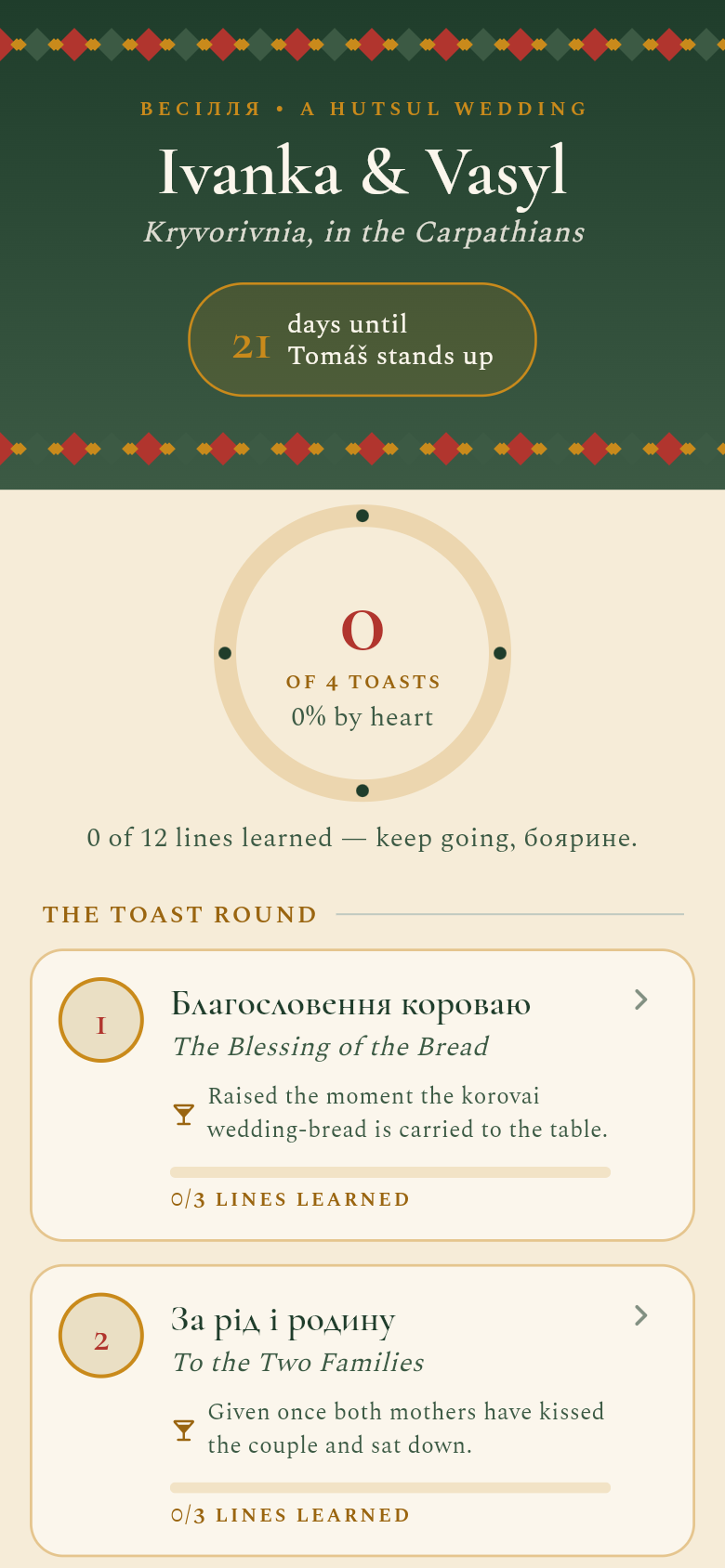
The app presents the toasts in exactly that fixed order, with a short note for each one explaining the cue, so Tomáš always knows not just the words but when to stand up. Scroll through the embedded demo and you will see how each toast is positioned as part of a sequence, not a list of interchangeable options.
Three layers per line: Ukrainian, sound, meaning
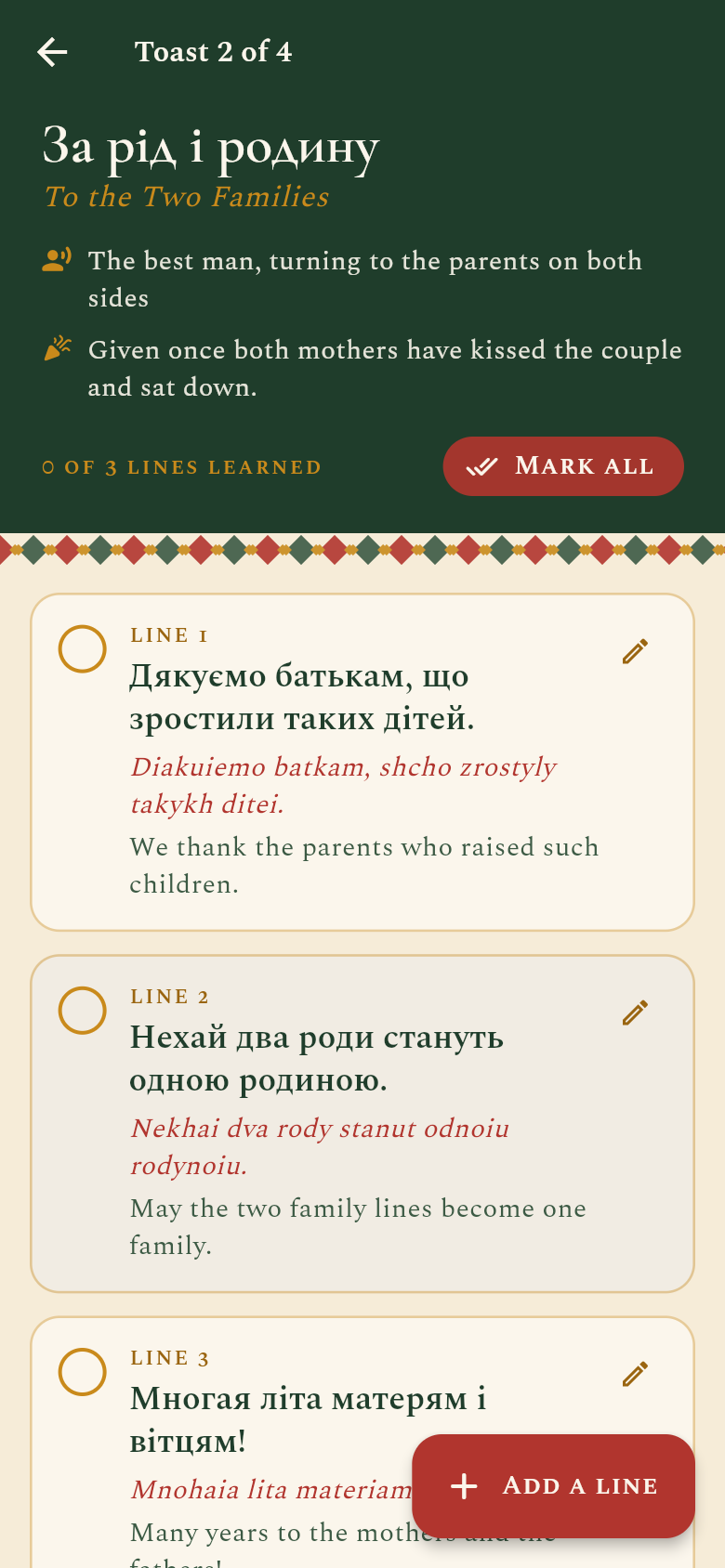
For someone who cannot read Cyrillic fluently, a raw Ukrainian text is close to useless under rehearsal pressure. The app shows every line three ways: the original Ukrainian (for authenticity and for when a native speaker checks your work), a Latin transliteration you can actually sound out, and a plain-language meaning so you understand what you are saying, not just how to say it.
That last layer matters more than it might seem. Memorizing sounds without meaning is fragile. When nerves hit at the table and a line slips, meaning gives you a foothold to recover. Try tapping into one of the toasts in the demo — expand a line and you will see how the three layers sit together, readable at a glance even on a small screen.
The transliteration follows a consistent read-aloud convention rather than academic romanization, because the goal is pronunciation, not linguistics.
A progress tracker built for repetitive rehearsal
Learning a toast is not a single event. It is a loop: read it, close the app, try to recall it, check yourself, mark what held, come back tomorrow. The app is designed around that loop. Each individual line has a memorized toggle. Overall progress and per-toast progress are both visible at a glance, so you can see at once that you have the first toast solid but the third is still shaky.
The check marks persist offline. No account, no sync, no cloud dependency. Tomáš was planning to rehearse in a mountain village with patchy signal, on train rides through rural Slovakia, in a quiet corner during the reception setup. The app works in all of those places because everything is stored locally.
Flip through the progress indicators in the embedded app. Mark a few lines as memorized and watch the bar move. That small feedback loop is what makes daily rehearsal feel like forward motion rather than repetition.
Never an empty screen
One deliberate choice: the app opens already full. The couple's names are there. The village is there. The countdown to the wedding date is running. There is no setup, no onboarding form, no blank template waiting to be filled.
For a one-person, one-occasion tool this is the right call. Every second Tomáš opens the app he is already inside the context of the specific day he is preparing for. The countdown in particular does something useful: it makes the deadline concrete and daily. Four weeks becomes three becomes two. That quiet pressure is part of what keeps rehearsal from slipping.
You can see the countdown and the couple's details at the top of the embedded demo. It is a small thing, but it makes the app feel like it was made for this wedding, not adapted from a generic template.
Built from a specific problem, not a general idea
Most language tools are built for a general learner working toward general fluency. This app is the opposite: it is built for one person, one event, four toasts, six weeks. That specificity is what makes it useful. A general flashcard app could theoretically do the job, but it would require Tomáš to enter all the content himself, figure out the sequencing, add the cues, and build his own progress tracker. The friction would likely mean he never started.
What Leanfinit does is turn that specific, concrete problem into a working tool quickly. If you have a situation like this — a ceremony, a ritual, a deadline, a set of content that needs to be learned in order — you can describe it and have something real to use within the day. The idea that becoming the tool does not require being a developer is what the link below is about.
39
files in the build
40.4 MB
app bundle
Flutter Web
runs in any browser
Have a similar one-off challenge?
Describe your specific problem, and Leanfinit will build the tool around it. No templates, no setup, no empty screens.